A 3840x2160 monitor looks superb, but it asks a lot of a graphics card. Four times the pixels of 1080p is why our 1080p vs 1440p vs 4K guide treats 4K as a high-end target, and why native frame rates fall off a cliff on mid-range cards. In late 2026 you also have to live with street prices that are well above launch.
Forge PC has not benchmarked these cards ourselves. Our picks draw on independent testing from Tom's Hardware and TechSpot, specifications from NVIDIA and AMD, and UK prices from SpecPrice's cheapest-by-model tracker, updated at 15:43 GMT on 14 November 2026. Prices are approximate and change daily. Tom's Hardware's performance figures below are geometric means across 19 games at native resolution, with no upscaling or frame generation, from its October 2026 best-GPU update (page last updated 2 October 2026).
Our 4K shortlist at a glance
Pick | Card | Memory | Lowest UK price (14 November 2026) |
|---|
Best overall | NVIDIA GeForce RTX 5070 Ti | 16GB GDDR7 | about £1,267.99 |
Best value | AMD Radeon RX 9070 XT | 16GB GDDR6 | about £819.98 |
Best high-end (sane money) | NVIDIA GeForce RTX 5080 | 16GB GDDR7 | about £1,519.99 |
Only if money is no object | NVIDIA GeForce RTX 5090 | 32GB GDDR7 | about £6,999.98 |
Best overall: GeForce RTX 5070 Ti
Tom's Hardware calls the RTX 5070 Ti the best high-end card for 1440p or 4K, because it has 16GB of memory and the full DLSS 4.5 and Multi Frame Generation stack. In that native-resolution suite it averaged 52.8fps at 4K, against 47.4fps for the RX 9070 XT and 37.6fps for the 12GB RTX 5070. Tom's also says the 5070 Ti has stronger ray-tracing performance than the 9070 XT, and that path-traced games play best when you can rely on DLSS 4.5 and multi-frame generation being in the title.
NVIDIA lists 8,960 CUDA cores, 16GB of GDDR7 on a 256-bit bus, 300W total graphics power and a 750W recommended power supply. Our VRAM guide and Tom's Hardware both treat 16GB as the sensible amount if you want to push 4K without upscaling, or explore ray tracing without running out of memory.
The catch is the UK price. At about £1,268 on 14 November, the 5070 Ti cost roughly £448 more than the cheapest RX 9070 XT. Tom's Hardware's argument is that if you spread a premium like that over a five-year life, the extra is easier to live with than it looks on the sticker, because NVIDIA's features keep showing up in new games. At today's UK prices we would only pay it if 4K, ray tracing and DLSS really are the point of the purchase. Our RX 9070 XT vs RTX 5070 Ti comparison goes into that trade-off.
Example model in our database: the MSI RTX 5070 Ti Ventus 3X OC.
Best value: Radeon RX 9070 XT
If you want 4K without spending four figures, the RX 9070 XT is the card to buy. At about £820 it is the cheapest current-generation 16GB card that is in the right performance class, and in Tom's Hardware's native suite it is only about 10% behind the 5070 Ti at 4K (47.4fps versus 52.8fps). TechSpot's September 2026 update, which tested the 9070 XT against the RTX 5070 across 52 games, found the AMD card 25% faster at 4K as well as 24% faster at 1440p.
AMD lists 64 compute units, 16GB of memory on a 256-bit bus, 304W board power and a 750W recommended power supply. FSR 4 upscaling and AMD's frame generation are the tools you will use when a game needs a lift; they are not as widely supported as DLSS, which is the main reason Tom's Hardware still prefers the 5070 Ti if you can afford it. If you mostly play raster games and will accept FSR when you need it, the 9070 XT is the better use of the money. It is also our best overall 1440p card, so it remains a good buy if you later drop back to 1440p.
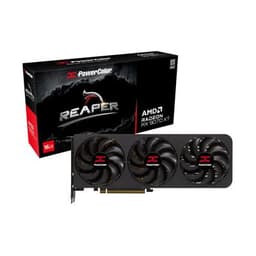
Example model: the PowerColor RX 9070 XT Reaper.
Best high-end, if you will not settle for the 5070 Ti: GeForce RTX 5080
Tom's Hardware says the RTX 5080 is 8% to 16% faster than the 5070 Ti, with the biggest gap at 4K, but that in September 2026 it was about 51% more expensive than the 5070 Ti at US mid-point prices, which it does not consider enough value unless you want the fastest card short of a 5090. In the UK on 14 November the gap was smaller: about £1,520 versus about £1,268, or roughly 20%. That is still a steep step for a mid-teens performance gain, but it is less absurd than the US mid-point Tom's Hardware was looking at.
NVIDIA lists 10,752 CUDA cores, 16GB of GDDR7 on a 256-bit bus, 360W total graphics power and an 850W recommended power supply. You still only get 16GB, so this is not a memory upgrade over the 5070 Ti. Check that your case can take the card and that the PSU can feed it; our PSU guide covers sizing.
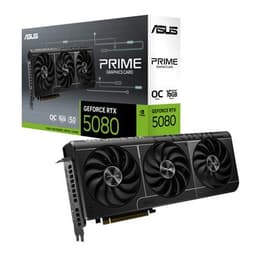
Example model: the ASUS Prime RTX 5080 16GB.
The RTX 5090: only if money is no object
The RTX 5090 is in a different world. Tom's Hardware's native suite put it at 88.0fps at 4K, and official specs include 32GB of GDDR7, 21,760 CUDA cores, 575W total graphics power and a 1,000W recommended power supply. It is the card you buy to turn every setting up on a high-refresh 4K screen, including path tracing.
It is also about £7,000 in the UK on 14 November, more than five times the 5070 Ti. Tom's Hardware calls current 5090 pricing stratospheric and says value calculations barely apply. We agree. If that number does not make you flinch, you already know you want one. If it does, the 5070 Ti or 5080 will do the job with DLSS.
Cards that are not 4K cards
The RTX 5070 (about £799.99) averaged only 37.6fps at native 4K in Tom's Hardware's suite, and its 12GB of memory is the limit Tom's flags for native 4K and unrestricted ray tracing. The RX 9070 (about £739.39) is close to the 5070 in that suite (41.1fps) and has 16GB, so it is the better of the two if you insist on 4K on a mid-range budget and will use upscaling, but it is still a stretch. The RX 9060 XT 16GB (about £579.98) averaged 24.5fps at native 4K, which is why we treat it as a 1440p card.
For a 4K screen itself, see our best 4K gaming monitor guide. Pair the card with a capable PSU, and enable Resizable BAR once it is installed.
Our verdict
For most people buying a 4K graphics card in the UK in November 2026, the RTX 5070 Ti at about £1,267.99 is the one to get if you want 16GB, strong ray tracing and NVIDIA's DLSS features. If you want the same class of native performance for hundreds of pounds less, the RX 9070 XT at about £819.98 is the better value, with Tom's Hardware putting it about 10% behind the 5070 Ti at native 4K. The RTX 5080 at about £1,519.99 is the sensible step up if you will not settle for the 5070 Ti; the RTX 5090 at about £7,000 is a luxury, not a recommendation. Forge PC has not tested these cards; our picks rely on Tom's Hardware and TechSpot testing, official specifications and SpecPrice's UK tracker, with prices read at 15:43 GMT on 14 November 2026.
The bottom line
For most people buying a 4K graphics card in the UK in November 2026, the RTX 5070 Ti at about £1,267.99 is the one to get if you want 16GB, strong ray tracing and NVIDIA's DLSS features. If you want the same class of native performance for hundreds of pounds less, the RX 9070 XT at about £819.98 is the better value, with Tom's Hardware putting it about 10% behind the 5070 Ti at native 4K. The RTX 5080 at about £1,519.99 is the sensible step up if you will not settle for the 5070 Ti; the RTX 5090 at about £7,000 is a luxury, not a recommendation. Forge PC has not tested these cards; our picks rely on Tom's Hardware and TechSpot testing, official specifications and SpecPrice's UK tracker, with prices read at 15:43 GMT on 14 November 2026.