A 2560x1440 monitor gives you noticeably sharper images than 1080p without the huge performance cost of 4K, which is why it is the resolution most enthusiasts settle on. Our 1080p vs 1440p vs 4K guide explains the trade-offs. The hard part in late 2026 is the price of the graphics card to drive it.
Forge PC has not benchmarked these cards ourselves. Our picks draw on independent testing from TechSpot and Tom's Hardware, specifications from AMD and NVIDIA, and UK prices from SpecPrice's tracker, which listed the lowest prices below at 09:25 GMT on 14 November 2026. Prices are approximate, change daily and are often well above launch prices; TechSpot's November survey of prices in 10 countries reported that graphics cards had become about 35% more expensive in three months.
Our 1440p shortlist at a glance
Pick | Card | Memory | Lowest UK price (14 November 2026) |
|---|
Best overall | AMD Radeon RX 9070 XT | 16GB GDDR6 | about £899.98 |
Best value | AMD Radeon RX 9070 | 16GB GDDR6 | about £831.95 |
Best for NVIDIA features | NVIDIA GeForce RTX 5070 | 12GB GDDR7 | about £824.99 |
Best budget 1440p | AMD Radeon RX 9060 XT 16GB | 16GB GDDR6 | about £600.95 |
Best high-end | NVIDIA GeForce RTX 5070 Ti | 16GB GDDR7 | about £1,267.99 |
Best overall: AMD Radeon RX 9070 XT
The RX 9070 XT is the card we would buy for 1440p right now. In TechSpot's September 2026 update, which tested it against the RTX 5070 across 52 games, the 9070 XT averaged 24% higher frame rates at 1440p and 25% higher at 4K, with stronger 1% lows. On TechSpot's US prices, the RTX 5070 cost 37% more per frame at 1440p. TechSpot had earlier found the 9070 XT and the RTX 5070 Ti delivered very similar performance overall across 52 games.
In the UK on 14 November, the cheapest 9070 XT was only about £75 more than the cheapest RTX 5070 and about £368 less than the cheapest RTX 5070 Ti, which makes it the strongest all-round value at this level. AMD lists 64 compute units, 16GB of memory on a 256-bit bus, 304W board power and a 750W recommended power supply. Tom's Hardware also names it its value pick for enthusiasts.
The catch: AMD's FSR 4 upscaling is supported in fewer games than NVIDIA's DLSS, and NVIDIA's newest features, such as DLSS 5 neural rendering, are exclusive to GeForce cards. Our RX 9070 XT vs RTX 5070 Ti comparison goes deeper.
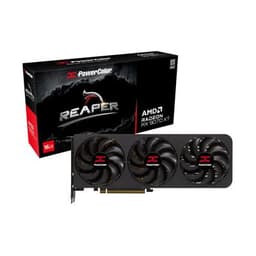
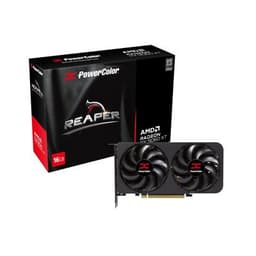
Example models in our database: the PowerColor RX 9070 XT Reaper.
Best value: AMD Radeon RX 9070
The non-XT RX 9070 keeps the 16GB of memory and 256-bit bus but has 56 compute units and a lower 220W board power, with a 650W recommended power supply. That makes it an easier fit for smaller cases and existing power supplies.
TechSpot's November pricing survey found the 9070 XT averaged about 17% more than the 9070 across the countries it tracks, for about 12% more performance, keeping the 9070 the better value. In the UK on 14 November the gap was smaller: about £68, or 8%. At that gap the XT is worth stretching to, but if you find a 9070 at a bigger discount, it is an excellent 1440p card. See our RX 9070 vs RTX 5070 comparison.
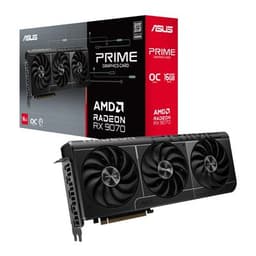
Example model: the ASUS Prime RX 9070 OC.
Best for NVIDIA features: GeForce RTX 5070
If you want DLSS 4.5, Multi Frame Generation and DLSS 5 support, the RTX 5070 is the most affordable way to get them with real 1440p performance. NVIDIA lists 6,144 CUDA cores, 12GB of GDDR7 on a 192-bit bus, 250W total graphics power and a 650W recommended power supply.
Tom's Hardware still recommends it for 1440p, noting that VRAM is less of an issue at that resolution and that most gamers prefer DLSS to FSR. The downside is that 12GB. Tom's says 12GB is generally enough for raster games but may present limitations for ray tracing even at 1440p, and it recommends 16GB if you want to explore ray tracing without restriction. Our VRAM guide explains why. It is also slower than the 9070 XT in TechSpot's testing while costing nearly the same in the UK.
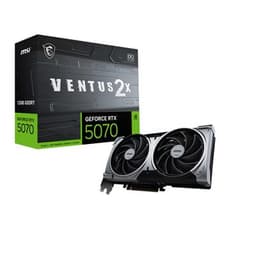
Example model: the MSI RTX 5070 Ventus 2X OC.
Best budget 1440p: Radeon RX 9060 XT 16GB
At about £600, the RX 9060 XT 16GB is not cheap, but TechSpot's November survey says it remains the most affordable way to get 16GB of memory on a current-generation graphics card. AMD lists 32 compute units, up to 3,130MHz, 16GB of GDDR6 on a 128-bit bus, 160W board power and a 450W recommended power supply, so it suits modest builds.
It is best thought of as a 1440p card for medium-to-high settings with upscaling, rather than maximum settings. Tom's Hardware points out that the RX 9070 GRE is about 30% faster at 1440p for about 10% more money in US pricing, but SpecPrice did not list a GRE in its UK cheapest-card tracker, so it may be hard to find here. Its closest rival is the RTX 5060 Ti 16GB at about £729.98; our RTX 5060 Ti 8GB vs 16GB comparison covers that card.
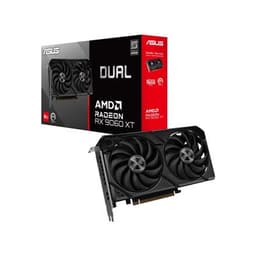
Example models: the PowerColor RX 9060 XT 16GB Reaper and ASUS Dual RX 9060 XT 16GB.
Best high-end: GeForce RTX 5070 Ti
Tom's Hardware calls the RTX 5070 Ti the best card for demanding enthusiasts at 1440p or 4K, thanks to its 16GB of memory and full DLSS 4.5 feature set. NVIDIA lists 8,960 CUDA cores, 16GB of GDDR7 on a 256-bit bus, 300W total graphics power and a 750W recommended power supply.
The problem is price. At about £1,268 on 14 November, it cost roughly 41% more than the cheapest RX 9070 XT in the UK, for performance TechSpot found to be very similar overall. TechSpot's November survey put the 5070 Ti about 60% above its US launch price on average across the countries it tracks. Tom's Hardware argues the extra cost over the 9070 XT is worth it when spread over a five-year life, for better ray tracing and NVIDIA's software features. At UK prices we would buy it only if you value those features highly or also play at 4K.
Example model: the MSI RTX 5070 Ti Ventus 3X OC.
What about cheaper cards?
The Intel Arc B580 (about £305.70) and RTX 5060 (about £424.95) are better matched to 1080p; see our best budget graphics card guide. The RTX 5060 Ti 8GB (about £489.99) is fast enough for some 1440p gaming, but its 8GB of memory is a real limit in newer games, as our RTX 5060 Ti 8GB vs 16GB comparison explains.
Before you buy
Check your power supply. The 9070 XT and 5070 Ti both call for a 750W unit. Our PSU guide explains how to size one.
Check card length against your case's maximum GPU length.
Enable Resizable BAR once it is installed; see our Resizable BAR guide.
Pair it with a good monitor. Our best 1440p gaming monitor guide has picks.
Our verdict
For most people buying a 1440p graphics card in the UK in November 2026, the Radeon RX 9070 XT is the one to get: TechSpot found it 24% faster than the RTX 5070 at 1440p across 52 games, and on 14 November it cost only about £75 more. The RX 9070 is a good alternative if you find it well below the XT, the RTX 5070 makes sense if NVIDIA's DLSS features matter more to you than extra memory, and the RX 9060 XT 16GB is the budget route. The RTX 5070 Ti is excellent but hard to justify at current UK prices. Forge PC has not tested these cards; our picks rely on TechSpot and Tom's Hardware testing, AMD and NVIDIA specifications and SpecPrice's UK price tracker.