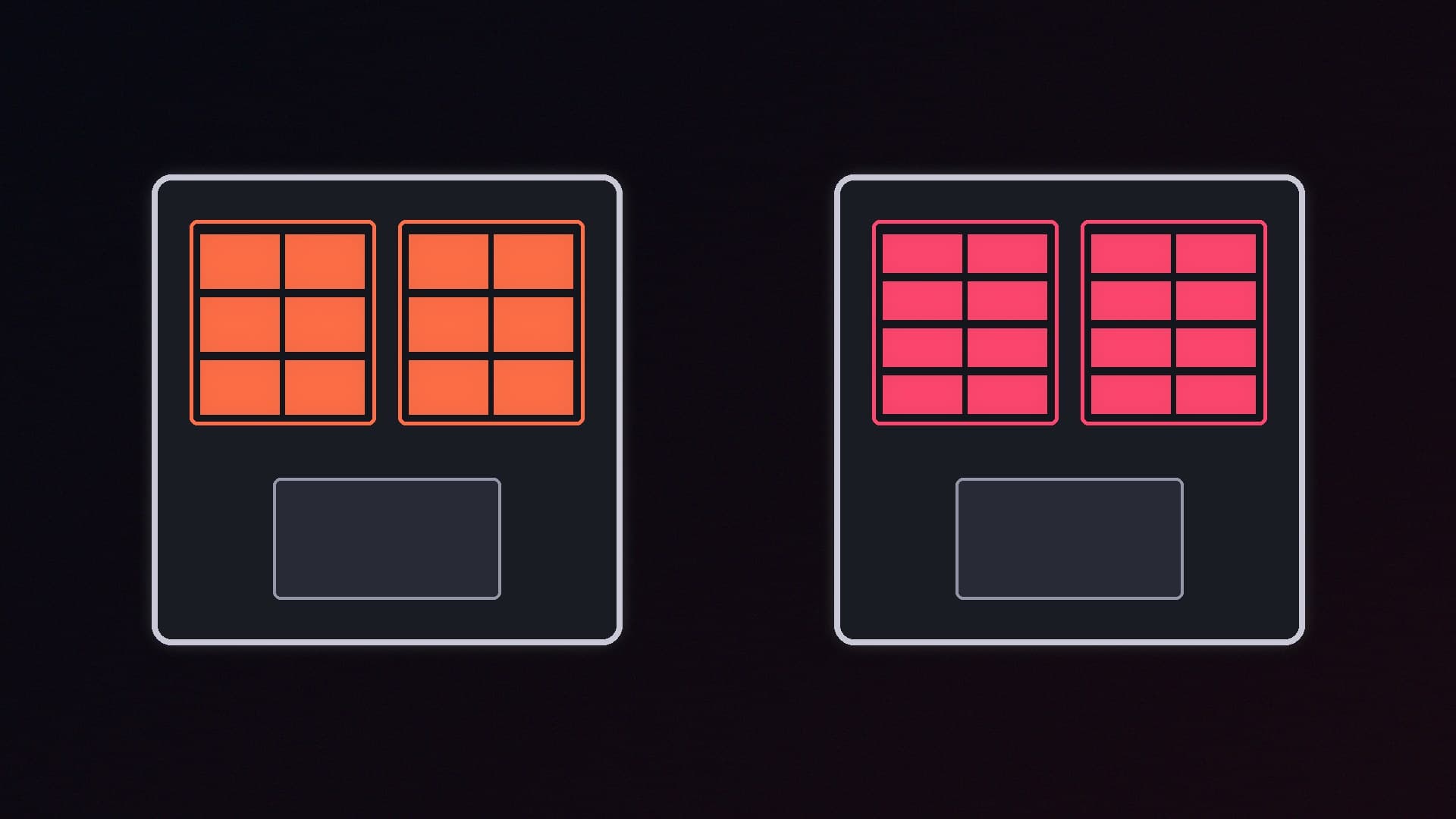
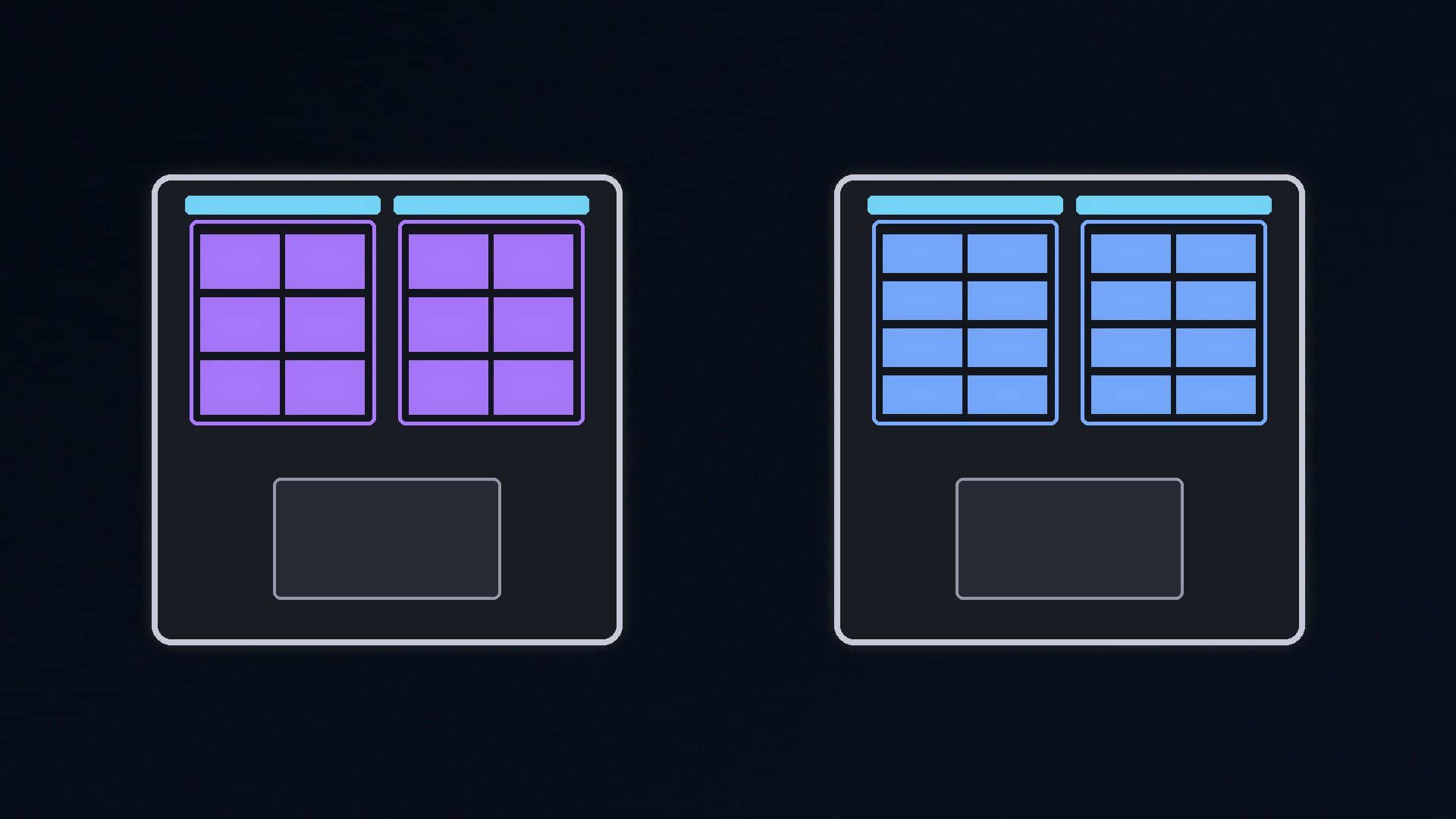
The Ryzen 9 9900X and Ryzen 9 9950X are the two standard (non-X3D) Ryzen 9 chips in AMD's Ryzen 9000 desktop range. Both are Zen 5 processors for the AM5 socket, both have 64MB of L3 cache and both want a serious cooler. The difference is four extra cores and a much higher power budget on the 9950X.
Specs side by side
| Ryzen 9 9900X | Ryzen 9 9950X |
|---|
Cores / threads | 12 / 24 | 16 / 32 |
Base clock | 4.4GHz | 4.3GHz |
Max boost clock | Up to 5.6GHz | Up to 5.7GHz |
L2 cache | 12MB | 16MB |
L3 cache | 64MB | 64MB |
Default TDP | 120W | 170W |
Socket | AM5 | AM5 |
Memory | DDR5, two channels | DDR5, two channels |
PCIe | PCIe 5.0, 28 lanes (24 usable) | PCIe 5.0, 28 lanes (24 usable) |
Cooler in the box | No | No |
AMD's cooler recommendation | Liquid cooler | Liquid cooler |
Launch date (AMD) | 15 August 2024 | 15 August 2024 |
What's the same
A lot. AMD lists the same platform details for both chips: the AM5 socket, the same supported chipsets (A620, B650, B650E, X670, X670E, B840, B850, X870 and X870E), dual-channel DDR5 with DDR5-5600 as the rated speed for two single-rank modules, PCIe 5.0 with 28 lanes of which 24 are usable, a maximum operating temperature (Tjmax) of 95°C and no cooler in the box. Both are unlocked, so you can use Precision Boost Overdrive and Curve Optimizer on either; our PBO and Curve Optimizer guide explains how.
That means any AM5 motherboard and DDR5 kit that suits one will suit the other. If you're reusing an older 600-series board, check the board maker's CPU support list for the minimum BIOS version it needs for Ryzen 9000, and see our guide to updating your BIOS safely.
The L3 cache is also identical at 64MB. AMD's X3D versions of these chips, the Ryzen 9 9900X3D and 9950X3D, are the ones with more cache: AMD lists 128MB of L3 for each.
What's different
Cores and threads
The 9950X has 16 cores and 32 threads against the 9900X's 12 cores and 24 threads, a third more. It also has 16MB of L2 cache to the 9900X's 12MB, because L2 is per core. TechPowerUp describes the 9900X as a balancing point between the 8-core Ryzen 7 9700X and the flagship 16-core 9950X, in both price and multithreaded performance, aimed at buyers who think eight cores are too few.
Extra cores matter most in work that splits across many threads: rendering, video encoding, compiling code and running several heavy jobs at once. For games, which generally don't use 16 cores, the gap between the two is likely to be much smaller. If gaming is your main use, look at independent benchmarks for the games you play before paying for cores you won't use.
Clocks
The boost clocks are close: up to 5.6GHz on the 9900X and up to 5.7GHz on the 9950X. The 9900X has a slightly higher base clock (4.4GHz against 4.3GHz). AMD notes that maximum boost depends on factors including cooling, motherboard design and BIOS, so real-world clocks will vary from system to system.
Power and cooling
This is the biggest practical difference. AMD rates the 9900X at a 120W default TDP and the 9950X at 170W. AMD recommends a liquid cooler for both, and neither comes with one, so budget for a capable cooler either way. With the 9950X in particular, a 360mm AIO is worth considering; our best AIO coolers guide and 240mm vs 360mm AIO comparison can help.
If you want to cut heat and noise, our guide to AMD Eco Mode explains how to run a Ryzen processor at a lower power setting.
Which should you buy?
Choose the Ryzen 9 9900X if you want more than eight cores for occasional rendering or encoding but also care about heat, noise and power supply headroom. Its 120W TDP is easier to cool than the 9950X's 170W.
Choose the Ryzen 9 9950X if your PC earns its keep on heavily multithreaded work, where the extra four cores can shorten long jobs, and you're prepared to pair it with a strong liquid cooler and a suitably sized power supply.
Consider neither if the PC is mainly for gaming: an 8-core chip such as the Ryzen 7 9800X3D is the more usual choice for a gaming build.
If you're weighing the 9950X against Intel's flagship for AI and creative work, see Core Ultra 9 285K vs Ryzen 9 9950X.
Our verdict
Pick the Ryzen 9 9900X if you want 12 Zen 5 cores with a more manageable 120W TDP; pick the Ryzen 9 9950X if heavily multithreaded work is your priority and you can cool a 170W chip. Both share the AM5 platform, the same memory and PCIe support and 64MB of L3 cache, and AMD recommends a liquid cooler for each.