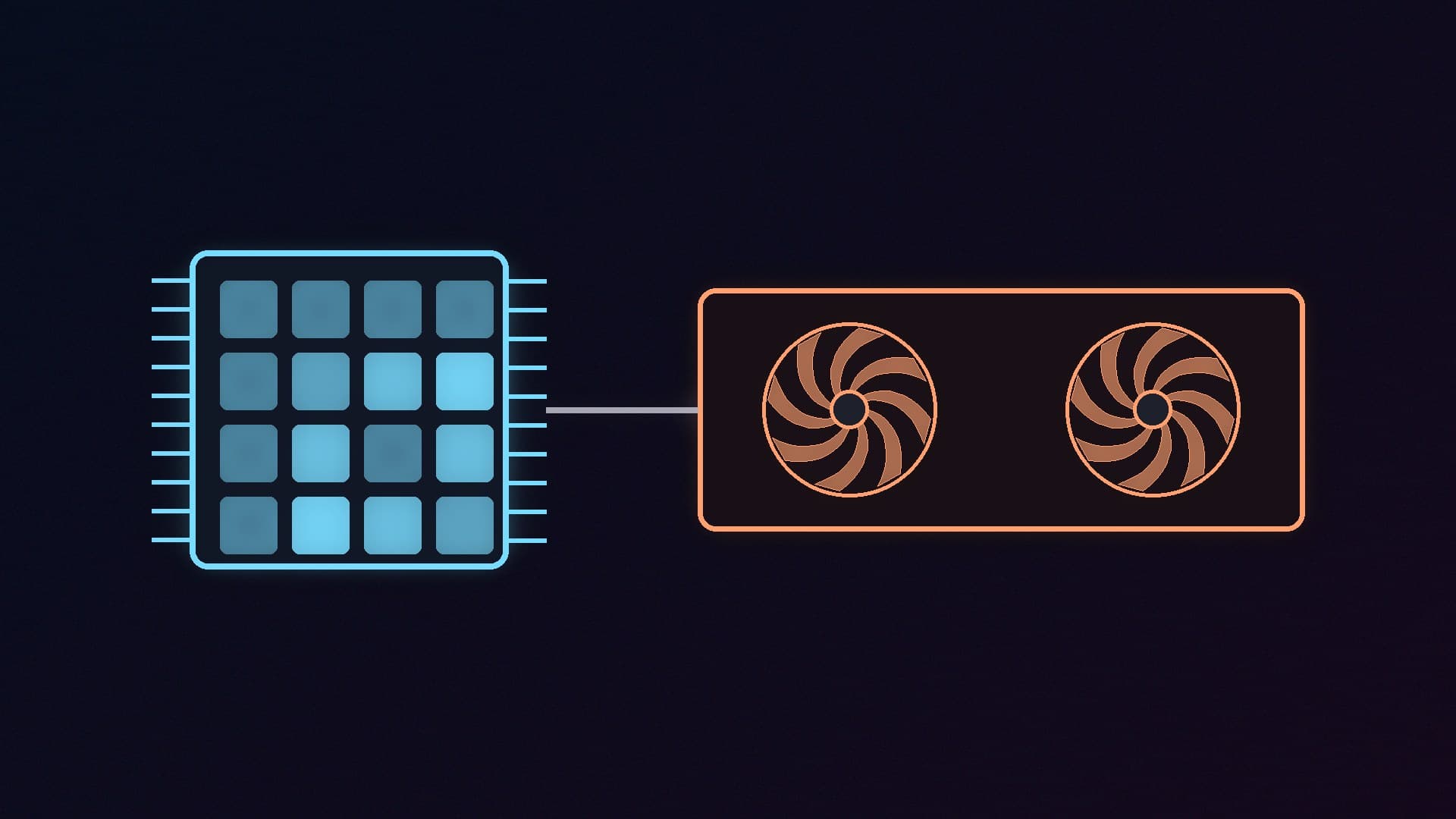
A neural processing unit (NPU) is now a selling point on almost every new laptop and many mini PCs, and Microsoft's Copilot+ PCs have NPUs capable of 40+ trillion operations per second (TOPS). Graphics cards, meanwhile, remain the default for running local chatbots and image generators. So if you want to run AI on your own PC, which one should do the work?
This comparison is based on official documentation from Microsoft, AMD, Intel and the Lemonade project, checked on 14 November 2026. Forge PC has not benchmarked NPUs against GPUs, so we do not quote speeds. For a primer on NPUs, read what an NPU is.
The short answer
| NPU | GPU (graphics card or integrated) |
|---|
Designed for | Efficient, always-on AI features | Heavy parallel work, including large AI models |
Power use | Low; AMD calls the NPU "more power-efficient than using the GPU" | Higher, especially discrete cards |
Memory | Shares system RAM | Discrete cards have their own fast VRAM; integrated GPUs share system RAM |
App support | Growing, but limited to specific apps and model formats | Broad: Ollama, LM Studio, Jan, ComfyUI and most other tools |
Best for | Windows AI features, background tasks, laptops on battery | Chatbots, coding assistants, image and video generation |
What NPUs are good at
NPUs are built to run AI efficiently in the background. Microsoft's Copilot+ PC page says NPUs power features such as "automatic framing in video calls" and help "refine writing in documents". Microsoft's own on-device language model is aimed at Copilot+ PCs too: in November 2026 it announced that Aion Instruct, a 2.3-billion-parameter model replacing the 3.8-billion-parameter Phi Silica, will roll out to Copilot+ PCs through the Windows Insider Program from late November. We covered that in our Aion Instruct news story.
Third-party apps can use NPUs too, but support is narrower. AMD's Lemonade server, for example, can run models on the XDNA 2 NPU in Ryzen AI 300 and 400-series processors, using specially prepared NPU and "hybrid" models rather than any model you download.
What GPUs are good at
Graphics cards remain the most flexible way to run local AI. Almost every popular app, from Ollama and LM Studio to ComfyUI, supports GPUs, and discrete cards have their own high-bandwidth video memory. As an example of raw AI throughput, Intel rates the Arc B580 graphics card at 233 TOPS (INT8), several times the 40 TOPS floor for a Copilot+ PC NPU, though TOPS figures from different vendors are not always measured the same way.
Even Microsoft is moving beyond the NPU: its Aion Instruct announcement says the model is expanding to supported GPUs, "including popular dGPUs like NVIDIA's RTX-series and AMD's RDNA4 generation".
Working together: hybrid mode
The choice is not always either/or. In Lemonade's hybrid mode on Ryzen AI PCs, AMD says the NPU processes your prompt and the integrated GPU generates the reply, playing to "each chip's strengths". Lemonade's FAQ adds that with short prompts the NPU finishes quickly, so you may see little NPU activity.
Which should you use?
You have a gaming PC with a graphics card: use the GPU. It will run far more apps and larger models. Our best GPU for local AI guide covers upgrades.
You have a Copilot+ or Ryzen AI laptop without a discrete GPU: let Windows' AI features use the NPU, and try NPU-aware apps such as Lemonade or Microsoft's Foundry Local for small models. For bigger models, the integrated GPU and plenty of RAM matter more.
You are buying a PC for local AI: do not pay extra for NPU TOPS alone. Memory (VRAM or unified memory) decides which models you can run, as our CPU vs GPU for local AI and RAM for local AI guides explain.
Our verdict
For running chatbots, coding assistants and image generators on your own PC in 2026, a GPU is still the better choice: it has the widest app support, and discrete cards bring their own fast memory, with Intel rating even the Arc B580 at 233 TOPS (INT8) against the 40+ TOPS NPUs in Copilot+ PCs. NPUs are best for efficient, always-on Windows AI features and small models on laptops, through apps such as AMD's Lemonade, which can also split work between NPU and GPU. Don't buy a PC for local AI on NPU TOPS alone. Forge PC has not benchmarked NPUs against GPUs; this comparison uses official documentation.