If you are building a Ryzen gaming PC on a sensible budget, you will end up choosing between a B650 and a B850 motherboard. They look almost identical on paper, sell at overlapping prices and run the same CPUs. AMD told Tom's Hardware in August 2025 that it was moving from B650 to B850, with B650 stock at retail being depleted over the coming quarters, but plenty of B650 boards are still on sale in the UK.
Forge PC has not tested these motherboards. This comparison uses AMD's chipset information, TechSpot's AM5 chipset guide (6 February 2025) and Tom's Hardware's report on the B650 discontinuation. UK prices are approximate, from SpecPrice's UK motherboard tracker when we checked on 14 and 15 November 2026, and they will change.
B650 vs B850 at a glance
| B650 | B850 |
|---|
Chipset chip | Promontory 21 | Promontory 21 |
Graphics slot | PCIe 4.0 | PCIe 4.0 (PCIe 5.0 optional) |
PCIe 5.0 M.2 slot | Optional | Required (at least one) |
CPU and memory overclocking | Yes | Yes |
USB4 | Optional | Optional |
CPU support | Ryzen 7000, 8000, 9000 | Ryzen 7000, 8000, 9000 |
Sources: TechSpot and Tom's Hardware chipset tables. B650E is a separate, higher tier with PCIe 5.0 for both the graphics card and storage.
Same silicon, same CPUs
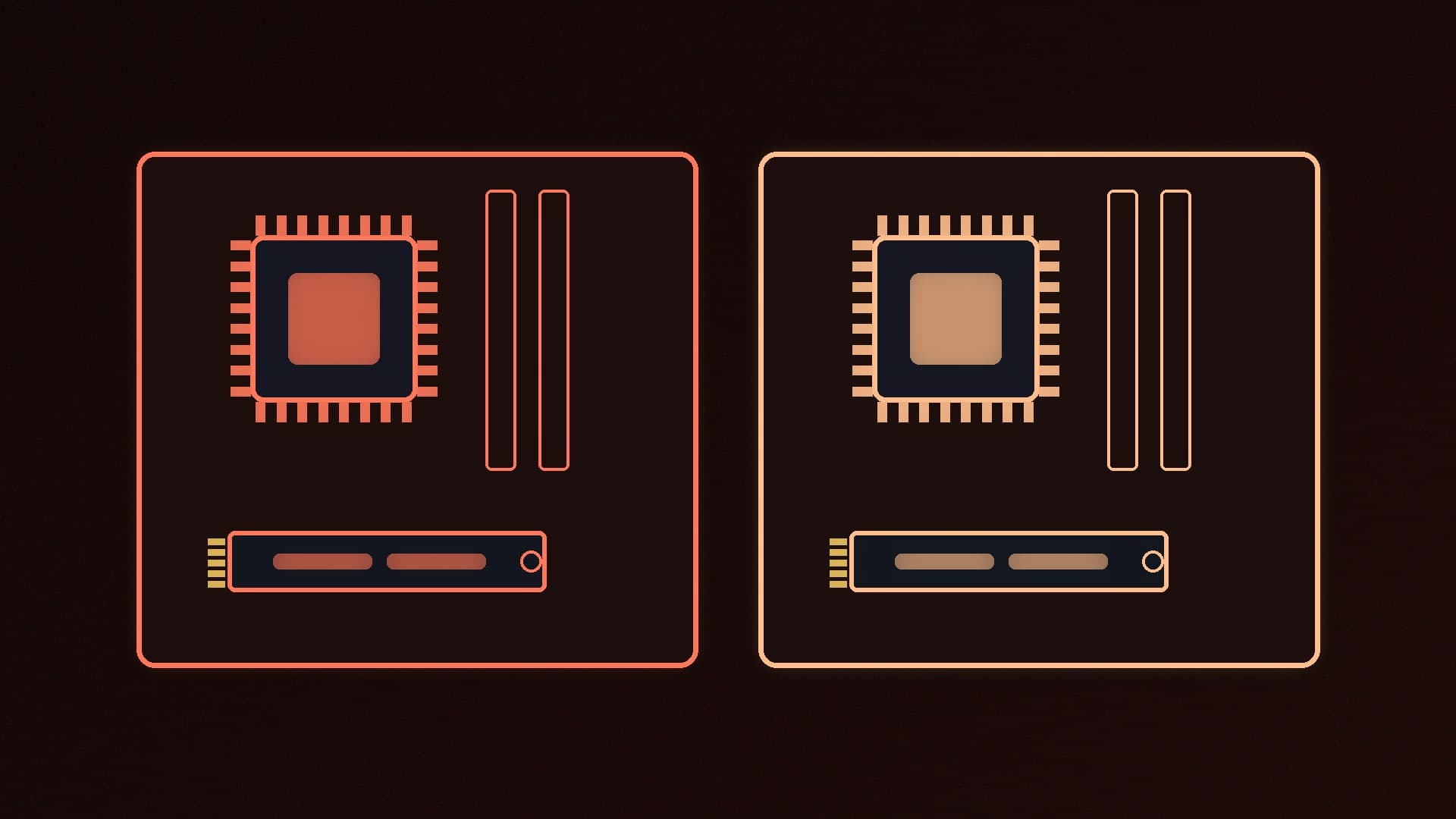
TechSpot explains that B650, B650E, B850 and X870 boards all use a single, fully enabled Promontory 21 chipset chip. That means the same number of chipset PCIe lanes, the same USB and SATA support from the chipset, and the same CPU and memory overclocking support. TechSpot says these boards "don't limit the CPU in any way", so the chipset itself will not hold back your Ryzen processor. Differences in performance come down to the individual board, such as its power delivery and cooling.
The real difference: PCIe 5.0 storage
The clearest rule change is storage. According to Tom's Hardware's chipset table, a B850 board must have at least one PCIe 5.0 M.2 slot, while on B650 it was optional. TechSpot notes that some B650 boards still have one, so check the specification of the exact board rather than relying on the name.
Does that matter for gaming? For most people, not yet. Fast PCIe 4.0 SSDs are already quick for loading games, and our NVMe vs SATA SSD guide explains why the drive type matters more than the very top speed. A PCIe 5.0 slot is mainly about future upgrades and very large file transfers.
Graphics card slot
Tom's Hardware says PCIe 5.0 support on the main x16 slot was absent from B650 and is optional on B850, so it depends on the board maker. Its table lists B850's standard graphics connection as PCIe 4.0. If you specifically want a PCIe 5.0 graphics slot at this level, look at B650E boards, which TechSpot says support PCIe 5.0 for both the graphics card and at least one M.2 drive.
Newer features on B850 boards
Because B850 boards are newer designs, many come with newer extras such as Wi-Fi 7 and faster Ethernet. These depend on the board, not the chipset. For example, SpecPrice's listing for the MSI MAG B850 Tomahawk WiFi shows 5GbE and Wi-Fi 7, while the Gigabyte B850 Gaming Wi-Fi 6 lists 1G LAN and Wi-Fi 6. If networking matters, check the board's Ethernet speed as well as its Wi-Fi, and see our Wi-Fi 7 vs Wi-Fi 6E guide to decide what you need.
UK prices compared
These were the prices SpecPrice showed when we checked on 14 and 15 November 2026:
The pattern is clear: there is no fixed B650 "discount". A cheap B850 micro-ATX board can cost less than a mid-range B650, and the ASUS TUF Gaming B650E-E WIFI, with PCIe 5.0 for graphics and storage, was cheaper than the Gigabyte B850 Eagle WiFi6E on the day we checked.
Which should you buy?
Buy a B650 board if it is cheaper than a comparable B850 and has the ports, M.2 slots and networking you need. You lose nothing in CPU performance. If the board is older stock, check that its BIOS supports your processor before you build; our guide to updating your BIOS safely shows how to update it.
Buy a B850 board if the price is close, or you want a guaranteed PCIe 5.0 M.2 slot and newer features such as Wi-Fi 7.
Consider B650E if you want PCIe 5.0 for the graphics card too, at a similar price.
For specific board picks, see our best AM5 motherboard guide, and if you are weighing up a step higher, our B850 vs X870 comparison.
Our verdict
B650 and B850 boards use the same Promontory 21 chipset chip and give the same CPU performance, so buy on features and price, not the name. B850 guarantees at least one PCIe 5.0 M.2 slot and tends to bring newer Wi-Fi and networking, while B650 boards can be better value as remaining stock sells off. On 15 November 2026, prices overlapped heavily, from about £90 for a basic B650 to about £99 for a basic B850, so compare the exact boards. Forge PC has not tested these boards; the comparison uses AMD, TechSpot and Tom's Hardware information.