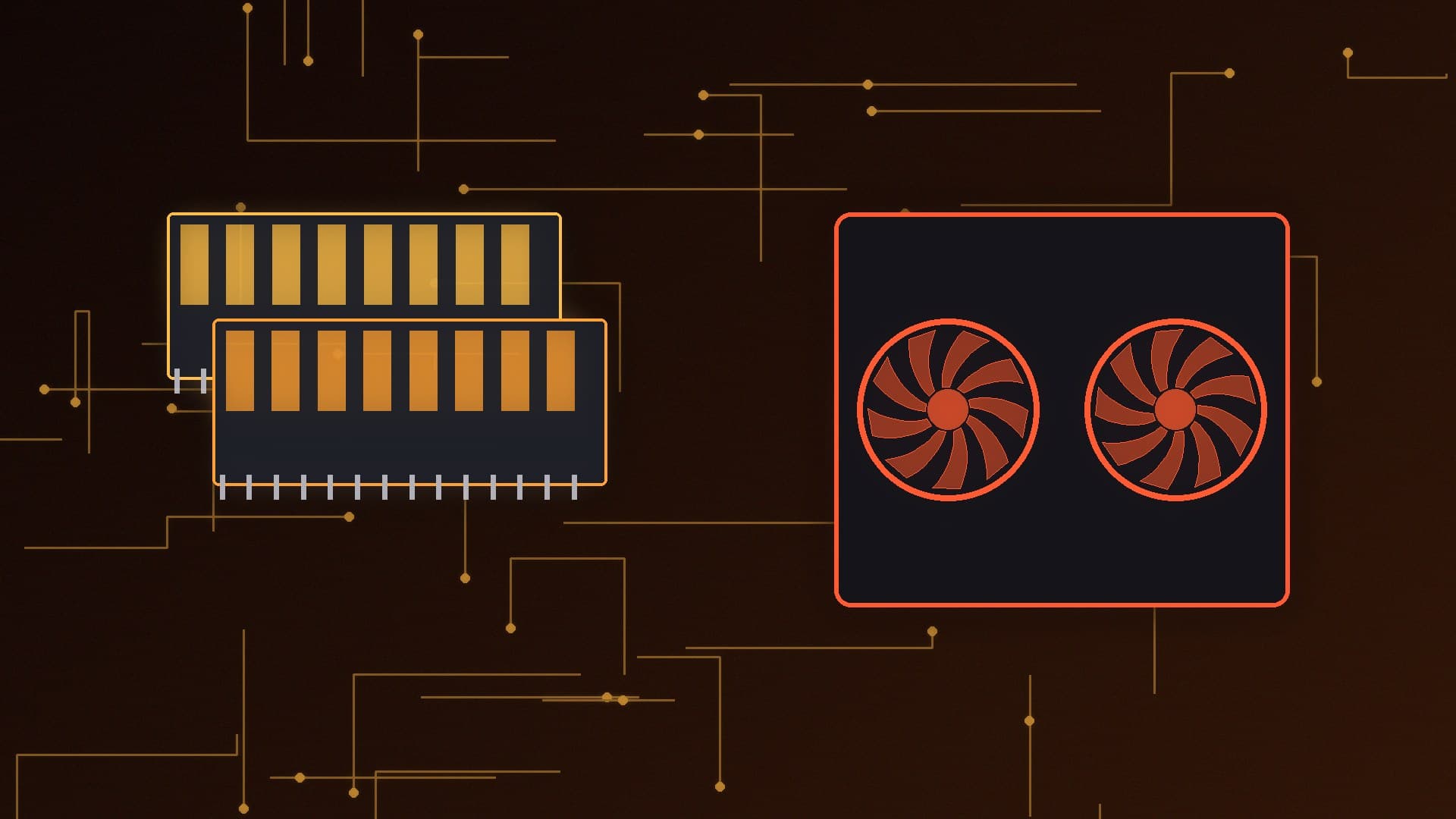
If you've priced a new PC this year, you'll have noticed two painful lines on the list: memory and the graphics card. This isn't a short-lived shop mark-up. Both sit on the same strained supply of memory chips, and UK street prices in mid-November are still far above what builders were used to a year ago.
This is a news explainer, not a review. Forge PC hasn't tested memory chips or graphics cards for this piece. The causes below come from reporting by the BBC, UK retailers and memory-price trackers, all credited at the end. UK prices are approximate and dated 13 November 2026.
What things cost today
On ramprices.uk, which tracks Amazon.co.uk listings, the median DDR5 kit was £18.47 per GB at 06:41 GMT on 13 November 2026. That's 195 per cent higher than a year earlier, and 20 per cent higher than 90 days ago. The median DDR4 kit was £8.22 per GB, still 87 per cent up on a year ago. A typical 32GB DDR5 desktop kit started at about £455; a 64GB kit started at about £802.
Graphics cards tell a similar story, even after a few listings softened. SpecPrice's cheapest-in-the-UK tracker, updated at 07:57 GMT on 13 November, put an RTX 5060 from about £425, an RX 9060 XT 16GB from about £580, an RX 9070 from about £732 and an RTX 5070 Ti from £1,215. The cheapest confirmed RTX 5070 was £597.99 at AWD-IT, with Scan at £779.99. An RTX 5090 still started at about £7,000. For a wider snapshot of the market, see our November 2026 market roundup.
The same squeeze, two different products
RAM and graphics cards don't use identical chips, but they compete for related factory capacity.
Desktop RAM is DDR4 or DDR5. Graphics cards use GDDR6 or GDDR7 for their video memory (VRAM). AI servers also need huge amounts of ordinary DRAM, plus a faster, stacked type called high-bandwidth memory (HBM).
In a 2 January 2026 BBC report, Chris Miller, author of Chip War, called AI "the main factor" driving demand for computer memory. "There's been a surge of demand for memory chips, driven above all by the high-end High Bandwidth Memory that AI requires," he said. "This has led to higher prices across different types of memory chips."
Mike Howard of Tech Insights told the BBC that cloud providers had by then made their 2026 and 2027 memory plans clear, and that it was "unmistakeable" supply "will not meet the levels that Amazon, Google, and other hyperscalers are planning for." He said some suppliers had "even paused issuing price quotes, a rare move that signals confidence that future prices will rise further." In PCs, he said, memory had typically been 15 to 20 per cent of total cost, "but current pricing has pushed that toward 30 to 40 percent."
UK retailers have described the same chain for graphics cards. Overclockers UK's 2026 GPU-price guide says tightening DRAM supply, limited production and high demand for the memory that powers AI servers have pushed up GDDR6 and GDDR7 costs, and that manufacturers have put more of their capacity into higher-margin server and AI products. When older, cheaper stock runs out, shops have to reorder at the new prices.
The BBC's January report also noted Micron's decision, announced in December 2025, to stop selling its Crucial consumer brand and focus on AI demand. Steve Mason of CyberPowerPC told the BBC that removed "one of the biggest players from the market."
This isn't only a graphics-card shortage
It's tempting to treat this as a repeat of the 2020–21 GPU crunch, when miners and pandemic demand emptied shelves. The mechanism this time is different. There are cards in UK shops. The problem is the price of the memory inside them, and of the system RAM next to them.
That's why a "sensible" 32GB DDR5 kit can now cost as much as a mid-range processor, and why an 8GB graphics card can look cheap until you read our VRAM guide. It's also why last-generation DDR4 platforms can still make financial sense if you already have a board, as we set out in DDR5 vs DDR4 and how much RAM you need for gaming.
Howard also told the BBC that AI hardware was likely to stay tight. In a later TechRadar report, Intel's chief executive, Lip-Bu Tan, was quoted as saying AI hardware would stay in short supply for the next two to three years, "driven by persistent constraints in the underlying tech supply chain." That comment was about the wider AI supply chain, not a promise about any one product, but it helps explain why nobody serious is calling this a one-month blip.
What UK builders should do
There is no clever trick that makes 32GB of DDR5 cheap again. The practical options are unglamorous:
Buy only the memory you need. For many games, 16GB still works and 32GB is the comfort line. Don't jump to 64GB unless you have a workload that uses it, such as local AI models.
If your older platform is still fine, stay on DDR4. A new AM5 or LGA 1851 build has to pay today's DDR5 prices.
Spend the graphics-card budget on VRAM and a sensible tier, not on a logo. Our graphics card guide and the RX 9070 vs RTX 5070 comparison are written for this market.
Treat Black Friday with caution. Our Black Friday 2026 UK parts guide is about spotting real discounts, not assuming everything will be cheap on 27 November.
Prices can move quickly, and a single shop listing can look like a bargain until you check stock. The figures in this article were checked on 13 November 2026 and may have changed by the time you buy.
Our verdict
RAM and graphics cards are expensive in 2026 because AI data centres are soaking up memory-factory capacity, including the high-bandwidth memory those systems need, and because consumer DDR and GDDR supply has been squeezed as a result. UK price trackers still show DDR5 at about three times last year's median, and many current graphics cards remain well above their launch prices. Build around the capacity you actually need, don't over-buy memory, and be wary of treating a short sale as a sign that the crunch is over.