Skip to content

VersusGPU

RX 9070 vs RTX 5070: Which Graphics Card Should You Buy in 2026?

The Radeon RX 9070 is cheaper in the UK, has 16GB of VRAM and wins most raster tests, while the RTX 5070 leads in ray tracing and upscaling. We compare published testing and UK prices.

By , Editorial team

· 6 min read

RX 9070 vs RTX 5070: Which Graphics Card Should You Buy in 2026?

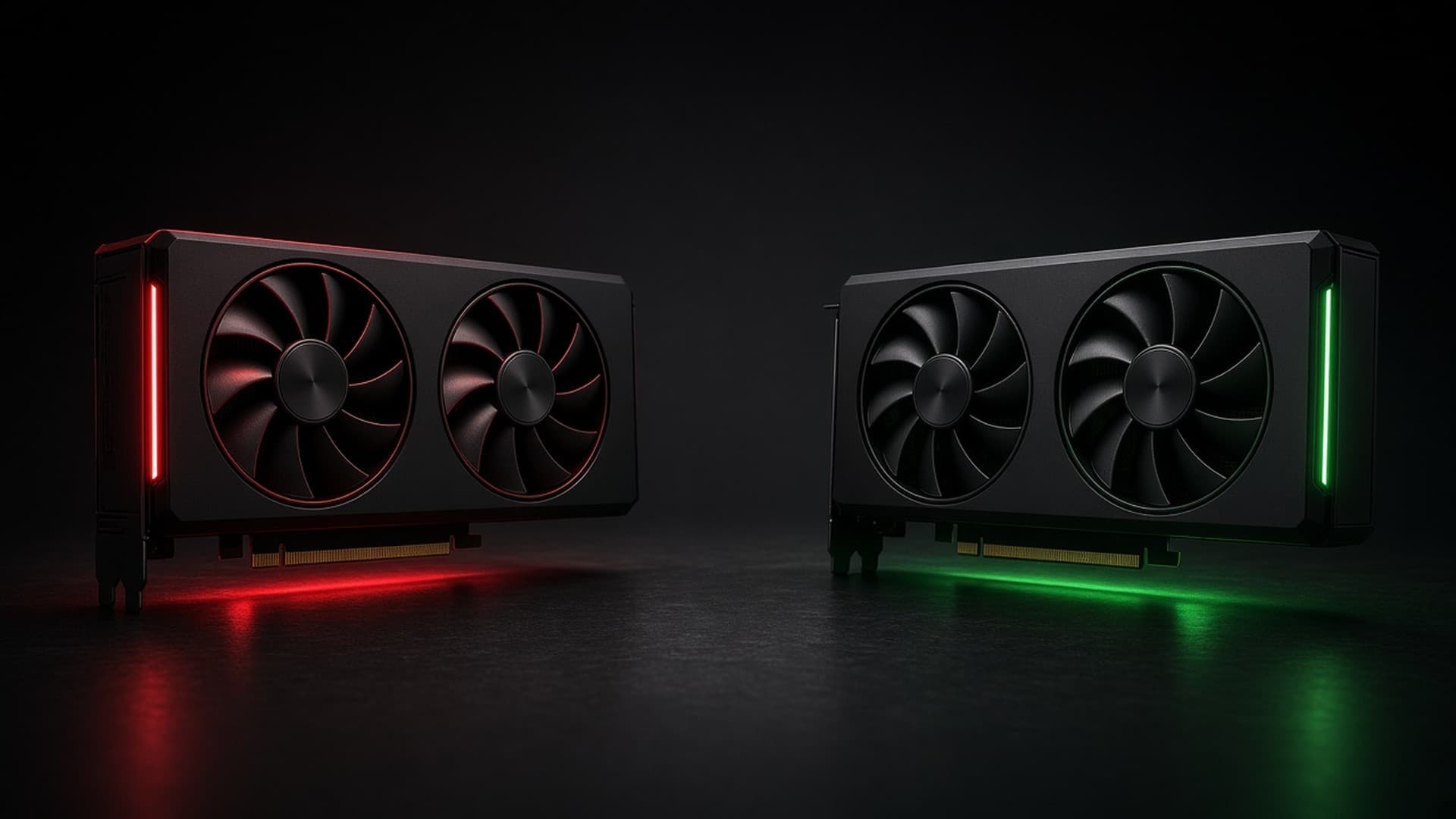
The Radeon RX 9070 and GeForce RTX 5070 are the two graphics cards most people shopping for a 1440p gaming PC end up deciding between. Both launched in early 2025 at $549 in the US. Twenty months on, their UK prices have drifted apart, and the testing has had time to settle.

This replaces our older RTX 4070 vs RTX 4080 comparison as our main graphics card head-to-head, since neither 40-series card is realistically available new in the UK any more.

Forge PC has not bench-tested these cards. The performance figures come from Tom's Hardware and TechSpot, credited throughout. Prices are the cheapest new UK listings we found on 12 November 2026, and all are approximate.

The short version

  • Price: the RX 9070 starts at about £732 and the RTX 5070 at about £815.

  • Memory: the RX 9070 has 16GB, the RTX 5070 12GB.

  • Performance: in Tom's Hardware's current hierarchy, the RX 9070 is about 8 per cent faster at 1440p in raster games. The RTX 5070 is about 8 per cent faster with ray tracing at 1440p. TechSpot's 23-game test found a bigger raster lead for the Radeon, at 13 per cent.

  • Features: NVIDIA still has the stronger upscaling and frame generation, along with better support in creative apps.

  • The twist: the faster RX 9070 XT was about £820 on the same day, almost exactly the RTX 5070's price.

  • Our pick: the RX 9070 for most gamers. Consider the RX 9070 XT before paying RTX 5070 money.

Specifications

Radeon RX 9070

GeForce RTX 5070

Architecture

RDNA 4

Blackwell

Compute units / CUDA cores

56 CUs (3,584 stream processors)

6,144 CUDA cores

Memory

16GB GDDR6

12GB GDDR7

Memory bus

256-bit

192-bit

Memory bandwidth

640GB/s

672GB/s

Board power

220W

250W

Recommended PSU

650W

650W

Interface

PCIe 5.0

PCIe 5.0

US launch price

$549

$549

Cheapest UK price (12 Nov 2026)

~£732

~£815

Specifications are from AMD and NVIDIA. Launch prices are from AMD's launch announcement and Tom's Hardware's MSRP list. Partner cards vary in clock speed, size and power connectors.

Performance: what the testing says

Tom's Hardware GPU hierarchy (updated 24 June 2026)

Tom's Hardware tests every card on a Ryzen 7 9800X3D system with a mix of high and ultra settings, without upscaling or frame generation. These are its geometric-mean frame rates:

Test (ultra settings)

RX 9070

RTX 5070

Difference

Raster, 1080p

140.9fps

132.6fps

RX 9070 +6%

Raster, 1440p

104.0fps

96.4fps

RX 9070 +8%

Raster, 4K

57.7fps

54.3fps

RX 9070 +6%

Ray tracing, 1080p

67.6fps

74.1fps

RTX 5070 +10%

Ray tracing, 1440p

47.6fps

51.5fps

RTX 5070 +8%

Ray tracing, 4K

25.8fps

22.7fps

RX 9070 +14%

Tom's Hardware calls the RX 9070 "the 1440p raster value champ" and the RTX 5070 "a somewhat distant third" in that category, behind the RX 9070 GRE. The 4K ray tracing result is the one place where the 12GB card's smaller frame buffer may be a factor. Both cards are well below 30fps there without upscaling, though.

TechSpot: RX 9070 vs RTX 5070 with DLSS 4 and FSR 4 (21 October 2025)

TechSpot's Tim Schiesser revisited the pair in 23 games with newer drivers. He found the RX 9070 13 per cent faster at native 1440p, and the same margin with each matching upscaling mode, up from about 4 per cent at launch. The 1 per cent lows were about 11 per cent better on the Radeon. TechSpot noted that DLSS 4 is supported in more games and has somewhat better image quality than FSR 4, that the RTX 5070 is faster in path-traced games, and that 12GB of VRAM runs into limits in some edge cases.

Tom's Hardware face-off (29 May 2025)

Tom's earlier head-to-head, by Aaron Klotz, found the two cards "virtually indistinguishable" on average at 1080p. The RX 9070 led by 8.2 per cent in its 1440p raster geomean and by 0.23 per cent in ray tracing at 1440p, and was 11 per cent faster at 4K. In Blender, the RTX 5070 was 68 per cent faster.
The three sources broadly agree. The RX 9070 is a few to 13 per cent faster in traditional rendering, depending on the game list and driver date. The RTX 5070 is ahead in heavier ray tracing and path tracing. Neither is a different class of card from the other.

Price per frame in the UK

Using Tom's Hardware's 1440p raster numbers and the cheapest UK prices on 12 November (our arithmetic, not Tom's):

Card

Price

1440p raster fps

£ per frame

RX 9070

£732

104.0

£7.04

RTX 5070

£815

96.4

£8.45

RX 9070 XT

£820

116.5

£7.04

On these numbers, the RTX 5070 costs about 20 per cent more per frame than either Radeon. Prices have also been rising. TechSpot's UK figures for October put the cheapest RX 9070 at about £640 and the RTX 5070 at about £740, so both have climbed since. Check on the day you buy.

Features and software

NVIDIA's advantages are real. Tom's Hardware's hierarchy says FSR 4.x upscaling "isn't on par with DLSS 4.5 yet". It also says AMD's frame generation is limited to a 2x boost where it's available, while NVIDIA offers Multi Frame Generation across the RTX 50 series. NVIDIA's comparison page now lists DLSS 5 for every RTX 50 card. If you use CUDA-accelerated creative software such as Blender, the RTX 5070's 68 per cent lead in Tom's testing is hard to ignore.

AMD's advantages are mostly about memory. 16GB is a meaningful buffer as games grow. TechSpot's testing of 8GB and 16GB cards shows how quickly a frame buffer can run out in new games, and 12GB is the next step up from that. Our VRAM guide explains where 12GB starts to feel tight. AMD's site also lists FSR "Redstone" for the RX 9000 series, its newer set of machine-learning rendering features.

Power: the RX 9070 is rated at 220W and the RTX 5070 at 250W. Both makers recommend a 650W power supply.

What about the RX 9070 XT?

On 12 November the cheapest RX 9070 XT (an XFX Swift at Scan) was £819.98, just £5 more than the cheapest RTX 5070. TechSpot's 52-game test from September 2026 found the RX 9070 XT 24 per cent faster than the RTX 5070 at 1440p. It concluded it "can't envision a gaming scenario" where it would pick the RTX 5070 over the cheaper 9070 XT. If you were going to spend RTX 5070 money, read our RX 9070 XT vs RTX 5070 Ti comparison first. The XT does need more power: AMD rates it at 304W and recommends a 750W PSU.

Which should you choose?

Choose the RX 9070 if:

  • You mainly play at 1440p and care about raster performance and price.

  • You want 16GB of VRAM for longevity.

  • Your power supply is a decent 650W unit.

Choose the RTX 5070 if:

  • You play a lot of ray-traced or path-traced games and will use DLSS.

  • You use CUDA or NVIDIA-accelerated creative apps.

  • You find one at or below the RX 9070's price. Then the feature set tips it.

Choose neither, and get the RX 9070 XT, if you were already prepared to pay about £815, because it costs almost the same and is faster.

Our verdict

The RX 9070 is the better buy for most UK gamers in November 2026. It is cheaper by about £80, has 4GB more memory, and is faster in raster games at 1440p and 4K in every test we cite. The RTX 5070 is not a bad card: it wins on ray tracing, upscaling quality and creative apps. But at today's prices it sits awkwardly beside the RX 9070 XT, which costs about the same and is considerably faster in TechSpot's testing. For a wider look at the market, see our best graphics card guide.

The bottom line

The RX 9070 is the better buy for most UK gamers in November 2026. It is cheaper by about £80, has 4GB more memory, and is faster in raster games at 1440p and 4K in every test we cite. The RTX 5070 is not a bad card: it wins on ray tracing, upscaling quality and creative apps. But at today's prices it sits awkwardly beside the RX 9070 XT, which costs about the same and is considerably faster in TechSpot's testing. For a wider look at the market, see our best graphics card guide.

Sources

About the author

Forge PC Staff

Editorial team

More from Forge PC Staff

Read next