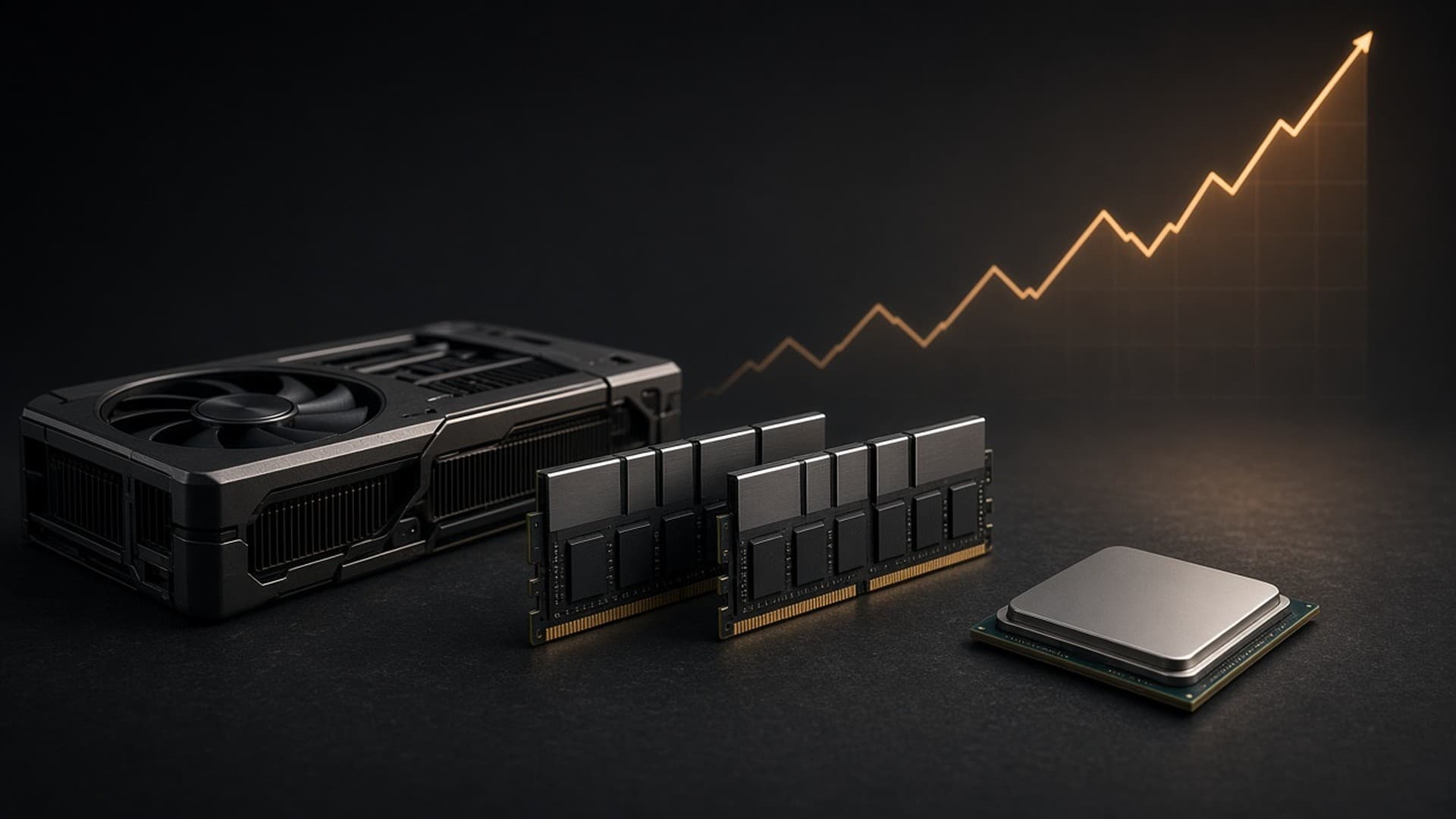
If you last priced a UK gaming PC in the spring, the November list will look unfriendly. The cards and chips you would actually want to buy are on shelves — this is not a 2020-style empty-box panic — but the prices attached to them have moved, and memory has moved most of all.
This is a market roundup, not a review, and it is not based on Forge PC lab tests. It pulls together official product facts, independently reported pricing, and the cheapest new UK listings we could verify on 12 November 2026, so you can decide whether to buy before Black Friday or wait.
Graphics cards: stock exists, fair prices mostly do not
The live generation is NVIDIA's GeForce RTX 50-series, AMD's Radeon RX 9000-series and Intel's Arc B-series. New UK listings for last-generation cards have largely dried up: SpecPrice's tracker showed no new RTX 40-series cards on 12 November, and the RX 7600 was the only RX 7000-series model still listed new. Anyone still using a March comparison that put an RTX 4070 at around £500–£550 is shopping from a market that has already moved on.
The more important story is the gap between launch MSRP and the till. TechSpot's Q4 2026 pricing update, published on 2 November, found that graphics cards had become about 35 per cent more expensive in three months across the ten countries it tracks, after average monthly rises of about 15 per cent in August, 7 per cent in September and 11 per cent in October. It also found that 16GB Radeon cards were still closer to a reasonable price than the equivalent GeForce models, and that the RX 9070 XT was, on average across those countries, selling for the same price as a 12GB RTX 5070, even though TechSpot's own recent 52-game benchmark had the AMD card about 25 per cent faster.
The UK snapshot on 12 November, from SpecPrice's cheapest-new-listing tracker (updated 11:53 GMT that day), looks like this in outline: an RTX 5060 from about £425, a 16GB RX 9060 XT from about £580, an RX 9070 from about £732, an RTX 5070 and RX 9070 XT both from about £815–£820, an RTX 5070 Ti from about £1,215, an RTX 5080 from about £1,500 and an RTX 5090 from about £7,000. Intel's Arc B580 was listed from about £306, though only one UK shop had it, and TechSpot's update said the UK B580 price was out of line with other countries, seemingly because of supply issues.
Those figures are floors, not typical basket prices. Partner cards with fancier coolers cost more, and SpecPrice skips pre-orders, so a cheaper RTX 5070 Ti you may see on a retailer page could be one: Scan had a £1,179.98 model marked “Due 20th Nov” on 12 November. NVIDIA's US launch prices ($549 for a 5070, $749 for a 5070 Ti, $999 for a 5080, $1,999 for a 5090) now read like historical labels. TechSpot also reported severely constrained 5090 supply and a knock-on rise in 5080 prices, which it put 22 per cent higher month on month across its ten countries, plus rumours of a 24GB 5080 replacing the 16GB model in the first quarter of 2027. Until that is announced, treat it as rumour.
The practical UK conclusion is unchanged by the rumour mill: mid-range value is sitting with AMD's 16GB cards, NVIDIA's feature set still costs a steep premium, and the two flagship GeForce cards are difficult to recommend at current street prices.
Memory: the quiet crisis in every new build
RAM is the part of the market that has changed the most since Forge PC last published in March. ramprices.uk's UK index, which tracks Amazon.co.uk prices and was updated on 12 November 2026, put the median DDR5 kit at £18.48 per gigabyte, up about 20 per cent in 90 days and about 200 per cent from the £6.16/GB median of a year earlier. PC Prowler's separate UK RAM index puts the typical DDR5 desktop kit at £17.50/GB. DDR4, at a median of about £8.22/GB on ramprices.uk, is still clearly cheaper, but it only helps if your motherboard already takes it.
A 32GB DDR5 kit is therefore no longer an afterthought. At ramprices.uk's £18.48/GB median for 32GB kits it works out at roughly £590, against about £205 a year ago, which is why Club386 has started treating AM4 and DDR4 LGA 1700 upgrades as serious options again. New AM5 and LGA 1851 boards have no such escape route: they are DDR5 only, so a “just the CPU” quote is incomplete until the kit is in the basket.
This also changes complete-PC maths. Forge PC's own March guide built an £800 AM5 PC around an RTX 4060 and a £45 16GB DDR5 kit. Neither price exists now: the cheapest new RTX 5060 was about £425 on 12 November, and even PC Prowler's cheapest DDR5 option was £190 for a single 16GB stick. An £800 build is a squeeze, and 16GB may be the only way to hit it at all. Anyone writing a budget PC guide this month has to say that out loud.
The processor market is the calmer of the three. You can buy the chips the reviews have been pointing at, and the key models were selling for about what Club386 listed in its 20 October guide (9850X3D £389 then, about £370 now; 9950X3D £509 then, about £515 now; 270K Plus £289 then, about £284 now).
SpecPrice's 12 November list had a Ryzen 5 9600X from about £160, a Ryzen 7 9800X3D from about £350, a Ryzen 7 9850X3D from about £370, a Ryzen 9 9950X3D from about £515, a Core Ultra 5 250K Plus from about £196 and a Core Ultra 7 270K Plus from about £284. Club386's late-October guide still has the 9850X3D as the gaming leader, with the cheaper 9800X3D close behind, the 9950X3D as the all-round flagship and the 270K Plus as the content-creation value chip. Tom's Hardware's hierarchy tells a similar story at the top of the gaming stack.
The strategic news is older than this week but still the thing to plan around. At Computex 2026, on 31 May, AMD said it would extend socket AM5 support through 2029. That announcement did not name future chips, but in late August AMD's technical documentation, spotted by InstLatX64 and reported by TechSpot and TechPowerUp, listed the next desktop generation, Zen 6 “Olympic Ridge”, for AM5, along with a family codenamed Medusa1. Each existing board will still need its maker's BIOS update. “We're committed to giving gamers high-performance technologies with the flexibility to upgrade their systems over time,” David McAfee, AMD's corporate vice president and general manager for the client channel and graphics business, said in that Computex announcement.
That promise is why a first-time buyer still has a reason to pay today's DDR5 prices and join AM5, rather than LGA 1851, which Club386 and others expect Intel to replace with LGA 1954 when Nova Lake arrives. It is not a reason to sit on a broken or badly under-specified PC waiting for Zen 6. AMD has not announced desktop Zen 6 chips or a date; TechPowerUp and others expect them in 2027. Treat unannounced products as unannounced.
What we would do before Black Friday
Black Friday is Friday 27 November 2026, with Cyber Monday on 30 November. Some UK sales start earlier, and a “sale” sticker is not automatically a bargain on a card whose price has climbed this year. TechSpot's UK figures show the cheapest RTX 5070 going from £510 in February to £740 in October.
If you need a 1440p graphics card for a machine that is otherwise fine, shopping now for an RX 9070 or 9070 XT at a known price is reasonable, and you can still look again during the sale week. If you need a whole new AM5 system, price the CPU, board and DDR5 kit as a set, and do not let a cheap processor headline hide a painful memory quote. If your AM4 or DDR4 Intel board still has a drop-in upgrade, that path has more merit than it did when 32GB of DDR5 was a minor line. If you were hoping to buy an RTX 5080 or 5090 at something near launch MSRP, November is not offering that deal.
We will come back to this with a dedicated Black Friday parts guide in the next two weeks, and the GPU and CPU buying guides published alongside this roundup will be updated if UK street prices change the recommendation, not just the pound figure in a table.