For local AI, the RTX 3090 is still in demand years after launch for one reason: 24GB of video memory. The RTX 5070 Ti is a current card with 16GB of newer GDDR7 memory and NVIDIA's Blackwell architecture. This comparison uses NVIDIA's published specifications and NVIDIA's own guidance on LLM inference. Forge PC hasn't tested either card, so there are no tokens-per-second or image-generation timings here.
Specs side by side
| RTX 3090 | RTX 5070 Ti |
|---|
Architecture | Ampere | Blackwell |
Tensor Cores | 3rd generation | 5th generation |
CUDA cores | 10,496 | 8,960 |
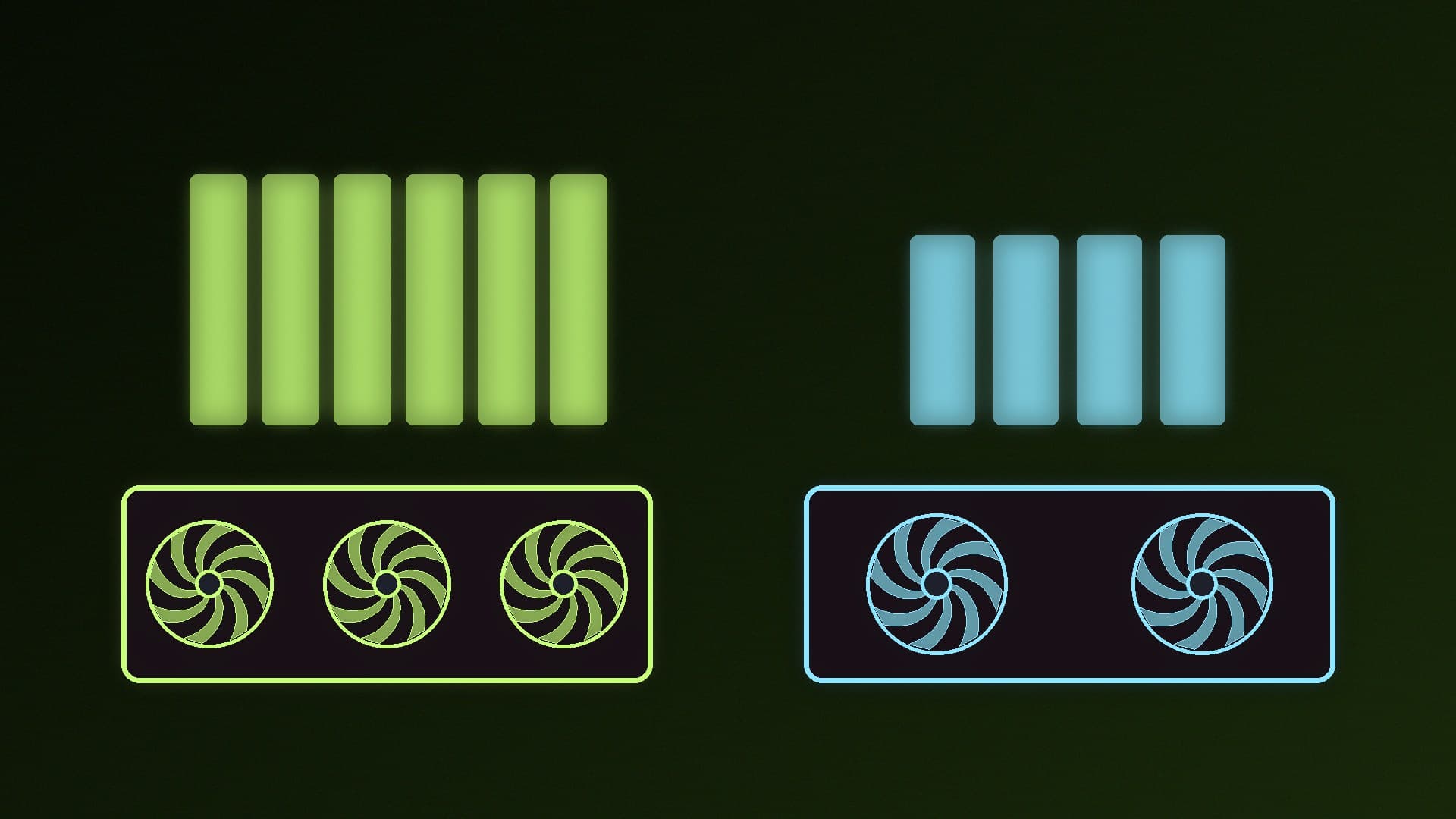
Memory | 24GB GDDR6X | 16GB GDDR7 |
Memory interface | 384-bit | 256-bit |
AI TOPS (NVIDIA figure) | not listed on NVIDIA's 30 Series page | 1,406 |
Graphics card power | 350W | 300W |
NVIDIA's required system power | 750W | 750W |
NVLink | Yes (SLI-ready) | not listed |
PCIe | Gen 4 | see card maker's page |
Specs are for NVIDIA's Founders Edition or reference designs; partner cards vary.
Why VRAM usually decides it
For running large language models, the key question is whether the model fits in video memory. NVIDIA's guide to LLM inference says the two main contributors to a model's GPU memory requirement are the model weights and the KV cache (which grows with context length). If the model and its cache don't fit, it spills into much slower system memory, or won't load at all.
That's where the 3090's 24GB matters. It gives you 8GB more headroom than the 5070 Ti for bigger models, higher-quality quantisations or longer context. Our LLM quantisation explainer and context length and VRAM guide show how those choices change memory use, and how much VRAM you need covers the basics.
NVIDIA also notes that generating output tokens (the decode phase) is memory-bound, and that model execution is frequently memory-bandwidth bound. The 3090 has a wider 384-bit bus; the 5070 Ti uses faster GDDR7 on a 256-bit bus. NVIDIA's pages we used don't list bandwidth figures, so we're not claiming either card is faster at generating text. Look for independent benchmarks of the specific model and app you plan to use.
Where the RTX 5070 Ti is better
Newer AI hardware. Blackwell's 5th-generation Tensor Cores and FP4 support, which NVIDIA highlights for the RTX 50 Series. FP4 only helps if your software and model format use it; our FP4 vs FP8 vs FP16 explainer explains when it does.
Lower power. 300W against 350W, with the same 750W system power recommendation from NVIDIA.
It's a current product. You buy it new with a full warranty, rather than taking a chance on a used card that may have years of heavy use. Our used GPU buying guide for local AI lists the checks to make.
Gaming features. NVIDIA lists DLSS Multi Frame Generation as an RTX 50 Series feature, which matters if the card doubles as your gaming GPU.
Where the RTX 3090 is better
24GB of VRAM for larger models and longer context.
NVLink support, which NVIDIA lists for the 3090 (with a bridge). You don't need it to split a model across two cards in common home LLM apps; see how to run a local LLM on two GPUs.
Our verdict
If the models you want to run need more than 16GB, the RTX 3090 is the better local AI card, because 24GB lets you load bigger models and longer context that simply won't fit on the 5070 Ti. If your models fit comfortably in 16GB, or you also want a current gaming card, the RTX 5070 Ti is the safer buy: it's new, under warranty, uses less power and has Blackwell's FP4-capable Tensor Cores. Forge PC hasn't tested either card; this comparison is based on NVIDIA's specifications and guidance. For more options, see our best GPU for local LLMs guide and RTX 5070 Ti vs RTX 5080 for local AI.