Every measurement and feature below comes from Lian Li's official product pages for the O11 Dynamic EVO and the O11 Vision Compact, read on 23 November 2026, so check them again before you buy, because makers sometimes revise specs.
The O11 Dynamic EVO and O11 Vision Compact look like close relatives, and they are. Both are dual-chamber cases with a separate rear compartment for cable management, both take a 360mm radiator, and both are roughly the same footprint. The difference is in what each one is trying to do. The EVO is a flexible all-rounder built around water cooling and rearranging the case, while the Vision Compact is built to show off your parts through glass on three sides and supports hidden-connector motherboards.
If you're new to this kind of layout, our guide to dual-chamber vs standard PC cases explains the pros and cons first.
Specs side by side
| O11 Dynamic EVO | O11 Vision Compact |
|---|
Dimensions (D × W × H) | 465 × 285 × 459mm | 447.5 × 287.5 × 446.4mm |
Materials | 4mm aluminium, 4mm tempered glass, 1mm steel | Steel, 4mm and 3mm tempered glass, aluminium |
Motherboards | E-ATX (under 280mm wide), ATX, Micro-ATX, Mini-ITX | Back-connect ATX, E-ATX (under 280mm), ATX, Micro-ATX, Mini-ITX |
Max GPU length | 426mm | 408mm |
Max CPU cooler height | 167mm | 167mm |
PSU | ATX up to 220mm; room for a second PSU | ATX under 220mm |
Max fans | 10 | 11 (mesh top), 8 (glass top) |
Radiators | Up to three 360mm (top, side, bottom) | 360mm at top, side or bottom |
Expansion slots | 8 | 6+1 |
Drive mounting | Up to nine 2.5in SSDs (pads for nine supplied), or a mix with 3.5in drives | 2× 2.5in behind tray, plus a cage for 2× 3.5in or 2.5in |
Front I/O | 2× USB 3.0, 1× USB-C (USB 3.1), audio | 2× USB 3.0, 1× USB-C (USB 3.1), audio |
Colours | Black, White, Harbor Grey | Black, White |
Cooling: the EVO is the bigger water-cooling case
Lian Li says the O11 Dynamic EVO can hold three 360mm radiators at the top, side and bottom, plus up to 10 fans. That makes it the stronger choice for a custom loop or for running a large AIO alongside extra radiators. Its side bracket can be flipped to make more room for thick radiator and fan combinations next to the motherboard, and Lian Li lists a 60mm fan mount on the drive cage to cool hard drives.
The Vision Compact lists 360mm radiator mounting at the top, side and bottom too, and up to 11 fans, but only with the mesh top panel fitted. With the glass top (what Lian Li calls Vision mode), the fan limit drops to eight. Lian Li also notes that its own GALAHAD II Trinity Performance AIO isn't compatible with the Vision Compact's side bracket, because it's too wide. If you want a top-mounted AIO, the mesh panel is the one designed for it.
Neither spec sheet lists any fans in the box, unlike Lian Li's Lancool cases, so check the retailer's listing and budget for fans if none are included. Our case fan airflow guide explains how to lay them out in a case like this.
Looks: the Vision Compact is built for display
This is where the two cases differ most. With its glass top panel fitted, the Vision Compact has glass on the front, side and top, which Lian Li says gives 270-degree visibility. The glass panels meet at the top corner on a magnetic mounting key that Lian Li rates for 35kg of force. The black version uses tinted glass and the white version uses clear glass with matching white grommets, thumbscrews and brackets.
It also has features aimed at a tidy, show-off build:
Back-connect motherboard support, so the power and data connectors can sit on the rear of the board. Our back-connect vs standard motherboards guide explains whether that's worth it.
Hidden AIO tubing: the tubes can run through channels into the rear chamber.
Mounting space for a small IPS screen above the motherboard (screen not included; Lian Li recommends 5in to 8.8in) with an opening at the back for its cable.
A pre-installed, adjustable GPU anti-sag bracket for cards from 278mm to 408mm long.
The O11 Dynamic EVO has front and side glass rather than three glass sides. Its party trick is flexibility. It can be flipped into Reverse Mode so the glass is on the other side, and the front I/O module can be moved to three positions without tools. Lian Li offers five optional kits for it: a vertical GPU kit, an upright GPU kit, an additional I/O kit, a front mesh kit and a top I/O kit. A GPU anti-sag bracket is included. The front mesh kit swaps the front glass for mesh and adds room for three 120mm or two 140mm fans at the front.
Size, storage and expansion
The two are close in size. The Vision Compact is about 17.5mm shallower and 13mm shorter, and Lian Li puts its volume at 57.4 litres, against 67.8 litres for the full-size O11 Vision.
The EVO wins on everything practical:
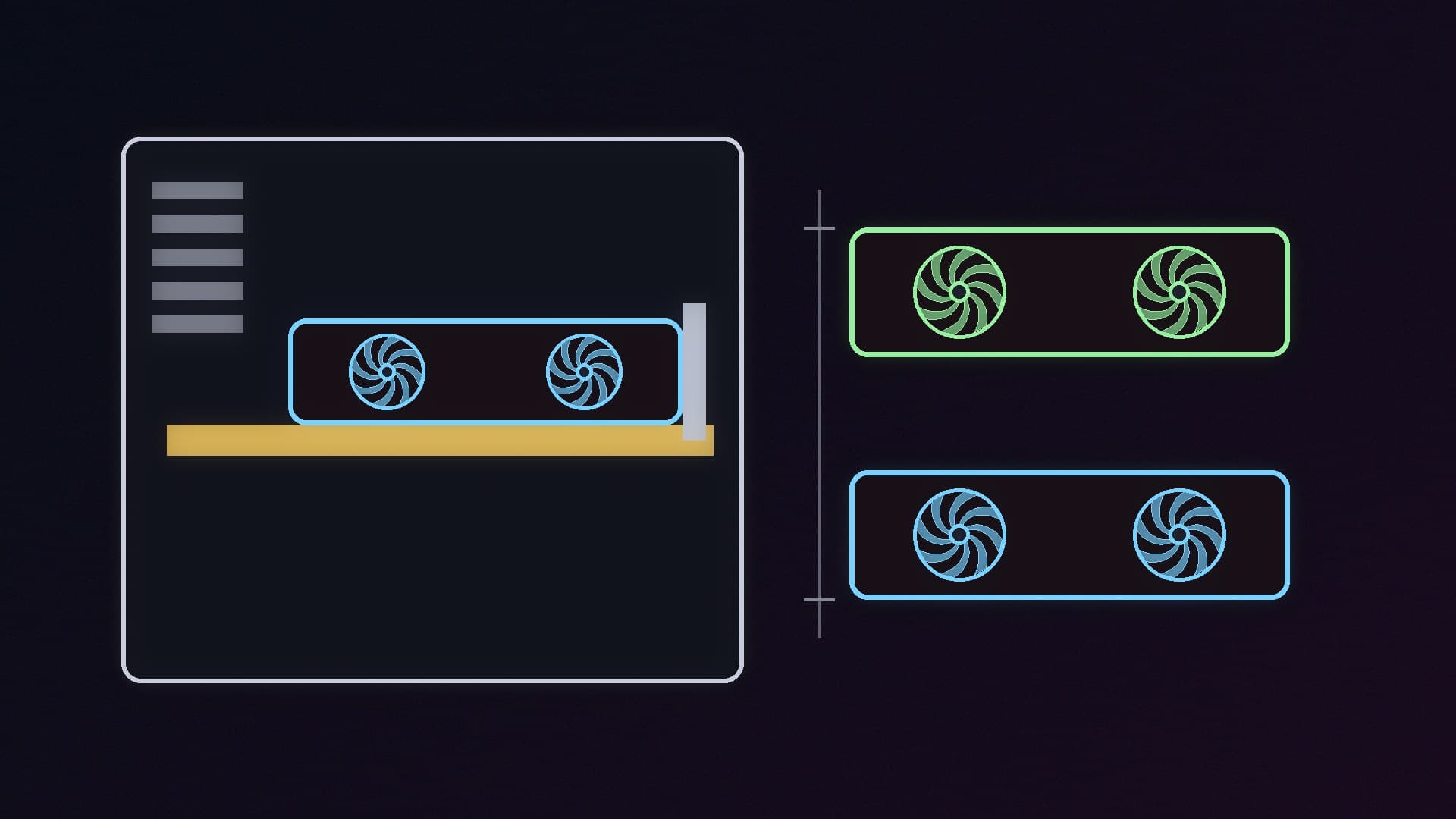
Longer graphics cards: 426mm against 408mm. Both are enough for most current cards, but always check your card's length (see how to check a graphics card fits your case).
More storage: mounting for up to nine 2.5in drives, against four drive positions in the Vision Compact's spec table.
Eight expansion slots against 6+1.
Dual PSU option: Lian Li says you can remove the drive cage to fit a second power supply.
CPU cooler height is the same 167mm in both, so check your air cooler's height before you buy.
Our verdict
Choose the Lian Li O11 Dynamic EVO if you care most about cooling and flexibility: it takes up to three 360mm radiators, longer graphics cards (426mm), more drives and a second PSU, and can be flipped into Reverse Mode. Choose the O11 Vision Compact if the look matters most: it has glass on three sides when the glass top is fitted, supports back-connect motherboards, hides AIO tubing and has space for a small screen, but you lose some fan capacity with the glass top fitted. All figures are from Lian Li's official specs, not our own testing.