This comparison is based on AMD's official product pages for the Ryzen AI 9 HX 370 and Ryzen AI Max+ 395, Ollama's hardware support documentation and HP's product page for the ZBook Ultra G1a, all read on 24 November 2026. We've left out prices because they vary hugely between laptop and mini PC models.
Both of these AMD processors carry the "Ryzen AI" name, both have a 50 TOPS neural processing unit (NPU), and both turn up in thin laptops and compact desktops sold as AI PCs. That makes it easy to assume they're broadly similar. For running large language models (LLMs) and image generators on your own machine, they really aren't. The Ryzen AI Max+ 395 is a much bigger chip with far more graphics hardware and a much wider memory interface, and that matters more for local AI than the NPU figure printed on the box.
At a glance
| Ryzen AI 9 HX 370 | Ryzen AI Max+ 395 |
|---|
Codename | Strix Point | Strix Halo |
CPU cores / threads | 12 / 24 (4x Zen 5, 8x Zen 5c) | 16 / 32 (16x Zen 5) |
Max boost / base clock | Up to 5.1GHz / 2GHz | Up to 5.1GHz / 3GHz |
L3 cache | 24MB | 64MB |
Integrated graphics | Radeon 890M, 16 graphics cores | Radeon 8060S, 40 graphics cores |
Graphics frequency | 2,900MHz | 2,900MHz |
NPU | Up to 50 TOPS | Up to 50 TOPS |
Overall AI TOPS (AMD figure) | Up to 80 TOPS | Up to 126 TOPS |
Memory type | DDR5 or LPDDR5X, 2 channels | 256-bit LPDDR5X |
Max memory speed | DDR5-5600, LPDDR5X-8000 | LPDDR5X-8000 |
Max memory (AMD figure) | 256GB | 128GB |
Default TDP (configurable) | 28W (15-54W) | 55W (45-120W) |
All figures are from AMD's product pages. Remember that laptop and mini PC makers choose how much memory to fit and what power limit to run, so two machines with the same chip can behave quite differently.
Why the NPU isn't the deciding factor
On paper the two chips are level on NPU performance: AMD quotes up to 50 TOPS for each. That's enough to meet Microsoft's 40+ TOPS requirement for Copilot+ PC features, and it's useful for Windows AI features and the growing number of apps that can run small models on the NPU. We've covered tools such as FastFlowLM that can run LLMs on AMD's NPU separately.
But most popular local AI tools, including Ollama, LM Studio and llama.cpp, do their heavy lifting on the GPU (or the CPU if there's no supported GPU). That's where the two chips split apart. AMD's "overall TOPS" figures, which add the CPU, GPU and NPU together, hint at the gap: up to 80 TOPS for the HX 370 against up to 126 TOPS for the Max+ 395. Our explainer on NPU vs GPU for local AI goes into more detail on which jobs suit which processor.
Graphics: 16 cores vs 40 cores
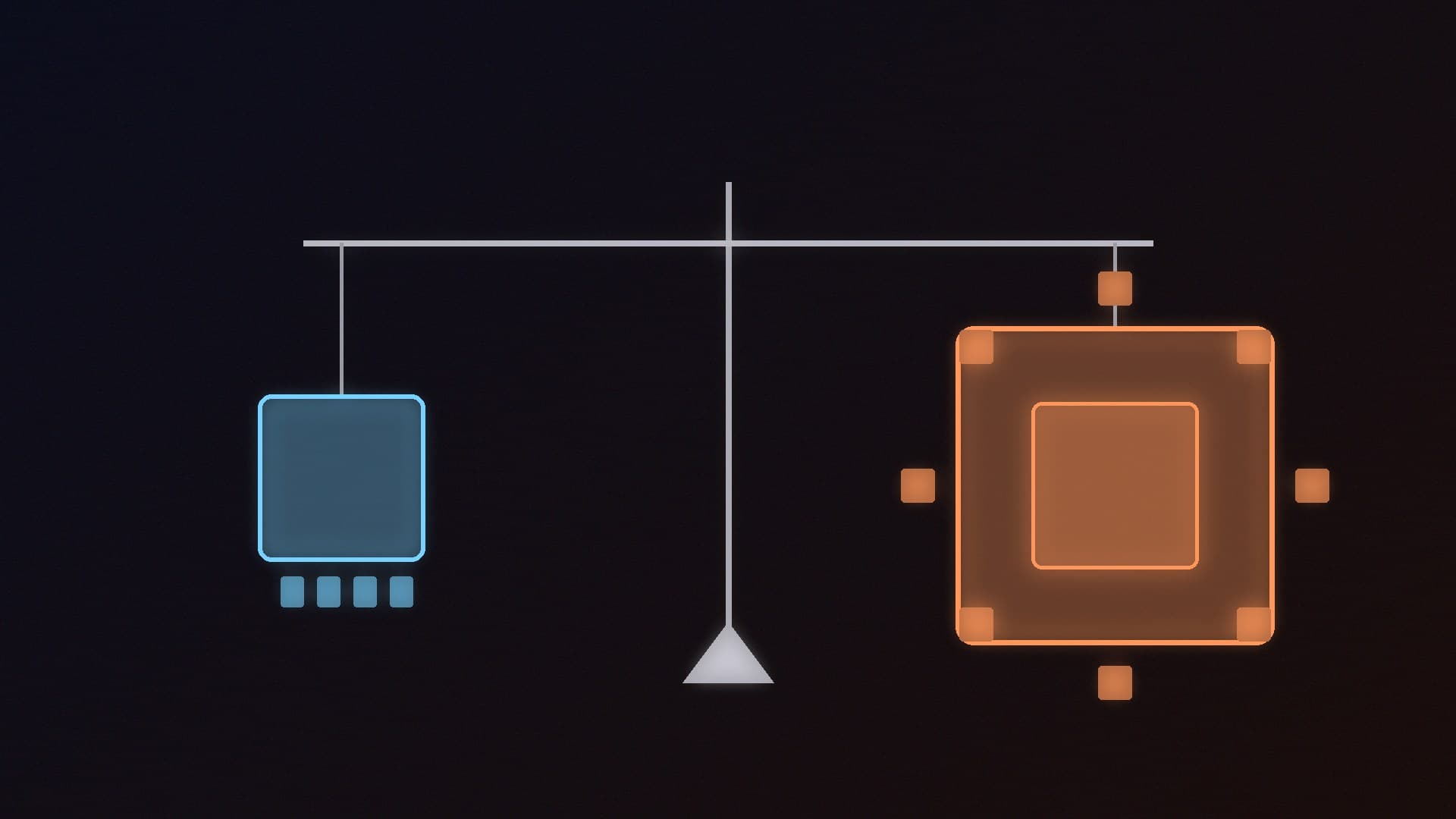
The Ryzen AI 9 HX 370 uses Radeon 890M integrated graphics with 16 graphics cores. The Ryzen AI Max+ 395 uses Radeon 8060S graphics with 40. Both run at up to 2,900MHz, so the Max+ 395 simply has two and a half times as many graphics cores to throw at the job.
For local AI that difference shows up most when the model is processing your prompt, documents or images, which tends to be compute-heavy. It also matters for image generation, where integrated graphics with only 16 cores will feel slow. We can't give you measured figures, but the specification gap is large enough that the two chips belong in different classes.
Memory: the bigger difference
When an LLM generates text, speed is mostly limited by how quickly the processor can read the model's weights from memory. Our explainer on memory bandwidth and local LLM speed covers why.
AMD lists the Ryzen AI Max+ 395 with a 256-bit LPDDR5X memory interface at up to LPDDR5X-8000. By our own calculation, a 256-bit interface at 8,000MT/s works out at roughly 256GB/s of peak bandwidth (AMD doesn't print a bandwidth figure on the page). The Ryzen AI 9 HX 370, by contrast, is listed with two memory channels of DDR5-5600 or LPDDR5X-8000, which is the conventional laptop arrangement. AMD doesn't list a bus width or bandwidth figure for it, but it is clearly a much narrower interface than the Max+ 395's 256-bit design.
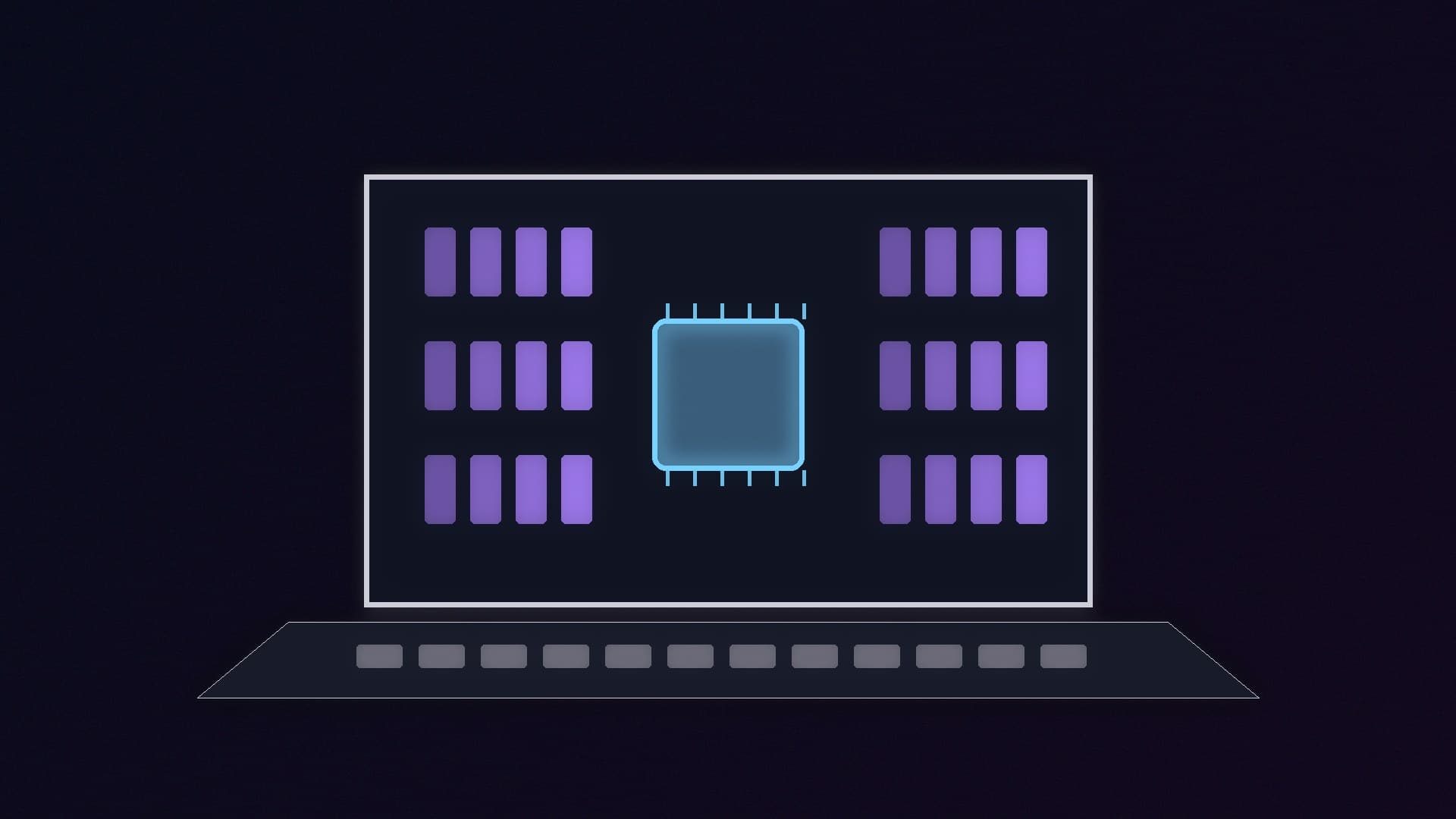
Capacity matters too. The HX 370's integrated graphics share ordinary system memory, and how much you get depends entirely on the laptop maker's configuration, although AMD lists support for up to 256GB. AMD lists a maximum of 128GB for the Max+ 395, and because it uses LPDDR5X the memory is generally soldered. HP, for example, says its ZBook Ultra G1a, which uses the closely related Ryzen AI Max+ PRO 395, can be configured with 128GB of unified memory and that up to 96GB of that can be assigned exclusively to the GPU. That's more memory than any single consumer graphics card offers, which is why Max+ 395 systems have become popular for running large models. Our unified memory vs VRAM explainer covers the trade-offs: lots of capacity, but much less bandwidth than a high-end desktop graphics card.
What that means for model sizes
As a rough guide, a 4-bit quantised model needs a little over half a gigabyte per billion parameters, plus room for context. On an HX 370 laptop with, say, 32GB of RAM, shared between Windows, your apps and the graphics, small and mid-sized models in the 7B to 14B class are the realistic target. A Max+ 395 machine with 128GB has room for far larger models, including big mixture-of-experts models that would never fit on a 16GB or 24GB graphics card.
Software support
Ollama's hardware documentation lists both the Ryzen AI 9 HX 370 and Ryzen AI Max+ 395 among the AMD processors it supports through AMD's ROCm v7 on Linux. On Windows, Ollama's ROCm support list currently covers only Radeon RX 7000-series and Radeon PRO W7000-series graphics cards, so integrated Ryzen AI graphics rely on Ollama's Vulkan backend instead, which Ollama says is included with most GPU drivers on Windows and is enabled by default. LM Studio and other llama.cpp-based apps can also use Vulkan.
In practice, that means both chips can run local LLMs on Windows and Linux, but if you want the most mature AMD route for a Max+ 395 machine dedicated to AI, Linux with ROCm is worth considering. CUDA-only tools won't run on either chip's graphics, which is the main reason some people still prefer a laptop with an NVIDIA GPU.
Power, cooling and battery life
AMD lists a 28W default TDP for the HX 370, configurable from 15W to 54W, while the Max+ 395 defaults to 55W and can be configured from 45W to 120W. That lower power envelope suits thin-and-light laptops, while the Max+ 395's higher limits demand more cooling; HP's ZBook Ultra G1a, for instance, is a 14in mobile workstation, and the chip also appears in compact desktops. If you run long AI jobs, a Max+ 395 machine configured at a high power limit will draw considerably more than an HX 370 laptop, so check the maker's cooling and power settings before you buy.
Which should you choose?
Choose the Ryzen AI 9 HX 370 if you want a portable everyday laptop that can run small local models, Copilot+ PC features and NPU-accelerated apps, and you don't need to run big models. Machines built around it are generally much cheaper than Max+ 395 systems.
Choose the Ryzen AI Max+ 395 if running larger models locally is a priority and you want a single portable machine or mini PC with up to 128GB of memory that the graphics can use. Buy as much memory as you can afford, because LPDDR5X is generally soldered and can't be upgraded later.
Consider a desktop or NVIDIA laptop instead if you need CUDA-only tools, or the fastest possible speed on models that fit in 16GB to 24GB of VRAM. Our laptop vs desktop for local AI comparison weighs that up.
Our verdict
For local AI, the Ryzen AI Max+ 395 is the clear winner: it has two and a half times the graphics cores of the Ryzen AI 9 HX 370, a much wider 256-bit memory interface and support for up to 128GB of memory that the graphics can draw on, which together let it run far bigger models. The HX 370 is still a capable thin-and-light chip with the same 50 TOPS NPU, and it makes sense if local AI is an occasional extra rather than the main reason you're buying. Just don't choose between them on the NPU figure, because it's the same on both and isn't what most local AI apps use.