A USB microphone plugs straight into your PC, with no audio interface needed, and usually sounds much clearer than a headset mic. This guide picks the best current USB mics for different jobs using the makers' official product pages and spec sheets. Everything below comes from the manufacturers' published specifications. UK prices are approximate, were checked on the makers' own UK stores on 25 November 2026, and will change quickly over Black Friday.
Quick picks
Microphone | Capsule | Pickup pattern | Outputs | Best for |
|---|
Shure MV7+ | Dynamic | Cardioid | USB-C and XLR | Best overall for voice |
RØDE PodMic USB | Dynamic | Not stated on maker page | USB-C and XLR | Best broadcast-style build |
Elgato Wave:3 MK.2 | 16mm condenser | Cardioid | USB-C | Best for streamers |
RØDE NT-USB+ | Condenser | Cardioid | USB-C | Best for vocals and music |
HyperX QuadCast 2 S | Three 14mm electret condensers | Cardioid, omni, bi-directional, stereo | USB-C | Best multi-pattern mic |
Logitech G Yeti GX | Dynamic | Supercardioid | USB-C | Best value dynamic mic |
Razer Seiren V3 Chroma | Condenser | Supercardioid | USB-C | Best RGB gaming mic |
Not sure which capsule type suits your room? Our dynamic vs condenser microphone guide explains the difference, and USB vs XLR microphone covers when an interface is worth it.
1. Shure MV7+: best overall for voice
The MV7+ is Shure's latest version of its hybrid podcast mic. Shure's user guide describes it as a USB dynamic microphone with a cardioid pattern, and it has both USB-C and XLR outputs, so you can plug it straight into your PC now and move to an audio interface or mixer later. Shure lists Voice Isolation Technology, an improved Auto Level Mode, a real-time Denoiser and a Digital Popper Stopper. Its LED touch panel works as a live level meter, and you tap it to mute. The free MOTIV Mix desktop app lets you change the sound signature, gain, EQ and compression, and set the panel to any of 16.8 million colours. There's a headphone jack for latency-free monitoring.
Shure's UK recommended retail price was £295 when we checked (25 November 2026). That's the most expensive mic here, but the XLR output means you won't need to replace it if you upgrade your setup. The Shure MV7+ Podcast Microphone is in our product database.
2. RØDE PodMic USB: best broadcast-style build
The PodMic USB is a dynamic broadcast microphone with both XLR and USB-C outputs, aimed at podcasting, streaming, gaming and voice-overs. Its USB side uses RØDE's Revolution Preamp, which RØDE calls ultra-low-noise and high-gain, plus APHEX digital processing. That gives you a high-pass filter, noise gate, compressor, Aural Exciter and Big Bottom effects through RØDE's software. It has an internal pop filter and shock mount, and comes with an external pop filter. RØDE also lists an integrated swing mount, an all-metal build and a headphone output with level control and zero-latency monitoring.
RØDE doesn't list a desk stand among its features, so budget for a stand or arm. Our best microphone arm guide has options. RØDE's global site doesn't show a UK price, so check your usual retailer.
3. Elgato Wave:3 MK.2: best for streamers
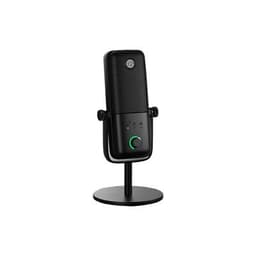
The Wave:3 MK.2 is a USB-C condenser mic with a 16mm capsule (integrated JFET), a cardioid pattern, 24-bit/48kHz resolution and a 70Hz to 20kHz frequency response, according to Elgato. Its main feature is the Wave FX Processor. This runs DSP effects and Elgato's Clipguard 2.0 anti-clipping on the mic itself, so the processed sound reaches every app. It also supports VST inserts through the free Wave Link 3.0 software. You also get tap-to-mute, a multifunction dial, auto gain, an LED ring that shows levels, and a 3.5mm headphone jack. Elgato lists Windows 11 or newer and macOS 14.2 or newer.
Elgato's UK store listed it at £159.99, with a £139.99 offer price, when we checked on 25 November 2026. The Elgato Wave:3 MK.2 USB Microphone is in our product database.
4. RØDE NT-USB+: best for vocals and music
If you also record singing or instruments, the NT-USB+ is the most studio-focused mic here. RØDE describes a studio-grade condenser capsule with a tight cardioid pattern, its Revolution Preamp, high-resolution analogue-to-digital conversion and APHEX processing through RØDE Connect, RØDE Central and RØDE Reporter. The headphone output has zero-latency monitoring with separate volume and mix controls. A detachable pop filter and desktop stand come in the box. It's class-compliant, so it also works with phones and tablets.
Elgato's own comparison sums up the difference: condenser mics sound more detailed and natural, while dynamic mics sound more focused and controlled. A condenser generally suits a quiet room best. As with the PodMic USB, RØDE's site doesn't list a UK price.
5. HyperX QuadCast 2 S: best multi-pattern mic
The QuadCast 2 S is the only mic here with switchable pickup patterns. Its three 14mm electret condenser capsules give you cardioid, omnidirectional, bi-directional and stereo modes. That's useful if you sometimes record two people across a desk or a group around one mic. HyperX lists a 20Hz to 20kHz frequency response and 32-bit/192kHz audio, plus a tap-to-mute sensor, an LED VU meter and over 100 addressable RGB LEDs. A multifunction knob adjusts gain, headphone volume, monitor mix and pattern. It comes with a detachable shock mount and stand, and has a two-year warranty. The listing we used is HyperX's US store, so we haven't quoted a UK price.
6. Logitech G Yeti GX: best value dynamic mic
The Yeti GX pairs a dynamic capsule with a supercardioid pattern, a tighter pickup than cardioid that Logitech G says gives a broadcast-style sound. Logitech's spec sheet lists 24-bit audio at up to 96kHz, a 50Hz to 18kHz frequency response, EQ and auto gain control. Blue VO!CE software adds filters and effects and, Logitech says, protects against clipping. It has two LIGHTSYNC RGB zones.
Logitech G's UK store listed it at £109.99, with an £89.99 offer price, on 25 November 2026. That makes it the cheapest of the dynamic mics here with a UK price listed. It doesn't have an XLR output like the MV7+ or PodMic USB.
7. Razer Seiren V3 Chroma: best RGB gaming mic
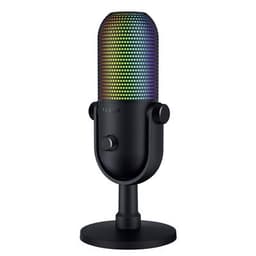
The Seiren V3 Chroma uses a supercardioid condenser capsule. Razer says the tighter pattern helps suppress background sounds such as mechanical keyboards. Tap the top to mute. You can also map double and triple taps to change lighting or toggle the mic's digital gain limiter. A 3.5mm headphone port and onboard audio mixing in Razer Synapse let you set separate mixes for what you hear and what your stream hears. The RGB lighting works with Razer Chroma and its smart-home partners. Razer's UK store listed it from £99.99 (down from £139.99) on 25 November 2026. The Razer Seiren V3 Chroma Black is in our product database.
How to choose
Noisy room or loud keyboard: consider a dynamic mic (MV7+, PodMic USB, Yeti GX) or a supercardioid pattern (Yeti GX, Seiren V3 Chroma), which Razer and Logitech G pitch for focused pickup.
Quiet room, music or a more detailed sound: a condenser such as the NT-USB+ or Wave:3 MK.2.
Planning to upgrade later: the MV7+ and PodMic USB also have XLR outputs. See how to connect an XLR microphone to a PC.
More than one voice: the QuadCast 2 S's omni and bi-directional modes.
Once it's plugged in, our OBS microphone filters guide helps you tidy up the sound, and how to fix a microphone not working in Windows 11 covers common problems. For a full streaming setup, see how to set up a PC for streaming.
Our verdict
The Shure MV7+ is our pick for most people, based on its specifications. It's a cardioid dynamic mic with both USB-C and XLR outputs, and adds Shure's voice isolation, auto level and denoising features, though it costs the most at £295 RRP. The Logitech G Yeti GX is the value dynamic choice, the Elgato Wave:3 MK.2 is the best fit for streamers who want onboard anti-clipping, the RØDE NT-USB+ suits vocals and music, and the HyperX QuadCast 2 S is the one to get if you need more than one pickup pattern.