Open the spec sheet for any GeForce RTX graphics card and you'll see two different kinds of core listed: thousands of CUDA cores and a "Tensor Cores (AI)" line rated in AI TOPS. They sit side by side on the same chip but do different jobs. This explainer covers what each type does, how they're arranged in NVIDIA's current Blackwell architecture and what the numbers mean when you're choosing a GPU for gaming or local AI. It's a concept comparison based on NVIDIA's RTX Blackwell architecture whitepaper and product pages.
The short version
| CUDA cores | Tensor Cores |
|---|
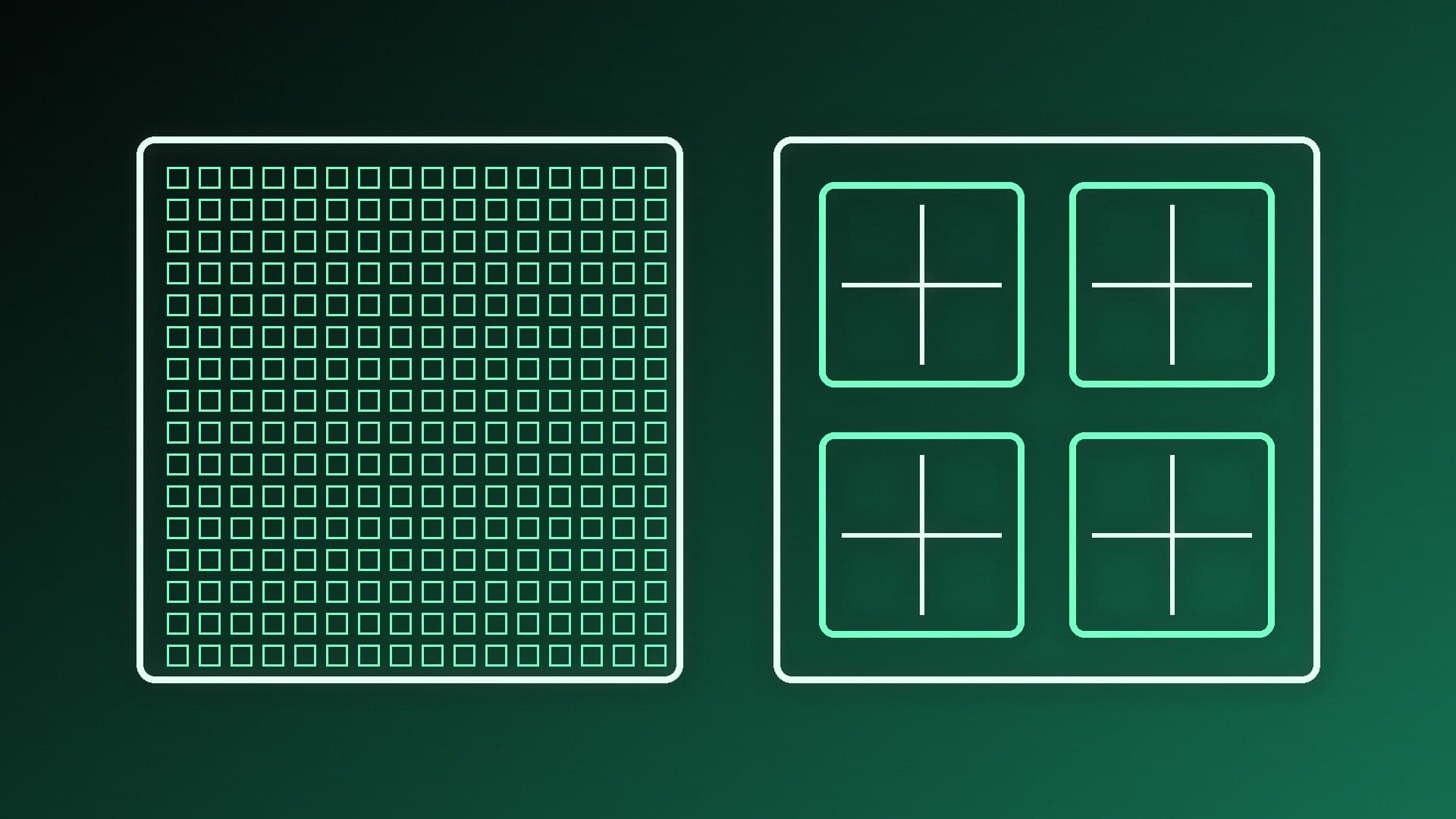
What they do | General-purpose parallel maths (FP32 and INT32) | Matrix multiply-and-accumulate maths |
Main uses | General graphics and compute maths | AI training and inference, DLSS, RTX Video, RTX HDR |
Number per Blackwell SM | 128 | 4 |
Spec sheet figure | Core count | AI TOPS |
Number formats | FP32, INT32 | FP16, BF16, TF32, INT8, FP8, plus FP6 and FP4 on RTX Blackwell |
How they're organised
NVIDIA GPUs are built from streaming multiprocessors (SMs). According to NVIDIA's RTX Blackwell whitepaper, each Blackwell SM contains 128 CUDA cores, one fourth-generation RT core, four fifth-generation Tensor Cores, four texture units, a 256KB register file and 128KB of L1/shared memory. NVIDIA says the full GB202 chip has 192 SMs and 24,576 CUDA cores.
So a card's CUDA core count and its Tensor Core count rise together: more SMs means more of both.
What CUDA cores do
CUDA cores are the GPU's general-purpose processors; NVIDIA's product pages list the CUDA core count alongside the Blackwell shader cores. They handle general-purpose FP32 and INT32 maths for graphics and compute work. In Blackwell, NVIDIA says the INT32 and FP32 cores are fully unified, doubling the number of possible integer operations compared with the previous Ada generation, though each core can only work as FP32 or INT32 in any one clock cycle.
What Tensor Cores do
NVIDIA describes Tensor Cores as specialised high-performance cores tailored for the matrix multiply-and-accumulate maths used in AI and HPC applications, and critical to both training and inference of deep learning neural networks. That matrix maths is the core of running a large language model or an image generator.
On RTX Blackwell cards, NVIDIA says the Tensor Cores support FP16, BF16, TF32, INT8 and FP8, and add FP4 and FP6 support. Lower-precision formats use less memory: NVIDIA's whitepaper gives the example of the FLUX.dev image model needing over 23GB of VRAM at FP16 but less than 10GB at FP4. Our guide to FP4 vs FP8 vs FP16 covers those formats in more detail.
Tensor Cores in gaming and everyday use
Tensor Cores aren't just for AI enthusiasts. NVIDIA uses them for several features gamers use every day:
DLSS, NVIDIA's AI upscaling and frame generation; see DLSS, FSR and frame generation explained.
RTX Video Super Resolution and RTX Video HDR, which NVIDIA says use the Tensor Cores to enhance web video.
RTX HDR and RTX Dynamic Vibrance, AI filters in the NVIDIA app that NVIDIA says are accelerated by Tensor Cores.
Reading the spec sheet
NVIDIA's RTX 5070 family page shows how the two figures appear:
| RTX 5070 Ti | RTX 5070 |
|---|
CUDA cores | 8,960 | 6,144 |
Tensor Cores (AI) | 5th gen, 1,406 AI TOPS | 5th gen, 988 AI TOPS |
AI TOPS is the figure NVIDIA lists against the Tensor Cores, so it's the number to compare between NVIDIA cards of the same generation for AI work; see our explainer on TOPS vs TFLOPS before comparing across brands.
Which matters for local AI?
For running local AI models, Tensor Cores do the heavy lifting, but they're rarely the only limit. VRAM decides how large a model you can load, which is why our best GPU for local LLMs guide and how much VRAM you need weigh memory heavily. Software support matters too: see CUDA vs ROCm vs Vulkan. Note that "CUDA" is also the name of NVIDIA's software platform.
Our verdict
CUDA cores are the general-purpose workhorses that handle most game rendering, while Tensor Cores are specialised matrix engines for AI, which NVIDIA also uses for DLSS, RTX Video and RTX HDR. On Blackwell cards, every SM has 128 CUDA cores and four Tensor Cores, so the two scale together. For gaming, judge cards on independent game benchmarks rather than either core count; for local AI, look at AI TOPS alongside VRAM, which usually decides what you can run.