Skip to content

VersusGPU

RX 9070 vs RX 9070 XT: What the XT Adds and Whether It Matters

AMD's RX 9070 and RX 9070 XT compared on official specs: both have 16GB of GDDR6 on a 256-bit bus and 64MB Infinity Cache, but the XT adds 8 compute units, a 2,970MHz boost clock and about 35% more FP32 compute, at 304W rather than 220W.

By , Senior Hardware Editor

3 min read

RX 9070 vs RX 9070 XT: What the XT Adds and Whether It Matters
PowerColor RX 9070 16GB Reaper compared with PowerColor RX 9070 XT 16GB Reaper
PowerColor RX 9070 16GB ReaperPowerColor RX 9070 XT 16GB Reaper
1080p average182fps202fps
1440p average142fps160fps
4K average75fps89fps
GPU Chip ManufacturerAMDAMD
GPU SeriesRX 9000 SeriesRX 9000 Series
VRAM Capacity (GB)1616
VRAM TypeGDDR6GDDR6
CUDA / Stream Processor Count—2560
Ray Tracing SupportYesYes
AI / Tensor SupportYesYes
Typical Board Power (W)250300
Recommended PSU Wattage (W)750750
Minimum PSU Wattage (W)650650
HDMI Count22
DisplayPort Count22
Max Display Count44
Max Resolution Supported4K8K

Estimated average frame rate across 10 games, paired with a top-tier processor. These are estimates from our benchmark dataset, not measurements of these exact units. Try other pairings

Every specification below comes from AMD's official product pages for the Radeon RX 9070 and RX 9070 XT, read on 23 November 2026. We haven't included frame rates, because we don't publish benchmark figures we haven't produced or can't credit. Partner cards from PowerColor, ASUS, Gigabyte and others can run at different clocks and power limits from AMD's reference figures. For example, the specs for PowerColor's RX 9070 16GB Reaper and RX 9070 XT 16GB Reaper are in our database.

These two cards are closer than their names suggest. AMD lists the same 53.9 billion transistor count for both, and they have the same 16GB of GDDR6 memory on a 256-bit bus, and the same 64MB of Infinity Cache. The XT gets more of the chip enabled, runs at higher clocks and draws considerably more power. If you're weighing either card against NVIDIA instead, see our RX 9070 vs RTX 5070 and RX 9070 XT vs RTX 5070 Ti comparisons.

Specs side by side

Spec (AMD's figures)

Radeon RX 9070

Radeon RX 9070 XT

Compute units

56

64

Stream processors

3,584

4,096

Ray accelerators

56

64

AI accelerators

112

128

Boost clock

Up to 2,520MHz

Up to 2,970MHz

Peak FP32 (vector)

36.1 TFLOPs

48.7 TFLOPs

Memory

16GB GDDR6, 256-bit

16GB GDDR6, 256-bit

Memory bandwidth

Up to 640GB/s

Up to 640GB/s

Infinity Cache

64MB

64MB

Interface

PCIe 5.0 x16

PCIe 5.0 x16

Typical board power

220W

304W

Minimum PSU recommendation

650W

750W

What's actually different

More of the GPU, running faster. The XT has 64 compute units to the RX 9070's 56, so it has about 14% more shader, ray tracing and AI hardware. AMD also gives it a much higher boost clock, up to 2,970MHz against 2,520MHz. Together, those take AMD's theoretical FP32 figure from 36.1 to 48.7 TFLOPs, about 35% higher. Theoretical TFLOPs don't translate one-for-one into frame rates, so the real-world gap in games will usually be smaller than that. Check independent reviews of the specific partner cards you're considering.

The same memory. Because both cards have identical memory capacity, bus width, bandwidth and cache, neither is better for very high-resolution textures or for fitting larger AI models in VRAM. For local AI, the XT's extra compute helps with speed, but the model size you can run is the same. Our GDDR7 vs GDDR6 explainer covers why bandwidth matters.
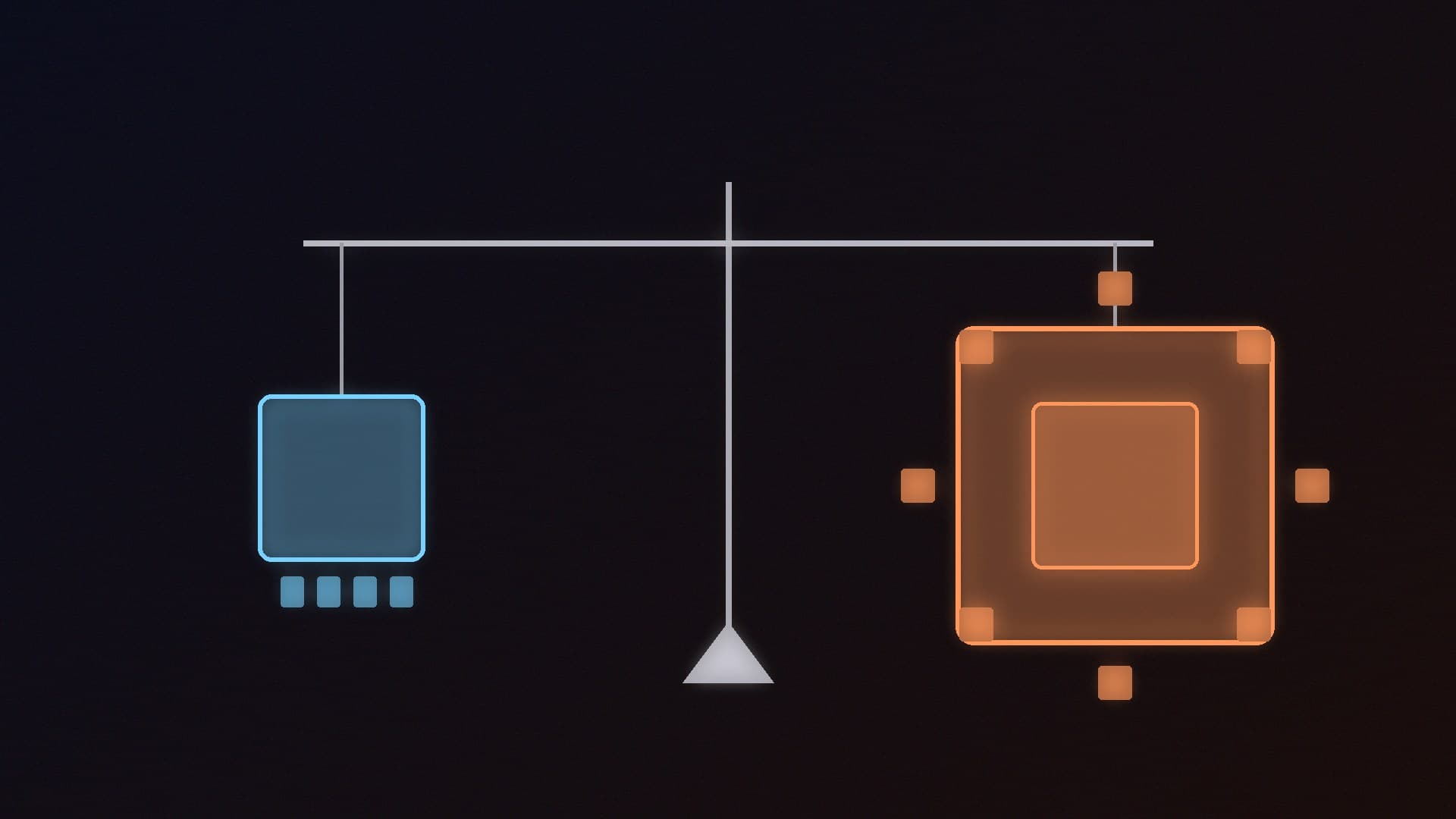
Power, heat and your PSU. This is the biggest practical difference. AMD rates the XT at 304W typical board power, 84W (about 38%) more than the RX 9070's 220W, and recommends a 750W power supply rather than 650W. That extra power goes up in heat inside your case, and partner cards with factory overclocks can draw more again. Before upgrading, check your PSU's wattage and connectors with our how to calculate PSU wattage guide.

Shared features. Both cards use PCIe 5.0 x16, and AMD's pages for both list AMD Software: Adrenalin Edition, AMD Fluid Motion Frames and AV1 video encode and decode.

Which should you buy?

Choose the RX 9070 XT if you want the most performance from this pair, for example for high-refresh 1440p or 4K gaming, you have a 750W or larger PSU with the right connectors, and your case has decent airflow. It's the faster card, and the price gap is usually what decides whether it's worth it.

Choose the RX 9070 if you have a 650W PSU, a smaller case or you care about noise and heat. You keep the same 16GB of memory and the same features, with lower power draw. It's also the better pick if the XT costs much more where you're buying, because the memory you get is identical.

Prices for both cards move a lot, especially around Black Friday, so compare current UK prices for the specific models before deciding. Our best GPU for 1440p guide puts both cards in context with the rest of the market.

Our verdict

The RX 9070 XT is the faster card: AMD gives it 64 compute units to 56, a boost clock up to 2,970MHz instead of 2,520MHz and about 35% more theoretical FP32 compute. The RX 9070 has exactly the same 16GB of GDDR6, 640GB/s of bandwidth and 64MB Infinity Cache, while using 220W rather than 304W and needing a 650W PSU rather than 750W. Buy the XT if your PSU, case and budget can handle it; otherwise the RX 9070 is the sensible choice. All figures are AMD's official specs, not our own testing.

The bottom line

The RX 9070 XT is the faster card: AMD gives it 64 compute units to 56, a boost clock up to 2,970MHz instead of 2,520MHz and about 35% more theoretical FP32 compute. The RX 9070 has exactly the same 16GB of GDDR6, 640GB/s of bandwidth and 64MB Infinity Cache, while using 220W rather than 304W and needing a 650W PSU rather than 750W. Buy the XT if your PSU, case and budget can handle it; otherwise the RX 9070 is the sensible choice. All figures are AMD's official specs, not our own testing.

Sources

  1. 01AMD, Radeon RX 9070 XT specifications
  2. 02AMD, Radeon RX 9070 specifications

About the author

Callum Reid

Senior Hardware Editor

Callum leads GPU, CPU and platform architecture coverage at Forge PC. Before joining the editorial desk, he spent nine years specifying, assembling and stress-testing custom gaming and workstation systems in the UK, with a focus on PCIe bandwidth, VRM thermal design, DDR5 memory tuning and 1440p/4K frame-time consistency.

More from Callum Reid

Read next

How to Set Up SillyTavern with a Local LLM Using KoboldCpp

How-To

How to Set Up SillyTavern with a Local LLM Using KoboldCpp

How to set up SillyTavern with a local LLM: installing it on Windows or Linux, loading a GGUF model in KoboldCpp, connecting the two, tuning GPU layers to fit your graphics card's VRAM, adjusting context settings and fixing common problems.

Marcus Thorne8 min

Best Laptops for Local AI in 2026: Which GPU and Chip to Look For

Best Picks

Best Laptops for Local AI in 2026: Which GPU and Chip to Look For

The best laptops for local AI in 2026 by platform: RTX 5090 Laptop GPU machines for speed with 24GB of VRAM, Ryzen AI Max+ 395 laptops for big models with up to 128GB of unified memory, RTX 5080 and 5070 Ti laptops for less, and Copilot+ PCs for battery life.

Hannah Vance8 min

How to Enable G-SYNC or FreeSync on Your Gaming Monitor

How-To

How to Enable G-SYNC or FreeSync on Your Gaming Monitor

How to enable G-SYNC on an NVIDIA graphics card and FreeSync on an AMD card: check your monitor's VRR support, switch on Adaptive-Sync in its menu, set the top refresh rate, then use NVIDIA Control Panel or AMD Software, with fixes if it won't work.

Marcus Thorne6 min