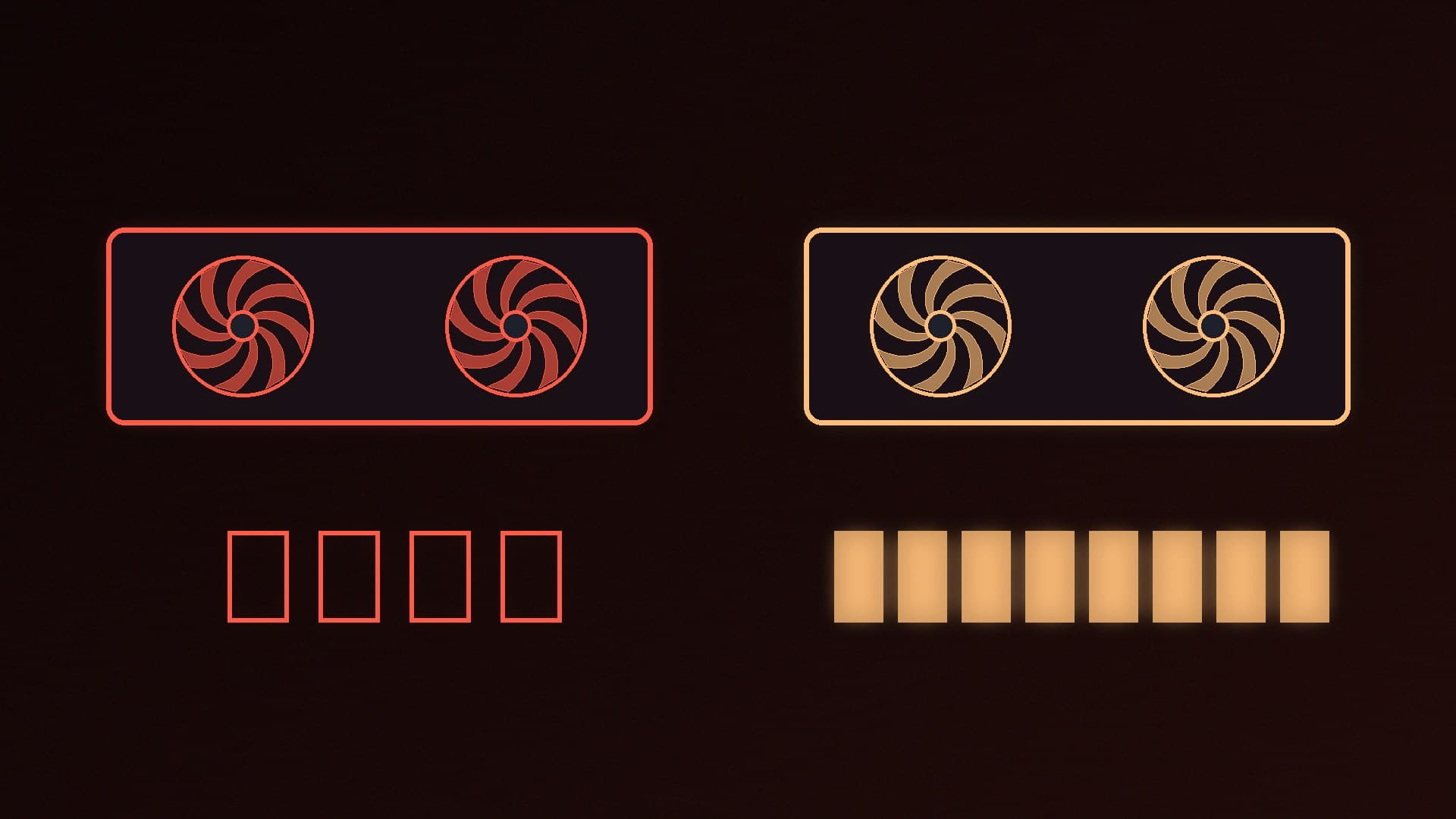
The Radeon RX 9060 XT is AMD's mainstream RDNA 4 graphics card, and it comes in two versions with the same name: one with 8GB of GDDR6 memory and one with 16GB. On 16 November 2026 the cheapest 8GB card was about £130 cheaper than the cheapest 16GB card in the UK, which makes the 8GB version tempting on a tight budget.
Forge PC hasn't tested these cards. Specifications come from AMD's official RX 9060 XT page, performance findings are TechSpot's independent test results, and prices are approximate UK prices from SpecPrice's listings viewed on 16 November 2026.
What's the same, and what's different
Apart from memory capacity, the two versions share the same core specification. AMD's RX 9060 XT page lists:
Specification | RX 9060 XT (both versions) |
|---|
Compute units / stream processors | 32 / 2,048 |
Game / boost clock | 2,530MHz / up to 3,130MHz |
Memory type and bus | GDDR6, 128-bit |
Memory speed / bandwidth | up to 20Gbps / up to 320GB/s |
Infinity Cache | 32MB |
Interface | PCIe 5.0 x16 |
Minimum PSU recommendation | 450W |
The only headline difference is 8GB or 16GB of VRAM. Board partners' factory-overclocked cards may run slightly higher clocks, but the memory amount is the thing that matters.
Why the memory matters
When a game needs more video memory than the card has, the extra data spills into your system RAM and has to travel over the PCIe bus. AMD lists up to 320GB/s of memory bandwidth for the 9060 XT's own memory, while TechSpot notes that a PCIe 4.0 x16 slot provides 64GB/s and PCIe 3.0 x16 half that, 32GB/s. That bottleneck is why running out of VRAM can cause sudden drops in frame rate and stuttering rather than a gentle slowdown. Our guide to how much VRAM you need explains this in more detail, and you can see how much your games use with our VRAM usage guide.
What independent testing found
TechSpot tested both versions at 1440p with upscaling and high presets. Some of its findings:
On a fast Ryzen 7 9800X3D system with PCIe 5.0, the 16GB card was 17% faster on average in TechSpot's Doom test and 22% faster in The Last of Us Part II, with much better 1% lows. The 8GB card was still usable in those tests.
In heavier tests the gap grew dramatically. In Indiana Jones and the Great Circle, the 8GB card had to use a lower texture setting and was still 45% slower; with both on the same top preset later in the game, the 16GB card was 184% faster. Path tracing wasn't available at all on the 8GB card.
When TechSpot moved to an older Core i7-8700K system limited to PCIe 3.0 and DDR4, the 16GB card was 52% faster on average and 190% faster in 1% lows.
In a follow-up PCIe test, TechSpot concluded that "16GB is sufficient, 8GB is not", and warned that many budget motherboards drop the main graphics slot to x8 when a second slot is used, which halves the bandwidth available when VRAM runs out.
These are TechSpot's results; your games, settings and PC will differ.
UK prices
On 16 November 2026, SpecPrice listed the cheapest RX 9060 XT 8GB at about £450 (a PowerColor Reaper at Scan) and the cheapest RX 9060 XT 16GB at about £580 (an ASUS Prime OC at Scan). That's a gap of about £130, or roughly 29%.
For comparison, the PowerColor RX 9060 XT 16GB Reaper and ASUS RX 9060 XT 16GB Dual are both in our specs database. If you're also considering NVIDIA, our RX 9060 XT vs RTX 5060 Ti 16GB comparison and RTX 5060 Ti 8GB vs 16GB cover the same dilemma.
Which should you buy?
Buy the 16GB version if: you play new AAA games, game at 1440p, want to keep the card for several years, or have an older PCIe 3.0 motherboard. It's the safer buy for almost everyone.
Consider the 8GB version only if: you mainly play esports and older games at 1080p, you're happy to lower texture settings, and the saving is what makes the build possible. Check that your motherboard runs the card at PCIe 4.0 or 5.0 x16.
Check prebuilt PCs carefully. TechSpot notes that many 8GB cards end up in prebuilt systems advertised simply as "RX 9060 XT", so check the VRAM in the specification before buying a complete PC.
Our verdict
The RX 9060 XT 8GB and 16GB use the same GPU, but TechSpot's testing shows the 8GB card falling well behind, and sometimes becoming unplayable, once games exceed its memory, especially on PCIe 3.0 systems. At about £450 against about £580 on 16 November 2026, the 16GB card is worth the extra £130 for most buyers. Only choose the 8GB version for 1080p esports and older games on a modern PCIe 4.0 or 5.0 platform. Forge PC hasn't tested these cards; performance findings are TechSpot's.