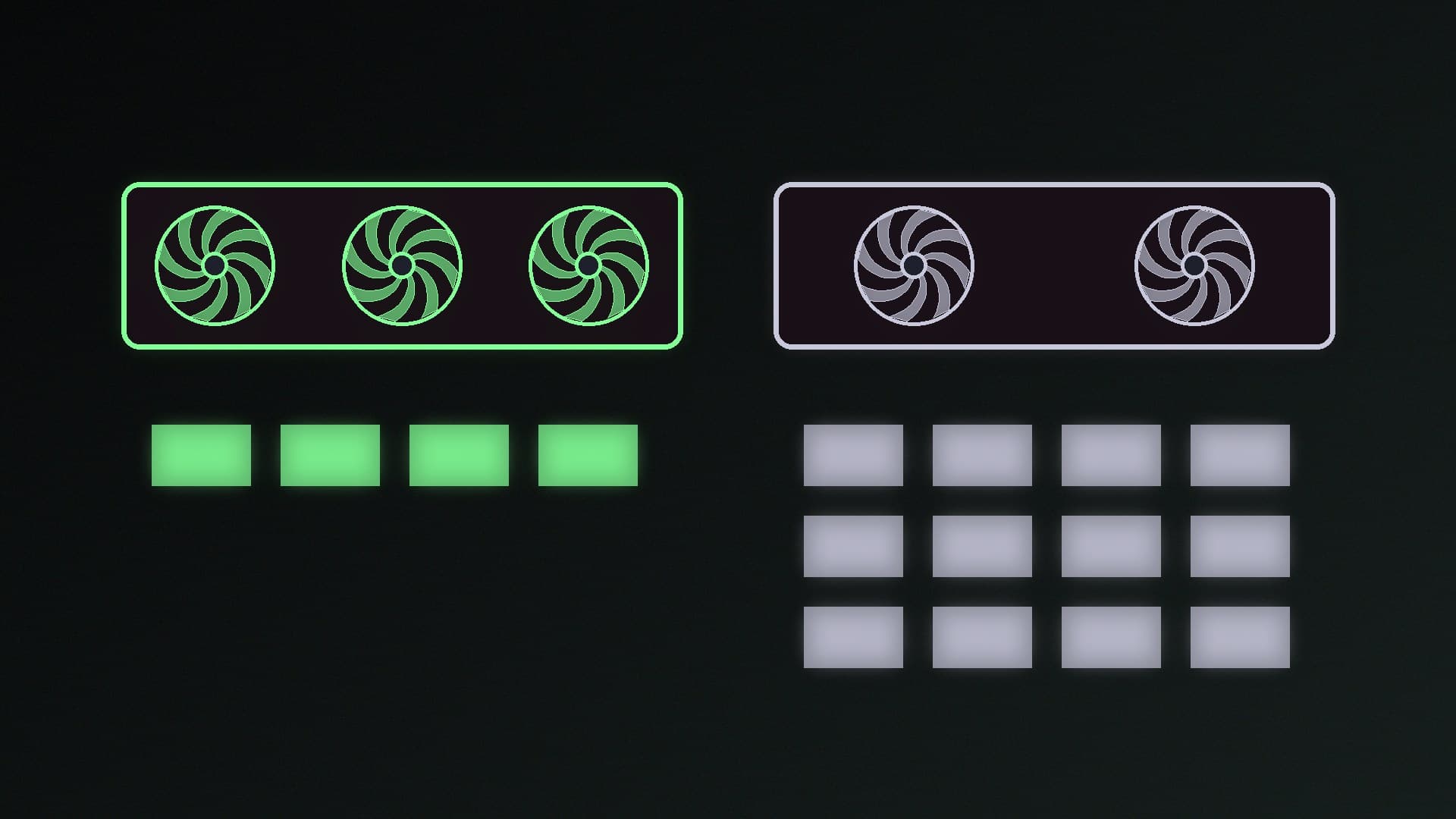
If you want to run large AI models on a single desktop graphics card, two NVIDIA Blackwell cards sit at the top: the GeForce RTX 5090 with 32GB of GDDR7, and the RTX PRO 6000 Blackwell Workstation Edition with 96GB. They share an architecture, but the PRO 6000 has three times the memory, which for local language models is often the number that matters most.
Forge PC hasn't tested either card. This comparison uses NVIDIA's official RTX 5090 specifications, the RTX PRO 6000 Blackwell Workstation Edition product page and datasheet, Ollama's model library for download sizes, and UK listings from SpecPrice and Scan checked on 17 November 2026. We haven't run AI benchmarks, so this is about what fits, not measured speed.
Specifications compared
| GeForce RTX 5090 | RTX PRO 6000 Blackwell Workstation Edition |
|---|
Architecture | Blackwell | Blackwell |
CUDA cores | 21,760 | 24,064 |
Memory | 32GB GDDR7 | 96GB GDDR7 with ECC |
Memory interface / bandwidth | 512-bit | 1,792GB/s |
AI TOPS (NVIDIA peak figure) | 3,352 | 4,000 (FP4 with sparsity) |
Power | 575W total graphics power | 600W max power consumption |
Multi-instance GPU | No | Yes (Universal MIG) |
Drivers | Game Ready and Studio | Enterprise drivers |
Approximate UK price (17 Nov 2026) | From about £7,599.99 (cheapest listing on SpecPrice, AWD-IT) | Scan lists it as "Call for price" |
NVIDIA's TOPS figures are theoretical peaks; the PRO 6000 datasheet notes its figure is FP4 with sparsity. Don't read them as real-world tokens-per-second.
What 96GB lets you run
For local language models, the whole model and its context cache ideally sit in VRAM. Once they spill into system RAM, speed drops sharply. That's why capacity matters more than CUDA core count for many local AI users; our context length and VRAM explainer goes into detail.
A few examples from Ollama's library show the difference:
gpt-oss 20B is a 14GB download, which fits comfortably on the RTX 5090 with room for context.
Llama 3.3 70B is a 43GB download at Ollama's default quantisation. That's too big for 32GB of VRAM without offloading part of it to system RAM, but fits on 96GB.
gpt-oss 120B is a 65GB download. Ollama's page notes that OpenAI quantised it so the larger model can fit on a single 80GB GPU; that rules out the RTX 5090 alone but suits the PRO 6000.
In other words, the RTX 5090 suits models whose download is comfortably under 32GB, such as gpt-oss 20B, while the PRO 6000 opens up 70B-class dense models such as Llama 3.3 70B and larger mixture-of-experts models such as gpt-oss 120B on one card. Our best local LLM models guide suggests models for each VRAM tier.
The PRO 6000's other advantages are aimed at businesses. Its memory has error-correction code (ECC), which protects against data corruption over long runs. NVIDIA says Universal MIG lets one card be split into multiple isolated instances, each with its own memory and compute, so several users or jobs can share it. NVIDIA's datasheet also highlights enterprise drivers and ISV certifications for professional software.
The RTX 5090, by contrast, is a gaming card first: NVIDIA calls it "the most powerful GeForce GPU ever made", it supports DLSS 4 with Multi Frame Generation and Game Ready drivers, and it's the better choice if the same PC is also your gaming machine.
Power and practicality
Both cards are big and power-hungry. NVIDIA lists 575W total graphics power for the RTX 5090 and 600W maximum for the PRO 6000, so either needs a high-quality, high-wattage power supply with a native 12V-2x6 connector and a case with strong airflow. See our guide to connecting a 12V-2x6 cable safely and our best 1000W power supply picks.
Price and alternatives
In the UK, the RTX 5090 is very expensive right now: SpecPrice's tracker, updated at 10:56 GMT on 17 November 2026, put the cheapest listing at £7,599.99 at AWD-IT. Scan lists the retail PNY RTX PRO 6000 Blackwell Workstation Edition as "Call for price", so expect to request a quote.
If you don't need 96GB on one card, there are alternatives: two smaller cards (see how to run a local LLM on two GPUs), AMD's 32GB Radeon AI PRO R9700 (our R9700 vs RTX 5090 comparison), or a unified-memory system such as DGX Spark or a Ryzen AI Max+ mini PC, which offer more memory at much lower bandwidth.
Our verdict
The RTX PRO 6000 Blackwell is the card to choose if you need large models on one GPU: 96GB of ECC GDDR7 runs 70B-class models and gpt-oss 120B without offloading, and MIG lets teams share it. The RTX 5090 has a third of the memory but is a capable 32GB card for models such as gpt-oss 20B and doubles as NVIDIA's most powerful GeForce gaming card. With the 5090 from about £7,600 in the UK and the PRO 6000 quote-only at Scan, get quotes before deciding. Forge PC hasn't tested either card.