Skip to content

VersusCase

HYTE Y60 vs Y70: Which Panoramic Glass Case Should You Buy?

HYTE's Y60 and Y70 both put a vertical graphics card behind panoramic glass, but they suit very different hardware. Using HYTE's specs, we compare GPU length and thickness limits, cooler height, radiator support, included fans and size so you can pick the right case for your build.

By , Senior Hardware Editor

4 min read

HYTE Y60 vs Y70: Which Panoramic Glass Case Should You Buy?
HYTE Y60 Mid Tower Case Black compared with HYTE Y70 Mid Tower Case Black
HYTE Y60 Mid Tower Case BlackHYTE Y70 Mid Tower Case Black
Case TypeMid TowerMid Tower
Supported Motherboard Form FactorsATX, Micro-ATX, Mini-ITXATX, Micro-ATX, Mini-ITX
PSU Form Factor SupportATXATX
Max GPU Length (mm)400400
Max CPU Air Cooler Height (mm)160160
Max PSU Length (mm)200200
Cable Management Clearance (mm)2525
Max Radiator Front360mm360mm
Max Radiator Top240mm240mm
Max Radiator Rear120mm120mm
Max Fan Support (Front)33
Max Fan Support (Top)22
Max Fan Support (Rear)11
Max Fan Support (Bottom)11

HYTE's Y60 and Y70 look like the same idea at two sizes: dual-chamber ATX mid-towers with three-piece panoramic glass, a vertically mounted graphics card and an included PCIe 4.0 riser. Look at the spec sheets side by side, though, and they're built for quite different hardware. The Y70 takes much bigger graphics cards, taller air coolers and thicker radiators, while the Y60 is smaller and comes with fans in the box. We've compared them using HYTE's official specifications.

Specs side by side

Specification

HYTE Y60

HYTE Y70

Type

Dual-chamber mid-tower ATX

Dual-chamber mid-tower ATX

Dimensions

456 x 285 x 462mm

470 x 320 x 470mm

Volume

60L

70.7L

Motherboards

EATX, ATX, mATX, ITX

ITX, mATX, ATX, EATX

Max GPU length

375mm

422mm

Max GPU thickness

75mm (60mm or less recommended)

105mm

Max CPU cooler height

160mm

180mm

Max PSU length

235mm (ATX)

235mm

Expansion slots

3 + 7 half-height

7 half + 4 full height

Riser

PCIe 4.0 x16, included

PCIe 4.0 x16, included

Included fans

3x 120mm (2 bottom, 1 rear)

None listed in HYTE's spec table

Front I/O

2x USB 3.0, 1x USB 3.2 Gen 2 Type-C, audio

2x USB-A 3.2 Gen 1, 1x USB-C 3.2 Gen 2, audio/mic combo

Storage

2x 3.5in or 4x 2.5in

2x 3.5in or 4x 2.5in

Graphics card fit is the biggest difference

Both cases mount the graphics card vertically by design. HYTE's support page for the Y60 says it's deliberately built around a vertical GPU and can't be converted to a standard horizontal layout, and the Y70 also uses a vertical mount with an included riser. That makes GPU thickness, not just length, the number to check.

The Y60 lists a maximum of 375mm long and 75mm thick, and HYTE recommends 60mm or less for the best cooling. That's because a vertical card's fans face the side glass, so a thick card leaves little room to breathe. The Y70 raises those limits to 422mm and 105mm, and HYTE markets it around "massive 4 slot vertical graphics". If you own, or plan to buy, a large triple-fan card, compare its thickness with these figures before anything else.

Cooling: Y60 is ready to go, Y70 has more room

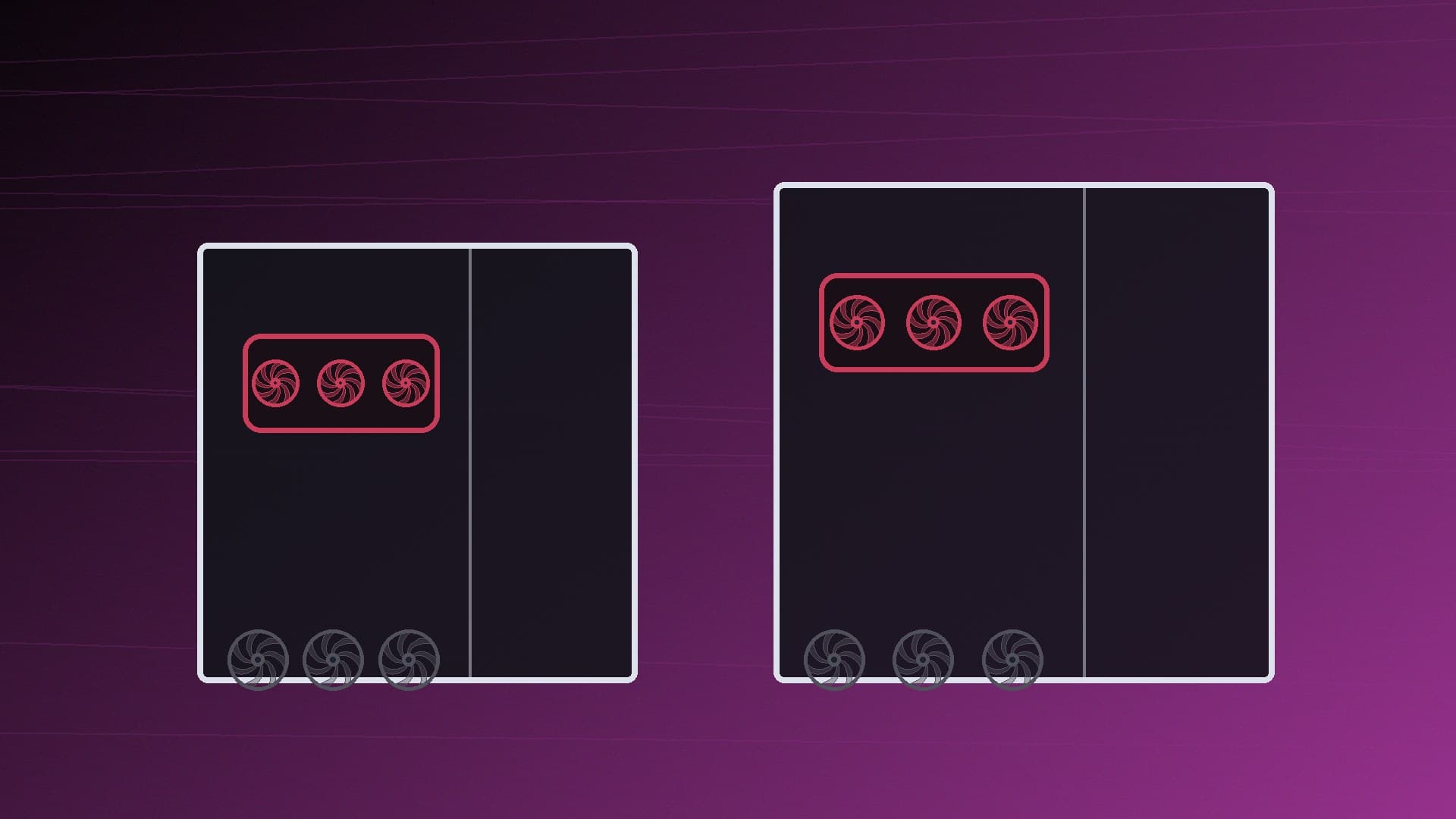
The Y60 comes with three pre-installed 120mm fans: two beneath the floor and one at the rear. HYTE says the bottom fans draw air up and over the graphics card. It supports a 240mm or 280mm side radiator up to 150mm thick (with a standard ATX board) and a 360mm top radiator, but the top mount is limited to radiators 30mm thick. HYTE also recommends adding two more intake fans on the side mount if you use an air cooler rather than liquid cooling.
The Y70 is built for more. It supports a 360mm radiator on the side (up to 125mm thick) and another 360mm radiator up top up to 68mm thick, with room for up to ten fans in total according to HYTE. Air coolers up to 180mm tall fit, compared with 160mm in the Y60. The catch is that HYTE's Y70 spec table doesn't list included fans, so budget for fans when you're pricing up a build, and check the exact listing you're buying.

If you're planning a dual-tower air cooler, the 20mm difference in cooler height matters: DeepCool's dual-tower AK620, for example, is exactly 160mm tall, so see our guide on checking CPU cooler clearance before assuming one will fit the Y60. For liquid cooling, our best PC case for a 360mm radiator roundup lists other options.

Expansion and size

Because the graphics card stands upright, both cases put half-height expansion slots behind it for cards such as capture cards or sound cards. The Y60 lists three full slots plus seven half-height; the Y70 lists seven half-height plus four full-height. The Y70 is wider (320mm against 285mm), 14mm longer and 8mm taller, and 10.7 litres larger overall, so measure your desk space if you're tight for room. Both take ATX power supplies up to 235mm long.

HYTE's Y70 page also lists a four-year warranty and a Touch Infinite version with an integrated display. We've linked both the standard Y70 and the Touch Infinite in our database below.

Which should you buy?

Choose the HYTE Y60 if your graphics card is 60mm thick or less, you'll use an AIO or a modest air cooler under 160mm, and you want fans included.

Choose the HYTE Y70 if you have a thick high-end card, want to run a tall dual-tower air cooler or two 360mm radiators, or simply want more working room. The Y70 Touch Infinite adds the integrated display. For HYTE's wider range, see our best HYTE PC case guide, and for a broader shortlist, our best PC case roundup.

The bottom line

The HYTE Y60 and Y70 share the same panoramic-glass, vertical-GPU design, but the Y70 is the one to buy for big hardware: it takes graphics cards up to 105mm thick and 422mm long, air coolers up to 180mm and a 360mm radiator on both the side and top. The Y60 is the better fit for a smaller build with a slimmer card (60mm or less is HYTE's recommendation) and an AIO or compact air cooler, and it comes with three fans, whereas HYTE's Y70 spec table lists none.

Sources

  1. 01HYTE, Y60 product page and tech specs
  2. 02HYTE, Y70 product page and tech specs
  3. 03HYTE Support, Meet The Y60
  4. 04DeepCool, AK620 specifications

About the author

Callum Reid

Senior Hardware Editor

Callum leads GPU, CPU and platform architecture coverage at Forge PC. Before joining the editorial desk, he spent nine years specifying, assembling and stress-testing custom gaming and workstation systems in the UK, with a focus on PCIe bandwidth, VRM thermal design, DDR5 memory tuning and 1440p/4K frame-time consistency.

More from Callum Reid

Read next

Fractal North vs North XL: Which Wood-Front Case Should You Buy?

Versus

Fractal North vs North XL: Which Wood-Front Case Should You Buy?

Fractal Design's North and North XL share the same wood-front, mesh-panel design and front I/O, but the XL takes 185mm air coolers, 420mm front radiators, 413mm graphics cards and E-ATX boards. Using Fractal's spec sheets, we compare size, cooling and compatibility to help you choose.

Callum Reid4 min

Alphacool Launches Apex Distro Plate for the Phanteks NV9 MKII

News

Alphacool Launches Apex Distro Plate for the Phanteks NV9 MKII

Alphacool has launched the Apex Distro Plate NV9 MKII, a front-panel distribution plate for custom water loops in Phanteks' NV9 MKII full-tower case. It has 15 brass G1/4 ports, a universal D5/VPP and DDC pump mount, aRGB lighting and black and white panels. Here's what it includes, what it fits and what to know before buying.

Eleanor Shaw2 min

Corsair WS 3200D RS Workstation Case Adds Steel Panels, TORX Screws and a Kensington Slot

News

Corsair WS 3200D RS Workstation Case Adds Steel Panels, TORX Screws and a Kensington Slot

Corsair has launched the WS 3200D RS WORKSTATION, a mid-tower case based on its 3200D RS with steel side panels, a Kensington lock slot, TORX security screws, E-ATX support, four RS120 fans and 360mm radiator support. It costs $79.99 in the US, and Scan lists it at about £79.99 (checked 27 November 2026) with stock due in January 2027.

Eleanor Shaw3 min

NZXT H5 vs H7 (2026): Which Curved-Glass NZXT Case Should You Buy?

Versus

NZXT H5 vs H7 (2026): Which Curved-Glass NZXT Case Should You Buy?

NZXT's 2026 H5 and H7 both use a single curved glass panel across the front and side, but the H7 is far bigger. We compare them on NZXT's official specs: size and volume, GPU and cooler clearance, 360mm vs 420mm radiators, fan support, glass tops and the RGB+ versions.

Callum Reid5 min