This comparison is based on Google's Chrome for Developers documentation and Microsoft's Edge developer documentation, both read on 25 November 2026.
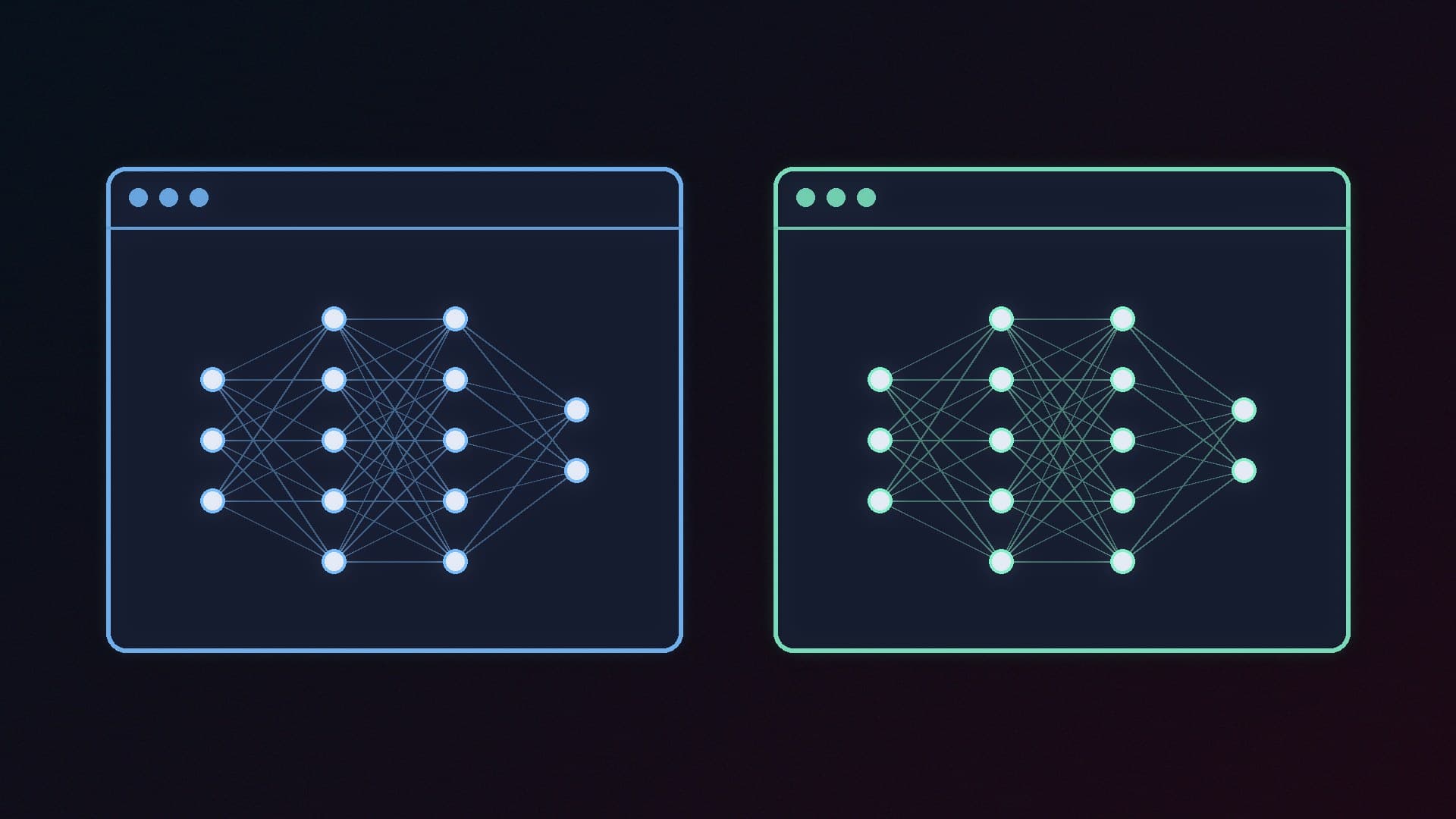
Your web browser may already be running a language model on your PC. Google Chrome ships with access to Gemini Nano, and Microsoft Edge now uses Aion Instruct, a 2.3-billion-parameter small language model from Microsoft. In both cases the browser downloads the model once, keeps it on your drive, and lets websites and extensions use it through JavaScript APIs such as the Prompt API, without sending your text to a cloud service.
For PC owners, this raises practical questions. Will my hardware run it? How much drive space does it take? Can I turn it off? This piece answers those from each company's official requirements. If you want the wider browser comparison, see our Chrome vs Edge article.
At a glance
| Chrome: Gemini Nano | Edge: Aion Instruct |
|---|
Model | Gemini Nano (Google doesn't give a parameter count in these docs) | Aion Instruct, 2.3B parameters |
Operating systems | Windows 10/11, macOS 13+, Linux, ChromeOS on Chromebook Plus | Windows 10/11, macOS 13.3+, 64-bit Linux with Vulkan GPU drivers (Edge 159+) |
Free space needed | At least 22GB on the profile drive | At least 20GB on the profile drive |
Model removed if free space falls below | 10GB | 5GB |
GPU route | Strictly more than 4GB of VRAM | 3GB of VRAM or more |
CPU-only route | Yes: 16GB of RAM and 4 or more CPU cores | Not listed |
Network for first download | Unlimited or unmetered | Unlimited or unmetered |
Prompt API status | Stable for websites from Chrome 148 (extensions from Chrome 138) | Developer preview and origin trial, Edge 158+ |
Check your device | chrome://on-device-internals
| edge://on-device-internals (Device performance class)
|
The free-space figures are thresholds for downloading, not the size of the model. Google says the built-in models "should be significantly smaller" than 22GB and that the exact size varies with updates. You can see the current size of Gemini Nano at chrome://on-device-internals.
Hardware: Chrome is more flexible, Edge asks less of your GPU
Chrome gives two ways in. If your graphics card or integrated GPU has strictly more than 4GB of VRAM, the model can run on the GPU. If not, Chrome can run it on the CPU, provided the PC has at least 16GB of RAM and four or more CPU cores. That CPU route means a lot of ordinary desktops without a strong GPU still qualify. The one exception Google lists is that the Prompt API with audio input requires a GPU.
Edge's published requirement is simpler: a GPU with 3GB of VRAM or more. That's a lower VRAM bar than Chrome's GPU route, so an older 4GB graphics card that misses Chrome's "more than 4GB" cut-off meets Edge's figure. Microsoft's documentation doesn't list a CPU-only fallback for the developer preview, so a PC with no suitable GPU may not qualify. Microsoft also says you may see issues on specific hardware configurations while the API is experimental.
Linux users should note that Edge's Linux support needs Vulkan GPU drivers and Edge 159 or later.
Storage: plan for the free-space rule
Both browsers need a large chunk of free space on the drive that holds your browser profile, normally your C: drive on Windows: 22GB for Chrome and 20GB for Edge. Both also delete the model if space later runs low: Chrome below 10GB free, Edge below 5GB. Chrome says it will download the model again once the requirements are met.
On a PC with a nearly full boot SSD, that can mean the model quietly disappears and comes back. If you use these features, keep a healthy amount of space free. Both companies describe the download as happening the first time a website or extension uses the built-in AI APIs.
What each model can do today
Chrome has the more mature set of APIs. Google's status table lists the Translator, Language Detector and Summarizer APIs as available in stable Chrome from version 138, and the Prompt API as available to websites from Chrome 148 and to extensions from Chrome 138. The Writer, Rewriter and Proofreader APIs are still in trials. Google says the Translator and Language Detector APIs use separate "expert" models, while the rest use the language model. From Chrome 149, Google says the models support English, Spanish, Japanese, German and French for input and output text. The Prompt API is multimodal; the writing APIs are text only.
Edge's Prompt API is a developer preview. You can try it on your own PC by enabling the Prompt API flag at edge://flags in Edge 158 or later, and site owners can register for an origin trial. Microsoft lists related experimental APIs for summarising, writing, proofreading, language detection, translation and a "Decisions" classification API. From Edge 158, Microsoft says text generated by the Prompt API carries an invisible watermark marking it as AI-generated, except when the output is constrained with a JSON schema or regular expression.
Microsoft is upfront that a model of this size "can potentially behave in ways that are unreliable, inaccurate, unfair, or offensive". The same caution applies to any small on-device model, including Gemini Nano.
Privacy and control
Both companies say the text you give the model stays on your device after the initial download. Google states that "no data is sent to Google or any third party when using the model", and Microsoft says input "never leaves the device, and isn't collected to train AI models".
In Edge, the model is unavailable if you turn off the On-device AI option under Settings > Copilot and AI, and IT departments can block the download with the GenAILocalFoundationalModelSettings or ComponentUpdatesEnabled policies. In Edge Canary, Dev and Beta, Microsoft turns On-device AI off by default so each channel doesn't download its own copy.
How to check whether your PC qualifies
Chrome: go to chrome://on-device-internals. Google's troubleshooting steps use the Broker State tab to check for errors, and running LanguageModel.availability(); in the DevTools console should return available once the model is ready.
Edge: go to edge://on-device-internals and look at Device performance class. Microsoft says a class of Medium or greater should support the Prompt API.
If you'd rather run a model of your own choosing in the browser, see how to run an LLM in your browser with WebLLM. For a bigger, more capable model, a desktop app is still the better route; our guide to running AI models locally with Ollama and LM Studio is the place to start.
Which should you choose?
Choose Chrome's Gemini Nano if you want the broadest hardware support, including PCs with no capable GPU but 16GB of RAM, and the most finished set of APIs.
Choose Edge's Aion Instruct if you already use Edge, have a GPU with 3GB to 4GB of VRAM that misses Chrome's GPU threshold, or are tight on drive space, since Edge removes its model at a lower free-space level. Developers should treat it as a preview for now.
Neither is a reason to switch browser on its own. Both models are small, and their quality and speed will vary with your hardware; we'd want to see independent testing before ranking one above the other.
Our verdict
Chrome's Gemini Nano is the more usable built-in browser model today: it runs on a GPU with more than 4GB of VRAM or on a CPU with 16GB of RAM, and its Prompt API is in stable Chrome. Edge's Aion Instruct needs only 3GB of VRAM and slightly less free space, but its Prompt API is still a developer preview and there's no listed CPU-only route. Both keep your text on your PC after the first download, both need around 20GB of free space on your profile drive, and both delete the model if that space runs low. Check on-device-internals in either browser to see whether your PC qualifies.