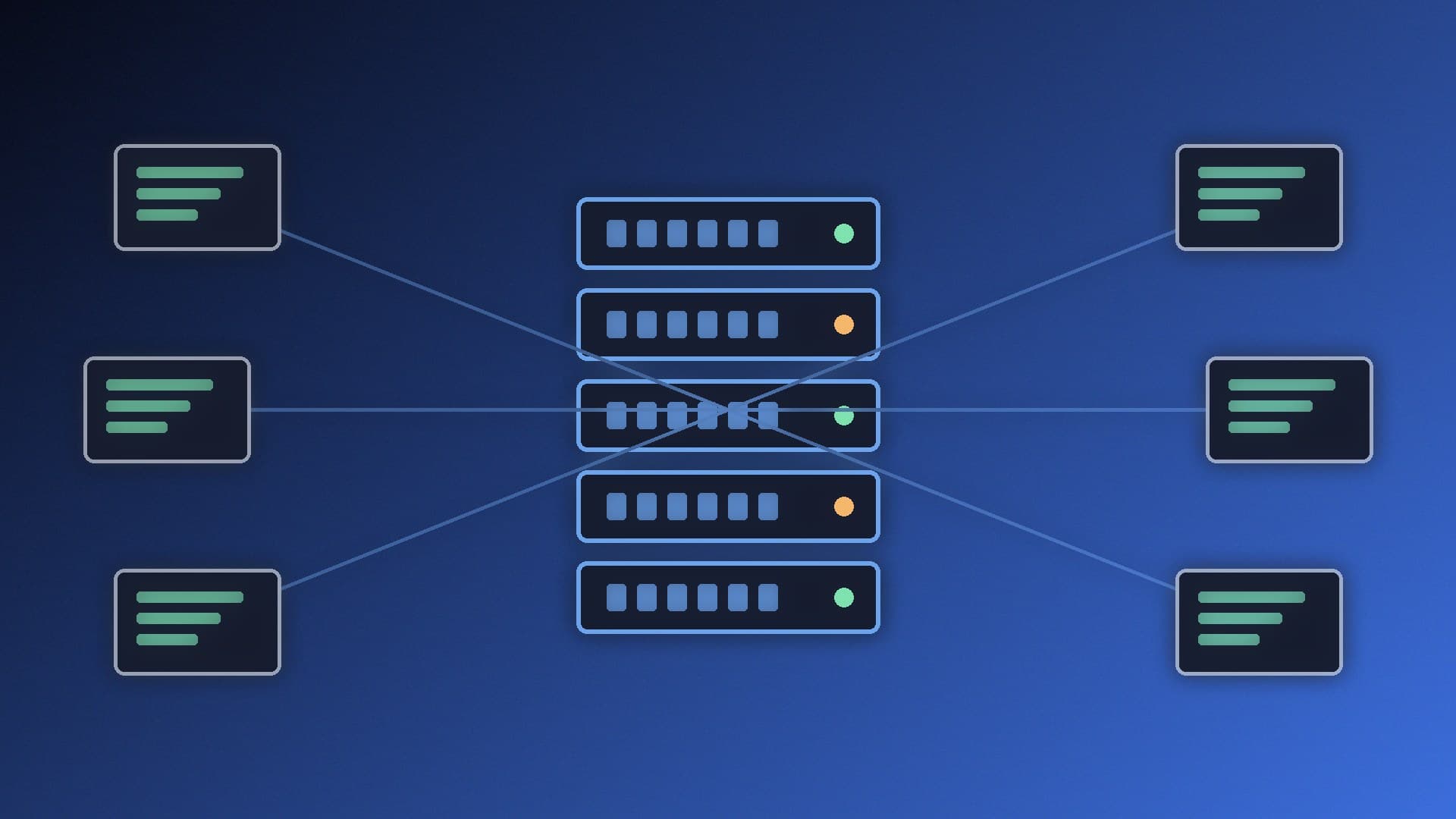
Most people start local AI with a chat app. Sooner or later, though, you want the model to run as a service: something that sits in the background, loads models on demand and answers requests from a front end, a coding assistant, a home automation system or another PC on your network. That's the job of LLM server software, and there are now several good, free options.
This guide ranks the main ones by who they suit. Everything below comes from each project's official documentation and GitHub pages, read on 27 November 2026.
Our picks at a glance
Server | Best for | API styles (per official docs) | Default address |
|---|
Ollama | Most people | Ollama REST API, OpenAI and Anthropic compatibility | 127.0.0.1:11434 |
llama.cpp (llama-server) | Control and efficiency | OpenAI-compatible, Anthropic Messages | 127.0.0.1 (configurable) |
LM Studio (llmster) | LM Studio users | OpenAI and Anthropic compatible, REST API | Set in LM Studio |
Lemonade | AMD Ryzen AI and Radeon | OpenAI, Anthropic and Ollama APIs | localhost:13305 |
KoboldCpp | One-file setup, creative use | KoboldAI, OpenAI, Anthropic, Ollama and more | localhost:5001 |
vLLM | Many users at once | OpenAI-compatible, Anthropic Messages, gRPC | Set at launch |
SGLang | Agents and large-scale serving | See project docs | Set at launch |
Best for most people: Ollama
Ollama is one of the easiest ways to get a model server running. It runs as an app on Windows and macOS (which update themselves, according to its FAQ) or is installed with a script on Linux, and once it's running it exposes a REST API for running and managing models at http://localhost:11434. Its documentation also lists OpenAI compatibility and Anthropic compatibility, so tools written for those cloud APIs can often be pointed at Ollama instead.
The safe default is worth knowing about: Ollama's FAQ says it binds to 127.0.0.1 on port 11434, so only the PC it's running on can reach it. You change the bind address with the OLLAMA_HOST environment variable, for example 0.0.0.0:11434, which is what you need to share it with other devices. Our guide to sharing Ollama on your local network walks through that, and our pick of the best Ollama front ends covers the apps you can put on top.
Choose Ollama if you want a model service that just works, with the widest choice of compatible apps.
Best for control: llama.cpp's llama-server
llama.cpp is the open-source engine whose code is bundled in other tools, including KoboldCpp, and its own llama-server is a capable server in its own right. The official README lists OpenAI API-compatible chat completions, responses and embeddings routes, Anthropic Messages API-compatible chat completions, a reranking endpoint, parallel decoding with multi-user support, multimodal input and speculative decoding.
It also has sensible security switches. By default --host listens on 127.0.0.1, and --api-key lets you require a key, with several keys allowed as a comma-separated list. A built-in chat app called Llama Chat is enabled by default, and a router mode (--models-dir) lets one server offer several models. We cover that in how to run multiple models with llama-server's router.
The trade-off is that you work from the command line and choose your own GGUF model files and settings. Start with our guide to running llama.cpp on Windows, and see llama.cpp vs Ollama if you're torn between the two.
Choose llama-server if you want every setting exposed and don't mind a terminal.
Best for LM Studio users: llmster
If you already download and test models in LM Studio, you don't need a second tool to run them as a service. LM Studio's documentation describes llmster as the core of the desktop app, packaged to be server-native without the GUI, so it can run on Linux boxes, cloud servers, GPU rigs or your own machine. You install it with a one-line script (there are commands for Linux and Mac, and a PowerShell command for Windows) and start it with lms daemon up.
Alternatively, the desktop app itself can run headless: LM Studio has a setting to run the LLM server on login, and closing the app then leaves the server running in the system tray. With just-in-time (JIT) loading turned on, a request to the OpenAI-compatible /v1/models endpoint returns every downloaded model, and inference requests load a model if it isn't already in memory. Our guide to running LM Studio headless with llmster has the full steps.
Choose llmster if LM Studio is already your model library.
Best for AMD Ryzen AI and Radeon: Lemonade
Lemonade describes itself as a local AI server that serves optimised models from your own GPUs and NPUs, covering chat, coding, speech and image generation. Its GitHub page says it installs a service that apps can connect to using standard OpenAI, Anthropic and Ollama APIs, with a default API base of http://localhost:13305/api/v1 in its examples.
What sets it apart is hardware support aimed at AMD systems: the project lists CPU, AMD integrated and discrete GPUs, AMD ROCm GPU families including Strix Halo (gfx1151) and the Radeon AI PRO R9700, and NPU support. It also lists NVIDIA GPUs from Turing onwards. See how to run local AI with Lemonade Server to get started.
Choose Lemonade if you have a Ryzen AI laptop or mini PC, or a Radeon card.
Best one-file option: KoboldCpp
KoboldCpp's tagline is "One File. Zero Install." Its GitHub page describes a single standalone executable for Windows, Linux or macOS with no installation and no external dependencies, running on CPU or GPU with full or partial offloading. It serves a web UI at http://localhost:5001 and offers compatible endpoints for KoboldAI, OpenAI, Ollama, A1111/Forge, ComfyUI, Whisper transcription, XTTS and OpenAI speech clients. The project also lists MCP server support and tool calling.
Its bundled KoboldAI Lite web UI includes memory, world info, characters, scenarios and persistent story saves, and can import Tavern character cards, so it suits storytelling and role-play set-ups where one program handles text, images and speech. Our guide on how to use KoboldCpp explains the launcher.
Choose KoboldCpp if you want a portable server you can run from a folder.
Best for many users: vLLM
vLLM is built for serving rather than for one person chatting. Its documentation highlights state-of-the-art serving throughput, PagedAttention, continuous batching of incoming requests, chunked prefill and prefix caching, plus an OpenAI-compatible API server with Anthropic Messages API and gRPC support. It lists support for NVIDIA GPUs, AMD GPUs and x86, Arm and PowerPC CPUs, with plugins for other hardware.
For a home PC it's more work to set up than Ollama; on Windows, our guide to installing vLLM in WSL2 shows the WSL2 route. It makes most sense when several people or agents will hit the same GPU at once.
Choose vLLM if you're serving a team, an office or a busy agent workflow.
Also consider: SGLang
SGLang describes itself as an open-source inference framework for large language, vision-language and diffusion models, optimised for agentic workloads, large-scale serving and RL rollouts. The project says it supports a wide range of GPUs, TPUs, NPUs, CPUs and Apple Silicon platforms. Like vLLM, it's aimed at serving rather than casual use, and our SGLang vs vLLM comparison explains how the two differ.
How to choose
One person, one PC: Ollama or llmster. Both are quick to set up and work with most front ends.
You want to tune everything: llama-server.
AMD Ryzen AI or Radeon hardware: Lemonade.
Portable, no installer: KoboldCpp.
Several users or agents at once: vLLM or SGLang.
Whichever you pick, keep it on 127.0.0.1 unless you need other devices to connect, and if you do open it up, use an API key where the server supports one and don't port-forward it to the internet. The same principles apply as in our guide to securing SillyTavern. How fast any of them runs depends mostly on your hardware, especially memory bandwidth, as explained in memory bandwidth and local LLM speed.
Our verdict
Ollama is the best local LLM server for most people: it's easy to install, binds to localhost by default and works with a huge range of apps through its own, OpenAI and Anthropic APIs. Choose llama.cpp's llama-server for maximum control, llmster if you already use LM Studio, Lemonade for AMD Ryzen AI and Radeon hardware, KoboldCpp for a portable one-file set-up, and vLLM or SGLang when you need to serve several users at once.