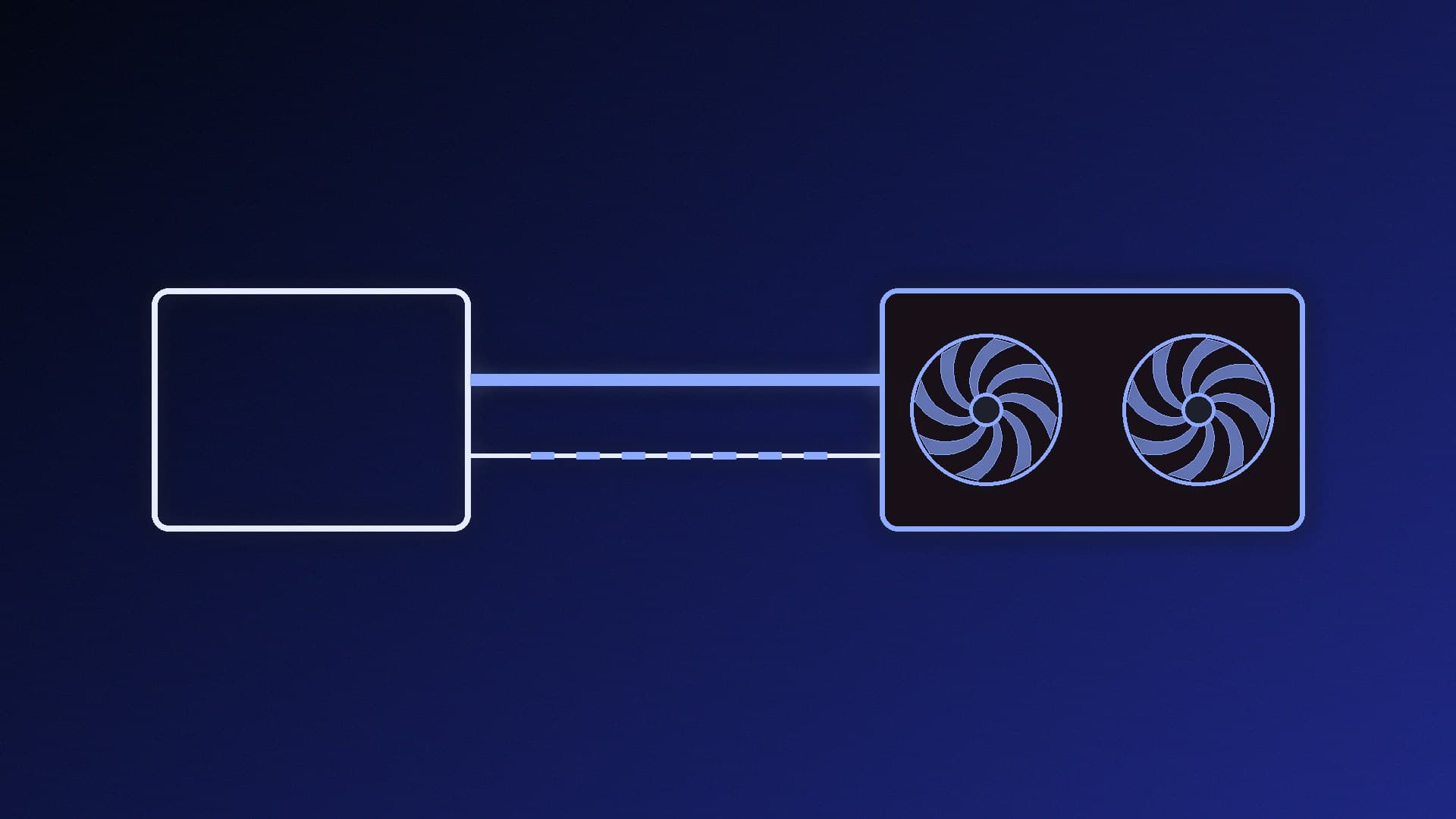
External graphics cards are having a moment, thanks to handheld gaming PCs, mini PCs and new docks with both OCuLink and USB4 ports. If your device has both, or you're choosing a mini PC partly for eGPU use, the connection matters. This comparison is based on the USB Implementers Forum's USB4 information, a dock maker's technical guide and independent testing by XDA Developers and a reviewer reported by Notebookcheck.
The short answer
| OCuLink | USB4 (40Gbps) | USB4 v2 (80Gbps) |
|---|
How the GPU connects | Direct PCIe 4.0 x4 link | PCIe tunnelled over a shared USB-C link | PCIe tunnelled over a shared USB-C link |
Nominal bandwidth | 64Gbps | 40Gbps, shared | Up to 80Gbps with 80Gbps-certified cables, shared |
Hot-plugging | No: shut down first | Yes | Yes |
Charging and peripherals over the same cable | No | Yes, depending on the dock | Yes, depending on the dock |
Availability | Some mini PCs and handhelds | Common on recent laptops and mini PCs | Newer devices only |
Bandwidth: OCuLink's big advantage
OCuLink is essentially an external cable for PCIe lanes. Minisforum's guide to its DEG2 dock describes it as a direct PCIe 4.0 x4 connection with nominal bandwidth of 64Gbps. XDA Developers notes that OCuLink can support more in theory, but that most current implementations offer around 8GB/s (64Gbps), compared with 40Gbps (around 5GB/s) for Thunderbolt 4.
USB4 works differently. According to the USB-IF, it's based on the Thunderbolt protocol and dynamically shares a single high-speed link between different types of traffic, including data and display. So PCIe traffic for your graphics card shares the link with anything else going over it. Minisforum makes the same point, saying the bandwidth available to the GPU depends on the host controller, connected devices and system configuration. USB4 v2 raises the maximum to 80Gbps over 80Gbps-certified cables, which narrows the gap on paper. Our USB4 vs Thunderbolt 5 comparison covers those standards in detail.
What independent testing shows
Results vary a lot between devices and games:
XDA Developers tested the same eGPU over OCuLink and USB4 on two machines. On a Minisforum AtomMan X7 Ti mini PC, it measured close to a 177% increase in PCIe bandwidth with OCuLink in 3DMark's bandwidth test, but only about 39% on a ONEXPLAYER X1 handheld, whose OCuLink implementation it described as poor. In games, the reviewer found OCuLink faster and smoother, but the size of the difference depended heavily on the game: small in some, very large in others.
Notebookcheck reported testing by Chinese reviewer Golden Pig Upgrade in which an RTX 4090 lost close to 23% of its performance over OCuLink when the image was sent back to the laptop's own screen. Using an external monitor connected directly to the graphics card reduced the penalty, and Notebookcheck noted the losses were still less severe than with Thunderbolt 3 and 4.
Minisforum's own guide claims OCuLink keeps GPU performance loss to 5% to 10%, compared with 20% to 35% on standard 40Gbps USB4. That's a dock maker's claim rather than an independent result, but it points in the same direction as the testing above.
One practical tip from Notebookcheck's report: plug your monitor into the external graphics card rather than using the laptop or handheld screen, so the image doesn't have to travel back over the link.
Convenience: USB4's big advantage
OCuLink only carries PCIe. Minisforum warns strongly against unplugging an OCuLink cable while the PC is running, comparing it to pulling a graphics card out of a running desktop: shut Windows down completely first. It recommends using USB4 v2 or Thunderbolt 5 instead if you need to plug and unplug a laptop while it's awake, because that supports hot-plugging.
USB4 can also carry USB data, display signals and charging over one cable. Minisforum's DEG2, for example, can charge a compatible laptop at up to 140W and connect the dock's own USB ports, network port and SSD over a single USB4 v2 cable. With OCuLink you'll typically need a second cable for charging and peripherals.
There's also availability. XDA says equipment with OCuLink support is hard to come by, and neither of its test devices came with an OCuLink cable, whereas USB4 and Thunderbolt ports are found on many modern laptops. Our best mini PC guide covers current models.
Which should you use?
Choose OCuLink if your mini PC or handheld has a proper PCIe 4.0 x4 OCuLink port, the eGPU will stay connected most of the time and you want as much of the graphics card's performance as possible, particularly for gaming on an external monitor.
Choose USB4 if you'll connect and disconnect often, want one cable for charging and peripherals, or your device simply doesn't have OCuLink. USB4 v2 at 80Gbps is the better option if both ends support it. Whichever you use, check the link afterwards with our guide to checking GPU PCIe link speed.
If you're thinking of an eGPU mainly for local AI rather than gaming, the trade-offs are different: see laptop vs desktop for local AI, and our report on the ASUS XG Core RX 9060 XT for a USB4 example.
Our verdict
OCuLink is the faster connection for an external graphics card, because it's a direct PCIe 4.0 x4 link rather than a shared, tunnelled one, and independent testing by XDA and the tests reported by Notebookcheck back that up, though the gain varies by device and game. USB4 wins on convenience: hot-plugging, charging and peripherals over one cable, and far wider device support. For a desk-bound gaming setup with an OCuLink-equipped mini PC, use OCuLink; for a laptop you unplug every day, use USB4, ideally the 80Gbps version.