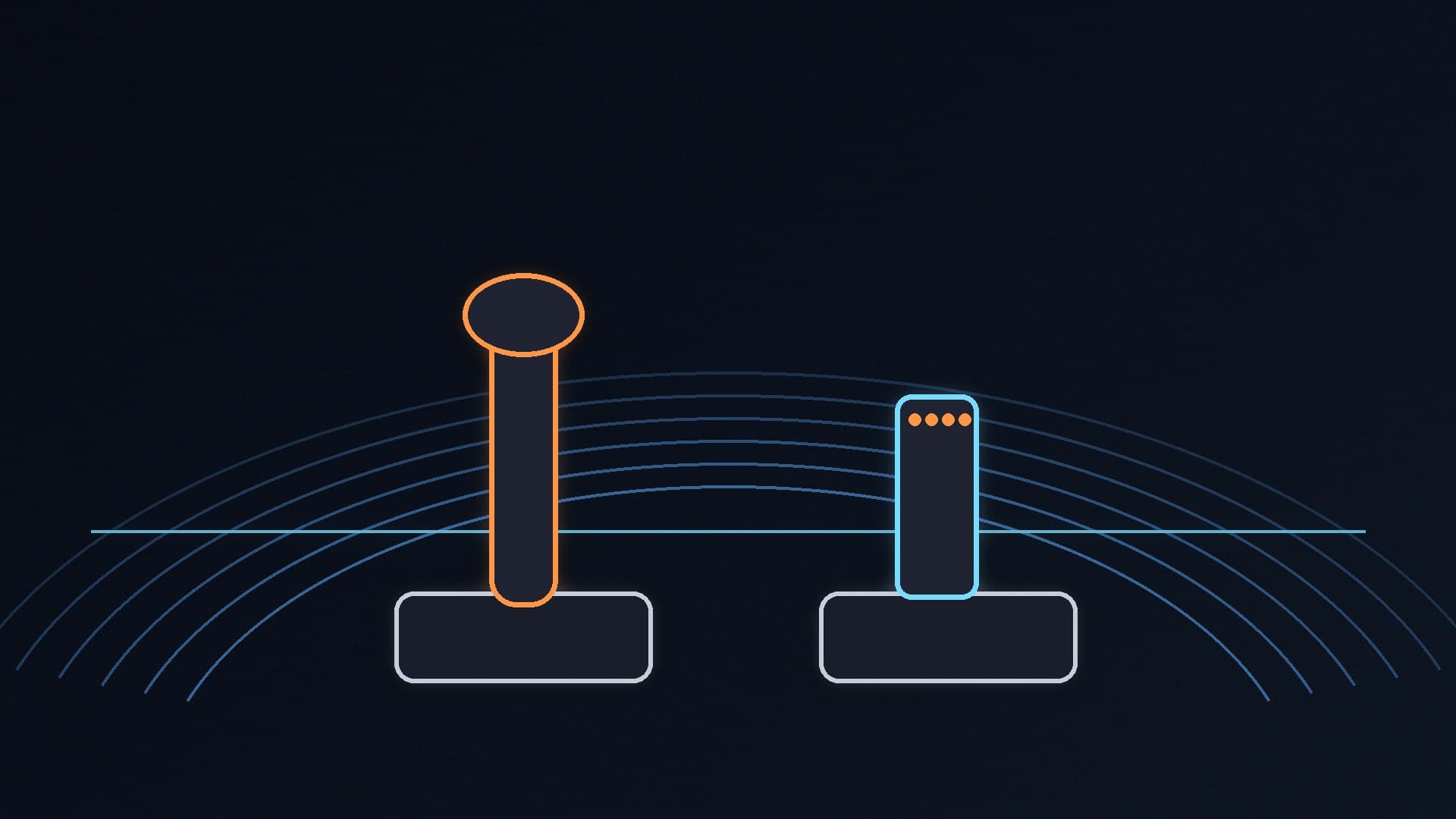
The biggest difference between a starter racing wheel and an enthusiast one isn't the rim or the buttons. It's how the motor's force reaches your hands. Wheel makers use gears, belts, a mix of the two, or put the motor directly on the steering shaft, and each approach changes how detailed the force feedback feels, how strong it can be and what you need to mount it on. It sets out how each design works, using the makers' own descriptions, and what that means when you're buying.
The short answer
| Gear-driven | Belt-driven / hybrid | Direct drive |
|---|
How force reaches the wheel | Motor turns the wheel through gears | Motor turns the wheel through a belt (hybrid designs mix belts and gears) | Motor sits on the wheel shaft, with no reduction mechanism |
Typical position in ranges | Entry level | Entry to mid-range | Upper mid-range to high end |
Example | Logitech G923 | Thrustmaster T128, T248 (hybrid) | Thrustmaster T598, Logitech RS50, Logitech PRO Racing Wheel |
Mounting | Desk clamp | Desk clamp | Desk clamp for lower-torque bases; a stand or rig makes more sense as torque rises |
Pedals in the box | Usually | Usually | Varies: the T598 includes them, both Logitech direct drive wheels don't |
Gear-driven wheels
A gear-driven wheel uses a small motor and a set of gears to multiply its force before it reaches the steering shaft. Gearing is compact and cheap, which is why it's common in starter sets. The trade-off is that the gear teeth can make the force feedback feel less smooth than in other designs.
Logitech's G923 is the best-known example on PC. Logitech describes it as gear-based, not direct drive, with closed-loop motor electronics. It adds TRUEFORCE, Logitech's own force feedback system, which Logitech says reads the game's physics and audio engines and processes that data 4,000 times per second. Logitech's point is that this gives a more accurate signal rather than more force.
Belt-driven and hybrid wheels
A belt drive uses a belt and pulleys between the motor and the wheel shaft instead of, or alongside, gears. Belts are generally smoother than plain gearing, which is why belt designs have long been the step up from starter wheels.
Thrustmaster uses the term hybrid for its T128 and T248. It says the T248's next-gen hybrid system gives up to 70% more power than its earlier T150, and that the design avoids the counterintuitive sensations and friction problems that it says are common in wheels without a belt-drive component. The T128 also uses hybrid drive force feedback and is aimed at casual players.
Thrustmaster's compatibility guide also lists a separate group of entry-level "bungee cord" wheels, such as the T80 and T98. Check that a cheap wheel actually has force feedback before you buy it, as that's the main reason to buy a wheel at all.
Direct drive wheels
A direct drive wheel puts the motor straight on the steering shaft. As Logitech puts it, direct drive removes the gear reduction mechanism entirely, so force feedback travels from the game to your hands without anything in between. Because the motor's force isn't multiplied by gears, direct drive bases need larger motors, which is one reason they tend to cost and weigh more.
Examples on sale now:
Thrustmaster T598: a Direct Axial Drive motor using an axial flux design, which Thrustmaster says has no cogging. It's rated at 5Nm of constant torque with a +100% overshoot capability, and the bundle includes a rim, a 2-pedal set and a clamp. Thrustmaster lists its weight as 6,400g.
Logitech RS50 System: up to 8Nm of peak torque with TRUEFORCE, and a slip-ring design that allows up to 2,700° of rotation. Pedals are sold separately.
Logitech G PRO Racing Wheel: 11Nm of direct drive torque with TRUEFORCE, a quick-release rim and magnetic Hall effect paddles. Pedals are sold separately.
Direct drive bases usually have detachable rims, so you can swap in a different wheel shape for formula, GT or rally cars. Thrustmaster's T598 accepts its wheel add-ons, though it says some need an adapter.
What the torque numbers mean
Makers don't quote torque the same way. Thrustmaster gives the T598's constant torque (5Nm) and says it can overshoot by up to 100% for short, boosted effects. Logitech quotes peak torque for the RS50 (up to 8Nm) and the PRO Racing Wheel (11Nm). A constant figure and a peak figure aren't a like-for-like comparison, so don't pick a wheel on its torque number alone.
More torque isn't automatically better either. Logitech's own guide frames the step from gear-based to direct drive as a more accurate signal, not only more force. What extra torque gives you is headroom: strong effects don't hit the motor's limit, so fine detail isn't lost.
Mounting, space and your desk
Gear and hybrid wheels are designed for desks. The Thrustmaster T128's clamp fits tables up to 5.5cm thick, and you can unclamp it after each session.
Direct drive wheels pull harder on whatever they're mounted to. Lower-torque bundles such as the T598 include a clamp, but as torque rises, a dedicated wheel stand or rig keeps the wheel steady and stops a desk from flexing.
Pedals need grip too. Under hard braking, pedals can slide on a hard floor. Thrustmaster includes carpet grips with the T598's pedals, and a rig fixes this entirely.
A gaming chair that doesn't roll back when you brake hard helps on any setup.
PC set-up differences
All the wheels mentioned here work on Windows. On PC, Thrustmaster recommends plugging its load cell pedal sets into a USB port on the PC rather than the wheel base, because connecting them to the base gives lower resolution. Its TH8A shifter and TSS handbrake should also connect directly by USB for full functionality. If something isn't detected, our guide to fixing USB devices not recognised in Windows 11 covers the basics.
Which should you buy?
Trying sim racing for the first time: a gear-driven or hybrid wheel with pedals in the box, such as the Logitech G923 or Thrustmaster T128.
You already race and want more detail: a hybrid wheel with more controls, such as the Thrustmaster T248, or go straight to an entry direct drive bundle.
You're building a rig: direct drive. A complete bundle such as the T598 keeps costs down, while modular bases such as the Logitech RS50 let you choose your own pedals and rims.
Our verdict
Direct drive gives the most direct force feedback because the motor sits on the wheel shaft, with no gears or belts in between, but it costs more and suits a solid stand or rig. Gear-driven and hybrid belt wheels, such as the Logitech G923 and Thrustmaster T128, remain the sensible way to start on a desk because they include pedals and clamp on easily. Compare constant torque with constant torque and peak with peak, and remember that pedals and mounting matter as much as the motor.