Not every local AI project needs a gaming PC with a big graphics card humming away in the corner. If you want something that stays on all day to run a small chatbot, a voice assistant, camera object detection or a robotics experiment, Nvidia's Jetson range is built for exactly that: small Arm-based computers with an Nvidia GPU, the CUDA software stack and power draw measured in tens of watts rather than hundreds.
The catch is that the range is confusing. Nvidia sells modules for people building products, developer kits for people experimenting, and partners sell their own boxes built around the same modules. This guide picks the Jetson to buy for different local AI jobs, using Nvidia's official Jetson Orin and Jetson Thor specification pages and Palit's Pandora specification page, all read on 26 November 2026. We haven't listed prices because we couldn't confirm current UK prices from Nvidia or its partners on that date.
Why memory matters more than TOPS
Nvidia's headline figures are AI performance in TOPS (trillions of operations per second) or TFLOPS. They're useful for comparing Jetsons with each other, but they're peak numbers, often quoted with sparsity, and they aren't a guide to how fast a chatbot will answer. For language models, the two numbers that matter most are how much memory you get and how fast that memory is, because the whole model has to fit in memory and every generated word means reading it again. Our explainer on why memory bandwidth sets local LLM speed goes into the detail.
On a Jetson the CPU and GPU share one pool of LPDDR memory, so the memory figure below is everything the system has, including the operating system.
Our picks at a glance
Pick | System | Memory (Nvidia/Palit spec) | Memory bandwidth | AI performance (maker's figure) | Power |
|---|
Best for beginners | Jetson Orin Nano Super Developer Kit | 8GB LPDDR5 | 102 GB/s | 67 INT8 TOPS | 7W-25W |
Best ready-made box | Palit Pandora (Jetson Orin NX 16GB Super) | 16GB LPDDR5 | 102.4 GB/s | 157 TOPS sparse / 78 dense | 12-36V DC input |
Best for bigger models on Orin | Jetson AGX Orin Developer Kit | 64GB LPDDR5 | 204.8 GB/s | 275 TOPS | Module configurable 15W-60W |
Best overall performance | Jetson AGX Thor Developer Kit | 128GB LPDDR5X | 273 GB/s | 2070 FP4 TFLOPS (sparse) | 40W-130W |
Best for beginners: Jetson Orin Nano Super Developer Kit
The Jetson Orin Nano Super Developer Kit is Nvidia's entry point, and its product page calls it "the most affordable generative AI supercomputer". Nvidia lists up to 67 INT8 TOPS from an Ampere GPU with 1,024 CUDA cores and 32 Tensor Cores, a 6-core Arm Cortex-A78AE CPU, 8GB of 128-bit LPDDR5 at 102 GB/s and a 7W to 25W power range. Storage is via the SD card slot and external NVMe.
The "Super" name comes from a software update. Nvidia says it raised the kit from 40 to 67 TOPS, memory bandwidth from 68 to 102 GB/s and CPU frequency from 1.5GHz to 1.7GHz, and that owners of the original Jetson Orin Nano Developer Kit can download the latest software to make theirs "Super" too. If you already have one, update it before buying anything new.
8GB shared with the operating system is tight for language models. It's enough for small models, speech recognition, text-to-speech and camera detection, but larger chat models won't fit. If you've already tried our guide to running a local LLM on a Raspberry Pi 5, the Orin Nano Super is the natural next step because its GPU can run CUDA builds of the same tools.
Choose it if: you want the cheapest way into Nvidia's edge AI stack for learning, small models, voice or camera projects.
Best ready-made box: Palit Pandora (Jetson Orin NX 16GB Super)
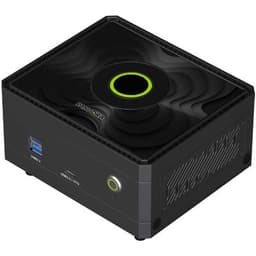
Nvidia's developer kits are aimed at experimenting and prototyping. If you'd rather have something closer to a finished mini PC, Palit's Pandora puts a Jetson Orin NX Super module in a 145 x 123 x 66mm, 470g enclosure. Palit lists two versions; the 16GB model (part number A002FV1P1) is the one in our database as the Palit Pandora Jetson Orin NX Super 16GB.
Palit's specification page lists an 8-core Arm Cortex-A78AE CPU, a 1,024-core Ampere GPU with 32 Tensor Cores, 157/78 TOPS (sparse/dense) and 16GB of 128-bit LPDDR5 at 102.4 GB/s, twice the memory of the Orin Nano Super at the same bandwidth. The expansion is the real draw: four M.2 slots, including an M.2 2280 PCIe Gen4 x2 slot with a pre-installed 128GB SSD, a second M.2 2280/3080 PCIe Gen4 x4 slot for an SSD or video capture card, an E-key slot for Wi-Fi and a B-key slot for a 4G or 5G module. There are two Gigabit Ethernet ports, HDMI 2.0, two USB 3.2 Gen 2 Type-A ports, a USB 3.2 Gen 2 Type-C (OTG) port, two USB 2.0 ports, 8-lane MIPI CSI-2 for cameras and a CAN bus header.
Palit says it needs JetPack 6.2 or later and takes a 12V to 36V DC input. That wide input range makes it easier to run from a vehicle or battery supply than a typical mini PC. Palit's specification page directs sales enquiries to Palit by email, so check UK availability before you plan a project around it.
Choose it if: you want 16GB of memory, room for a proper NVMe drive and camera inputs in a box you can put on a shelf or in a project.
Best for bigger models on Orin: Jetson AGX Orin Developer Kit
The Jetson AGX Orin Developer Kit is the most powerful Orin system. Nvidia's specification table lists 275 TOPS from a 2,048-core Ampere GPU with 64 Tensor Cores, 64GB of 256-bit LPDDR5 at 204.8 GB/s and 64GB of eMMC 5.1 storage, in a 110 x 110 x 71.65mm package including feet and cooler. Nvidia says AGX Orin modules are configurable between 15W and 60W.
The 64GB of memory is the reason to choose it. That's enough to hold mid-sized language models that won't fit on an 8GB or 16GB Jetson, alongside speech and vision models, and twice the bandwidth of the Orin NX and Nano. Nvidia also says the kit can emulate any Jetson Orin module, so it's the one to get if you're developing a product and haven't decided which module it will ship on.
Choose it if: you want the most memory and bandwidth in the Orin family, or you're prototyping for a smaller Orin module.
Jetson Thor is Nvidia's Blackwell-generation Jetson, and the AGX Thor Developer Kit is a big step up. Nvidia lists 2070 FP4 TFLOPS (sparse) from the Jetson T5000 module, a 2,560-core Blackwell GPU with fifth-generation Tensor Cores and Multi-Instance GPU support, a 14-core Arm Neoverse-V3AE CPU and 128GB of 256-bit LPDDR5X at 273 GB/s. Storage is a 1TB NVMe drive in an M.2 Key M slot, and power runs from 40W to 130W. Nvidia says the Thor modules deliver more than 7.5 times the AI compute of AGX Orin with 3.5 times better energy efficiency.
The I/O is aimed at robots rather than desks: a 5GbE RJ45 port, a QSFP28 connector providing four 25GbE links, HDMI and DisplayPort, two USB-A 3.2 and two USB-C 3.1 ports, Gigabit Ethernet and two CAN headers. Nvidia also lists a cheaper Jetson T4000 module rated at 1200 FP4 TFLOPS (sparse) for products.
For pure local language model work, it's worth comparing Thor with Nvidia's GB10 desktop systems: the AGX Thor Developer Kit lists the same 128GB and 273 GB/s memory figures as GB10 machines such as DGX Spark, but GB10 boxes come with desktop-style ports and DGX OS. Our best Nvidia GB10 mini PC guide covers those. Thor makes more sense when you need its sensor, camera and CAN connections, or its 40W lower power setting.
Choose it if: you're building robotics or multi-camera systems that need big models on the device, or you want the most powerful Jetson available.
Software: check your JetPack version
Every Jetson runs Nvidia's JetPack SDK, its Linux-based software suite for the platform. The version matters for local AI tools. Ollama's v0.40.18 release on 24 November 2026 removed JetPack 5 support, so if you're running an older JetPack on an Orin board, plan an upgrade before updating Ollama. Palit lists JetPack 6.2 or later for the Pandora.
Jetsons are Arm machines, so the same rule applies as on any Arm system: every app or container you want needs an Arm64 build with Jetson GPU support. Projects that publish Jetson builds will be the easiest place to start.
Which should you choose?
For learning, voice assistants and camera detection: the Jetson Orin Nano Super Developer Kit. If cameras are your main use, our best AI detector hardware for Frigate guide covers the other detector hardware worth considering.
For a tidy always-on box with real storage: the Palit Pandora with Orin NX 16GB Super.
For mid-sized language models at low power: the Jetson AGX Orin Developer Kit with 64GB.
For the biggest models on a Jetson, or serious robotics: the Jetson AGX Thor Developer Kit.
If you already have a desktop PC: a graphics card or an AI accelerator card may be simpler. See our guides to the best low-power GPU for local AI and the best M.2 AI accelerator.
Our verdict
For most people curious about low-power local AI, the Jetson Orin Nano Super Developer Kit is the place to start, as long as you accept that 8GB limits you to small models. The Palit Pandora is the better buy if you want 16GB and proper NVMe storage in a finished enclosure. Step up to the AGX Orin Developer Kit for 64GB, or the AGX Thor Developer Kit for 128GB and Blackwell, but at that level compare it with a GB10 desktop system before you buy, because Thor's extra connections only matter if you'll use them.