Supercomputing 2026 (SC26) is under way this week, and the three big GPU makers have all used it to talk up new data centre accelerators. Nvidia announced a new chip called Rubin HPC on 16 November, AMD introduced the Instinct MI450X on 12 November, and Intel shared performance claims for its GPU D270, the card formerly code-named Crescent Island, on 16 November.
None of these is a gaming graphics card, and none will be sold at Scan or Overclockers. But they show where GPU silicon and high-bandwidth memory is heading, which is why we've rounded them up for PC builders. Forge PC hasn't tested any of this hardware; every figure below is the manufacturer's own claim.
Nvidia Rubin HPC: more than 50,000 CUDA cores, due in 2028
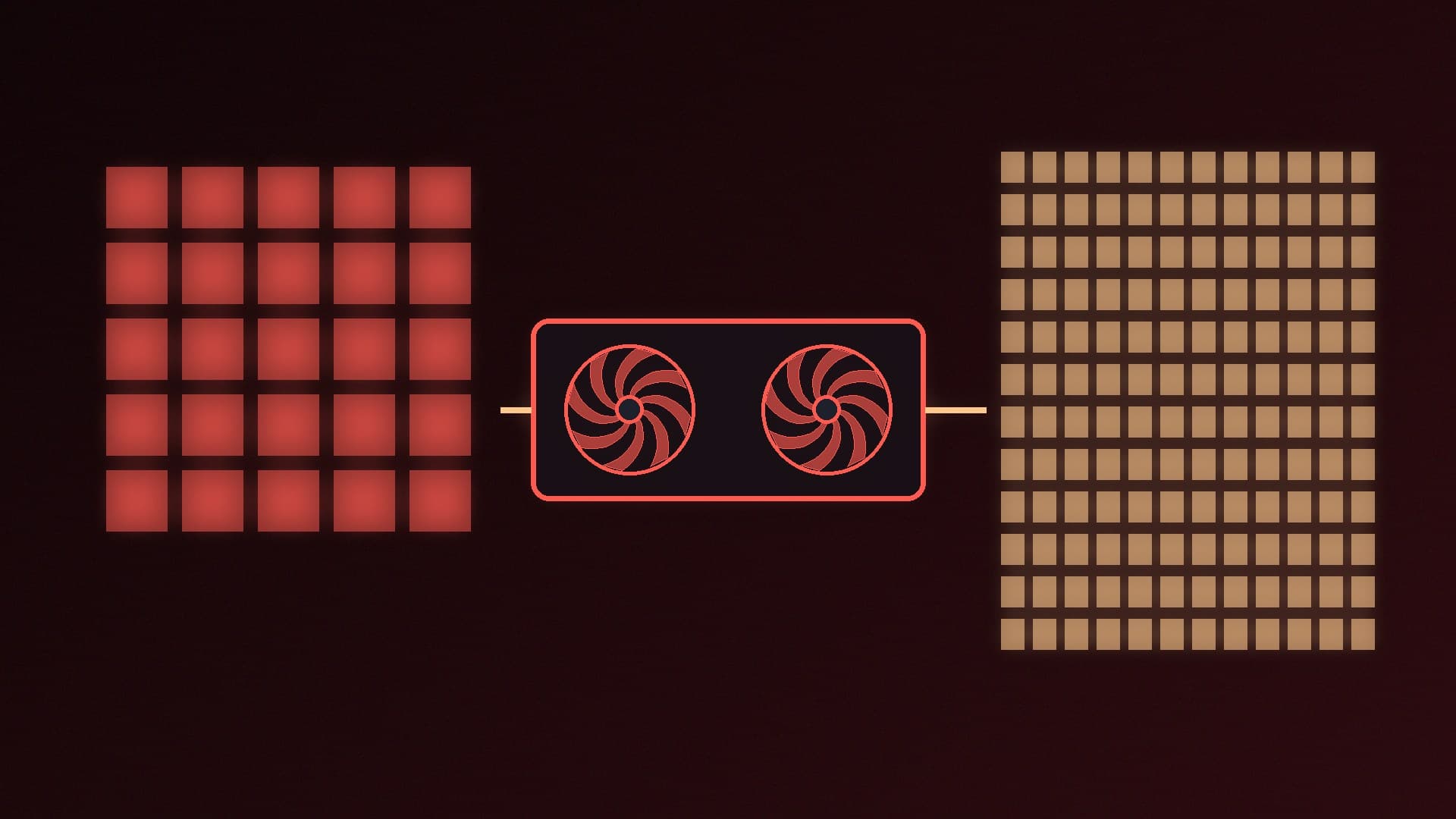
Nvidia says Rubin HPC is a new GPU in its Vera Rubin platform aimed at simulation and data processing for science, engineering and analytics. Its headline claim is a "record number of CUDA cores", more than 50,000 on a single GPU, along with a sparse data acceleration feature and seventh-generation NVLink for linking GPUs together.
Nvidia pitches the chip at AI agents that run scientific simulations, such as climate models, genomic analysis and financial risk. It is not coming soon: Nvidia says Rubin HPC is expected to be available in 2028.
Tom's Hardware points out that today's Rubin GPU has 224 SMs and 28,672 CUDA cores, so more than 50,000 cores implies a multi-die design. Nvidia didn't reveal the chip's layout, memory capacity or bandwidth.
AMD Instinct MI450X: 288GB of HBM4 per GPU
AMD's announcement on 12 November covered three parts of its Instinct MI400 Series:
MI450X (new): 288GB of HBM4 memory per GPU, with the same compute, memory bandwidth and connectivity as the MI455X. AMD says it is for customers of its Helios rack-scale system whose workloads fit in that memory.
MI455X: AMD claims 21,333 tokens per second per GPU on DeepSeek-R1 in an MLPerf Inference Offline configuration it tested, which it says is up to 30% higher throughput than Nvidia Vera Rubin's latest published MLPerf offline result. AMD's footnote says this was AMD's own testing in October 2026, compared against a published Nvidia result.
MI430X: aimed at scientific computing, with native FP64 (double-precision) maths, 432GB of HBM4 and up to 23.3TB/s of memory bandwidth.
AMD's product page lists the MI450X with a 23.3TB/s peak memory bandwidth, 192MB of L2 cache and 320 billion transistors.
Intel GPU D270: a 350W PCIe card with 160GB of LPDDR5X
Intel's D270 takes a different approach. Instead of expensive HBM, the Intel-branded card uses 160GB of LPDDR5X with 1.5TB/s of bandwidth, and Intel says partner designs can scale to 480GB. It uses the Xe3P architecture with 32 Xe cores and 256 XMX engines, supports data types from FP4 to full-rate FP64, and fits in a 350W, air-cooled PCIe 5.0 card for standard servers.
Intel's performance claims compare it with Nvidia's RTX PRO 6000 Blackwell Server Edition, a 600W card. Intel says the D270 delivered up to 5.9 times the throughput in options-pricing (financial modelling) benchmarks. Phoronix notes that across the limited benchmarks Intel shared, the results ranged from 1.92 times to 5.9 times. These are Intel's own figures and cover a narrow set of workloads.
Why should PC gamers care?
These chips will never sit in a home PC, but they affect the parts that do.
Memory demand. Each MI450X carries 288GB of HBM4 and each MI430X 432GB. AI demand for memory is one of the factors behind this year's price rises, which we looked at in why RAM and GPUs are so expensive in 2026.
Intel's LPDDR5X bet. Intel is using LPDDR5X, the low-power memory type also used in many laptops, on a data centre card, and pitching memory capacity as a key selling point. That shows how much memory capacity matters for AI work, the same reason local AI users chase VRAM; see how much VRAM you need in 2026.
No sign of cheaper gaming GPUs. Nothing announced at SC26 changes consumer graphics card supply in the short term. If you're shopping this Black Friday, our best graphics card guide is a better place to start.
For home AI, the nearest thing to this class of hardware remains Nvidia's RTX Spark systems and AMD's Ryzen AI Max machines; see Nvidia RTX Spark desktops in the UK and the best PC for local AI.
Our verdict
SC26 brought three big data centre GPU announcements: Nvidia's Rubin HPC with more than 50,000 CUDA cores (due in 2028), AMD's Instinct MI450X with 288GB of HBM4, and Intel's 350W GPU D270 with 160GB of LPDDR5X. All performance figures are the manufacturers' own claims on selected workloads. For PC builders the takeaway is indirect: AI and HPC demand for memory and GPU silicon is still rising, so don't expect it to ease RAM or GPU prices soon. Forge PC hasn't tested any of these products.