AMD and Microsoft announced on 17 November 2026 that AMD's Instinct MI350P accelerator will be supported on Windows Server 2025 and the upcoming Windows Server 2028. The aim is to let businesses run AI models on their own Windows servers, close to their own data, instead of sending everything to a cloud service.
This isn't a graphics card you'll put in a gaming PC, and Forge PC hasn't tested it. But it's a useful signal for anyone following local AI: the same "keep the model on your own hardware" idea we cover for desktop PCs is now being pushed hard in business IT. This story is based on AMD's announcement and its official MI350P specification page.
What AMD and Microsoft announced
According to AMD's blog post:
Windows Server support: the Instinct MI350P will be supported on Windows Server 2025 and the upcoming Windows Server 2028, for GPU-accelerated AI inference.
AMD Inference Microservices (AIMs) and GPU partitioning are supported at launch. AMD says partitioning lets IT teams split one MI350P into supported partitions, so a small embedding model or language model doesn't need a whole card.
SQL Server and RAG: AMD highlights SQL Server 2025's built-in vector features, with locally hosted embedding models on the MI350P supplying vectors for retrieval-augmented generation (RAG) apps. AMD describes a demonstration with Microsoft's SQL Server team as "planned".
AMD's pitch is partly about cost and control: it argues that hosting suitable AI workloads on premises can help organisations manage cloud token spending and keep sensitive data in-house, while still using cloud models where they make sense. Those are AMD's claims; real savings will depend on each organisation's workloads.
The MI350P in numbers
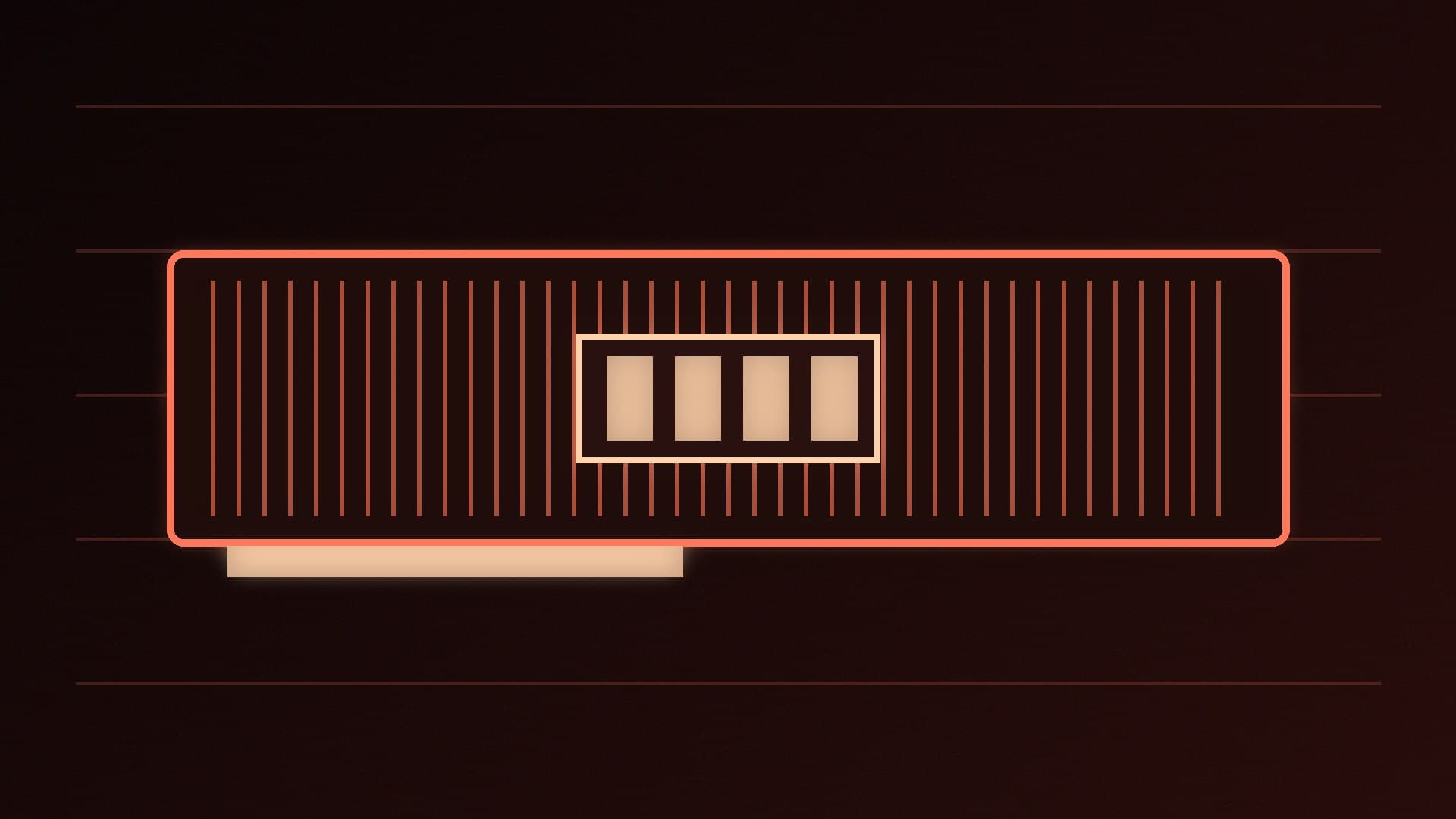
AMD's specification page lists the MI350P as a full-height, double-slot, passively cooled PCIe card for servers:
Spec (AMD) | Instinct MI350P |
|---|
Architecture | CDNA 4 (TSMC 3nm and 6nm) |
Compute units / stream processors | 128 / 8,192 |
Peak engine clock | 2,200MHz |
Memory | 144GB HBM3E, 4,096-bit, up to 4TB/s |
Peak FP16 matrix | 1.15 PFLOPs (2.3 PFLOPs with structured sparsity) |
Peak MXFP4 / MXFP6 | 4.6 PFLOPs |
Typical board power | 600W maximum; 450W configurable |
Power connector | 12V-2x6 |
Length | 10.5in (267mm) |
Two details stand out for PC builders. First, the card uses the same 12V-2x6 power connector found on high-end GeForce cards, which we explain in our guide to connecting a 12V-2x6 cable safely. Second, it's passively cooled: there's no fan, because it's designed for servers that push air through the card. In a normal desktop case it would overheat.
Note that AMD's specification page still listed Linux x86 64-bit under OS support when we checked; Windows Server support is what's new in this announcement.
Why it matters for local AI on desktops
The amount of fast memory is the main limit on which AI models you can run, whether that's a 16GB gaming card or a 144GB server accelerator. That's why our guides keep coming back to VRAM: see how much RAM you need for local AI and our explainer on LLM context length and VRAM.
For home users, the closest equivalents are workstation cards and unified-memory systems. Our Radeon AI PRO R9700 vs RTX 5090 for local AI comparison and our best GPU for local LLMs guide cover what's realistic in a desktop PC.
AMD hasn't given a price for the MI350P in this announcement, and it's designed for servers rather than desktop PCs.
Our verdict
The Instinct MI350P is a 144GB, 600W, passively cooled PCIe accelerator for servers, and AMD and Microsoft now say it will be supported on Windows Server 2025 and Windows Server 2028, with GPU partitioning and AMD Inference Microservices at launch. It isn't for gaming PCs, but it shows big vendors betting on on-premises AI. If you want local AI at home, focus on VRAM per pound on a desktop GPU instead. Forge PC hasn't tested the MI350P.