Every processor needs a cooler. The choice that causes the most hesitation is not the brand, but the type: a traditional air cooler with a metal stack and one or two fans, or an all-in-one (AIO) liquid cooler with a pump, tubes and a radiator. Both can keep a modern CPU in a safe range. They do it in different ways, at different prices, and with different things that can go wrong.
Forge PC has not lab-tested coolers for this article. The comparison below draws on Tom's Hardware's air-versus-AIO guide and its cooler reviews, and on the picks already set out in our best CPU cooler guide. If a PC is already running hot, fix the immediate problem with our overheating guide before you buy anything.
How the two types work
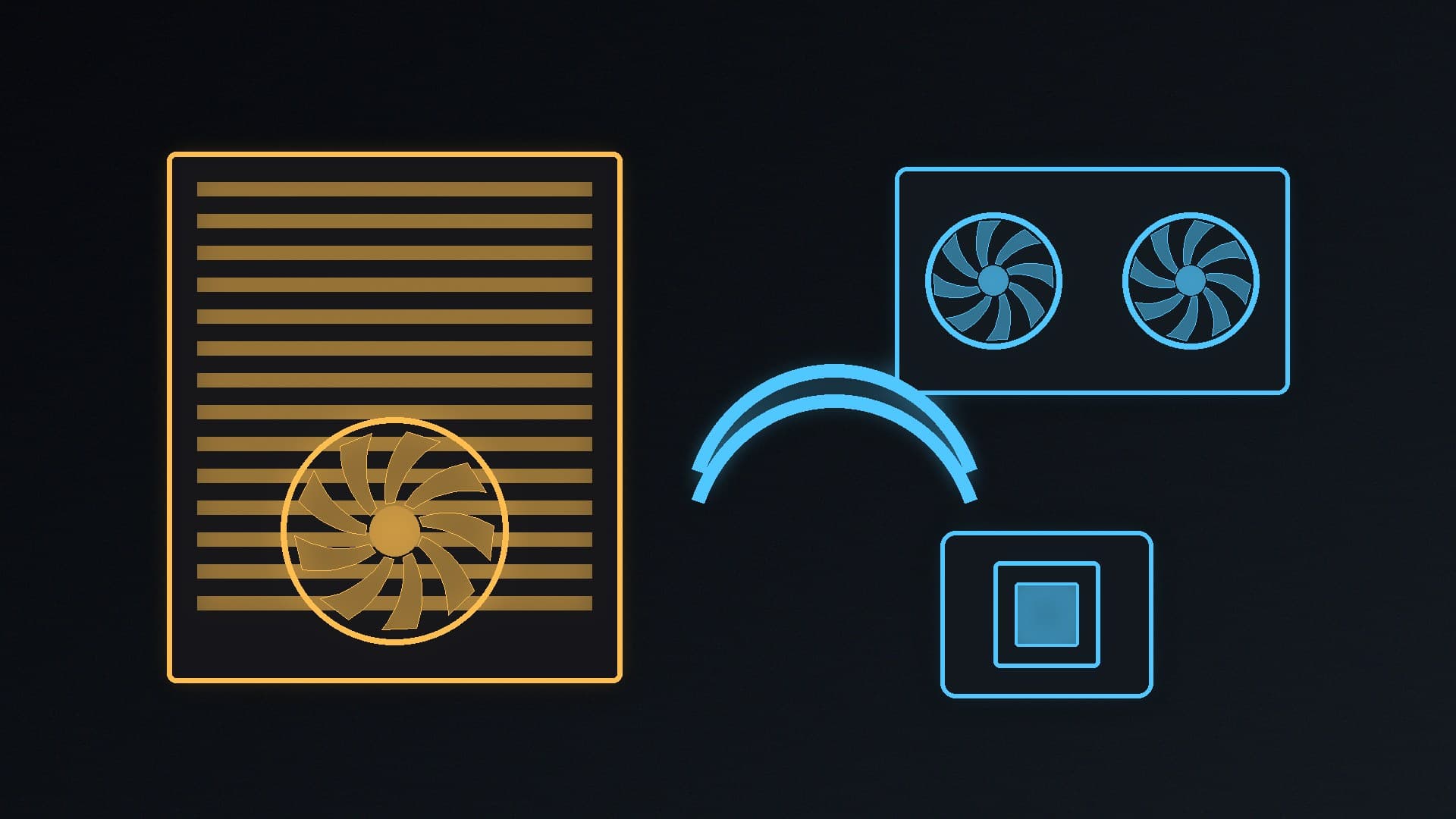
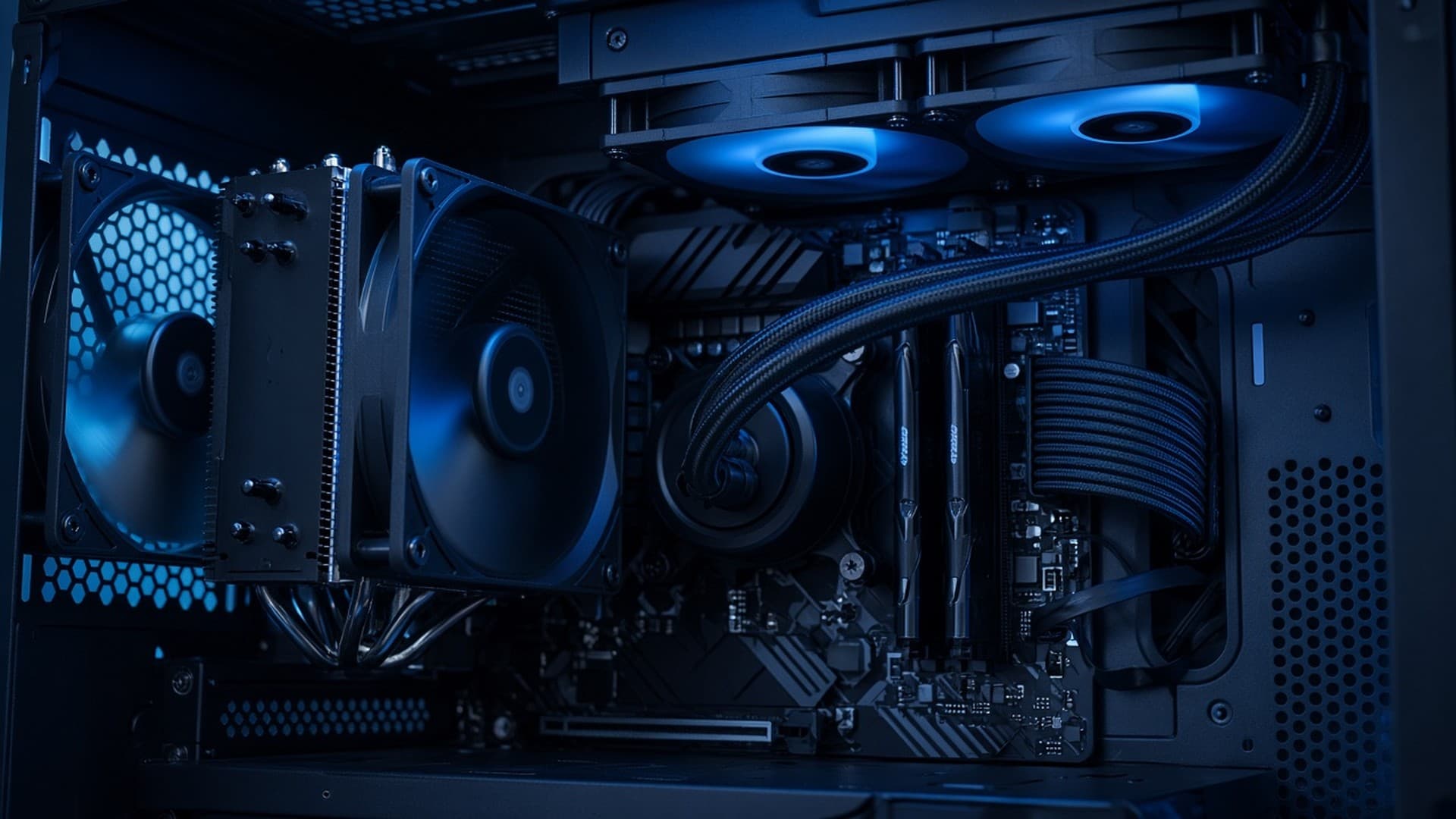
An air cooler is a metal heatsink, usually a tower of fins, that sits on the processor with a layer of thermal paste. One or two fans blow air through the fins. The only moving parts are the fans, which you can replace if they fail. High-end models such as dual-tower designs are large, and they need clearance over the motherboard for height, width and nearby memory sticks.
An AIO is a sealed liquid loop. A cold plate sits on the processor, a pump moves coolant through tubes to a radiator, and fans on that radiator dump the heat into the case airflow. Tom's Hardware notes that the radiator usually mounts in the top or front of the case. You are not building a custom water loop: the unit arrives filled and closed. Radiators come in common sizes, typically 120mm, 240mm, 280mm and 360mm, and your case has to have a mount to match.
Cooling and noise
Tom's Hardware's comparison is careful not to pretend that every AIO beats every air cooler. It says a larger radiator can often move more heat at a lower fan speed, which is the usual reason people call AIOs quieter under load. It also says high-end air coolers, naming the Noctua NH-D15 and Thermalright Peerless Assassin 140 in that guide, can deliver excellent temperatures and low noise, especially if you are not overclocking, and that the gap between a good air cooler and a good AIO is often small in ordinary use.
The same outlet's cooler testing is what sits behind our buying guide. Tom's Hardware has rated the Thermalright Peerless Assassin 120 SE as the best air cooler for most people, and in that review it reported the dual-tower cooler handling an Intel Core i9-12900K drawing over 200W, with a maximum noise of 34.5dB in its test. It has also reviewed Arctic's Liquid Freezer III Pro range as a leading AIO. Those are Tom's figures, not ours, and they are one test platform, not a promise for every chip.
A 120mm AIO is easy to underestimate. Tom's explicitly warns that not every liquid cooler, especially a single-fan radiator, will outperform or out-quiet a good modern air cooler. If you are buying liquid, 240mm is a more realistic starting size, and 360mm is the usual choice for high-power chips, provided the case can take it.
Size, installation and reliability
This is often the better reason to choose one type over the other.
Air cooler advantages, as Tom's Hardware and most reviewers describe them:
Usually cheaper for a given level of everyday cooling.
No pump and no fluid, so there is nothing to leak and fewer parts to wear out. If a fan dies, you replace the fan.
The tower can also push air over the area around the socket, which can help VRM and memory temperatures in some layouts.
Air cooler drawbacks:
A large dual-tower can be awkward in a compact case, and can hang over RAM slots or foul a tall graphics card, depending on the board.
The cooler is a visible lump in the middle of the case, which some people simply do not like.
AIO advantages:
The bulky part is the radiator, so the area over the motherboard stays clearer. Tom's flags this as useful in tight cases.
A 360mm radiator has more surface area to work with on a high-power CPU, or on a chip you intend to keep under a long, heavy load.
The look is cleaner in a glass-panel case if that matters to you.
AIO drawbacks, again following Tom's Hardware:
Typically more expensive, especially once you add screens, RGB or a larger radiator.
Installation involves mounting a radiator and fans as well as the block, plus pump and fan cables.
Leaks are uncommon, but they are not impossible, and a failed pump usually means replacing the whole unit. Air coolers do not have that failure mode.
The pump is another noise source. A good unit is quiet; a poor or failing one is not.
Which should you buy?
For most AM5 and LGA 1851 gaming PCs, especially mid-range chips that are not being overclocked, a capable air cooler is enough. Our cooler guide, which used UK prices checked on 12 November 2026 (and not re-checked for this article on 13 November 2026), pointed to the Arctic Freezer 36 at about £19–£21, or the cheaper Thermalright Assassin X 120 R SE at about £18, for ordinary builds. The Peerless Assassin 120 SE is Tom's Hardware's "best air cooler" pick, though UK stock of the exact SE model was limited when we last checked.
Buy a 240mm or 360mm AIO if you have a high-power processor, you want more cooling headroom for long renders or overclocking, or a large air tower will not fit. Our guide's AIO pick was the Arctic Liquid Freezer III Pro 360, at about £70–£80, with the 240mm version at about £60, on 12 November 2026. Confirm those prices when you buy; they can move, and the radiator has to fit your case.
Do not buy an AIO just because a box is marketed for gaming, and do not buy a 360mm unit for a small case that only takes 240mm. Measure first.
Our verdict
A good air cooler is the right default for most gaming PCs: it is cheaper, simpler and, in Tom's Hardware's testing, a dual-tower design such as the Peerless Assassin 120 SE can handle high-power chips quietly. Choose a 240mm or 360mm AIO, such as Arctic's Liquid Freezer III Pro, when the processor or the case makes that extra radiator useful, and you accept a pump as another moving part. We have not tested these coolers ourselves; the comparison follows Tom's Hardware's reviews and advice, with UK prices last checked for our cooler guide on 12 November 2026 and not re-checked on 13 November 2026.